The Carved Door Couplet
Whatever success we wear, we earned by walking the path our ancestors cleared.
Whatever position we hold, we use to build good fortune for the generations to come.
These carved panels stand on the staircase leading up to the bedrooms of Yung See San Fong. Every night for more than a century, anyone climbing these stairs to sleep has passed between these two thoughts: gratitude for those who came before, and hope for those still to come. It is a benediction at the close of each day.
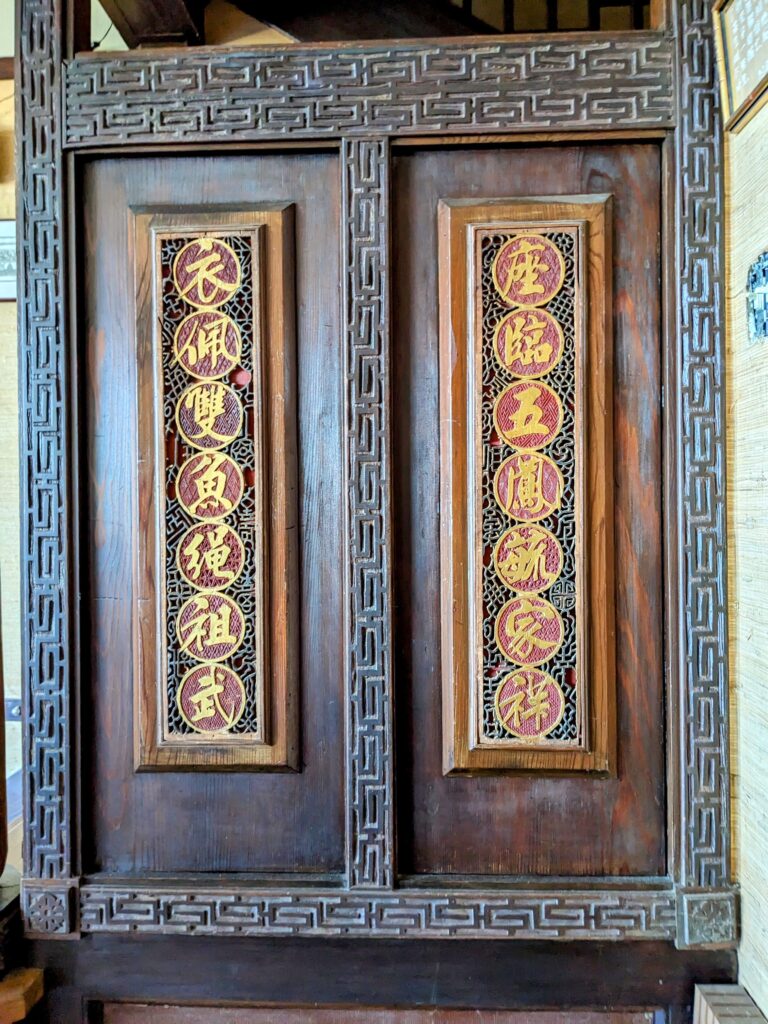
Each panel carries seven Chinese characters in raised gold calligraphy on red medallions. Together they form a couplet, a paired verse in the tradition of placing a family’s hopes where the household passes every day.
Remarkably, this couplet appears nowhere else on record. As far as we can tell, it was composed or selected specifically for this house around 1917, and it was only first transcribed and translated in 2026, with the help of readers of classical Chinese from the US, Taiwan, and China, and a Reddit group that specializes in translations.
The Chinese Imagery
The plain English above carries the meaning, but the original characters speak in the imagery of classical China. Read in traditional order, the couplet is:
衣佩雙魚繩祖武 Clothes bearing a dual-fish clasp, we walk in the footsteps of our ancestors.
座臨五鳳毓家祥 Seated before five phoenixes, the home fosters blessings for the family.
The “dual-fish clasp” refers to paired fish tallies once worn at court, emblems of earned rank and trust. The phrase “walking in the ancestors’ footsteps” (繩其祖武) comes from the Shijing (Book of Odes), one of the oldest works of Chinese literature. Phoenixes and fish are both enduring symbols of prosperity.
Hidden Symbols in the Openwork
Look closely at the lattice carving surrounding the medallions. It is not a random pattern. Woven into the openwork are auspicious symbols: the double happiness character (囍), the character for longevity (壽) in both standard and stylized forms, the Buddhist wan (萬) symbol meaning ten thousand or boundlessness, coin shapes for wealth, and endless knot motifs. Embellishing an inscription with such symbols is traditional, though their irregular, almost playful arrangement here is distinctive.
A Charming Mystery
Chinese couplets are traditionally read right to left, and the rules of poetic tone dictate which line comes first. By those rules, these panels are mounted in reverse, and they have been that way for over a hundred years, since they are built into the larger panel structure and were never movable.
Was it simply a mistake? Perhaps. But there is a more intriguing possibility. The household was directed until the late 1920s by a Chinese man named Gin, who cooked, gardened, and assisted with the interior decoration. He would have known exactly how the lines should read. Ruth Comfort Mitchell Young, the celebrated novelist who built this house with her husband, loved to show it off to her guests, who included President Hoover, the Governor of California, and Hollywood stars. One theory holds that the panels were arranged left to right so that Ruth could present them naturally, in English reading order, to her visitors. We will likely never know.
Why It Belongs Here
Ruth Comfort Mitchell Young became deeply captivated by Chinese culture around 1910, and Yung See San Fong, “Young’s Home on the Heavenly Hill,” was the fullest expression of that devotion. Oral history suggests the family worked with merchants in San Francisco’s Chinatown, or possibly in China, to commission the interior artwork, and their Chinese staff may have helped validate the designs.
Whether Ruth requested this particular verse or it was brought to her, its theme fits her perfectly. Her novels returned again and again to the ties between past and future generations. This couplet, honoring the ancestors behind us and the descendants ahead, has offered that same thought to everyone climbing the stairs to rest since 1917.