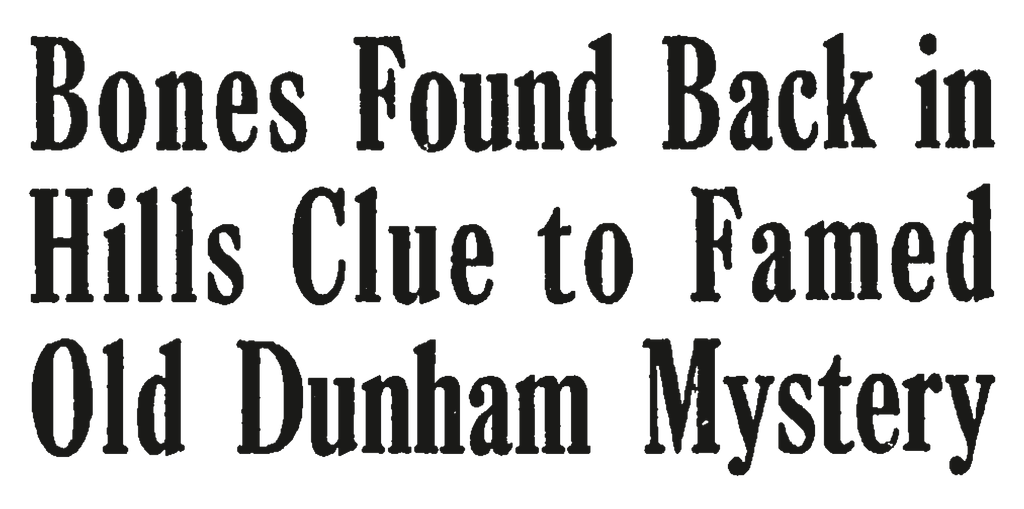
The above headline ran in the Mercury News because Sanborn Young found the first hard clue in California’s coldest case: two bones in a creek bank, four miles from where the murderer vanished. Then he did what no one else had done in twenty-six years. He brought the whole valley along to watch.
Sanborn Young was riding the range with a ranch manager named George Carey, somewhere in the folded country below Mount Hamilton, when he saw two bones sticking out of a creek bank. A cave-in had peeled the soggy soil back and left them exposed. A matched pair, about a foot apart, with the length and heft of human thighs.
Any other man might have ridden on. Young did the arithmetic instead. He was roughly four miles from the last confirmed sighting of James C. Dunham, the man who had killed six people at a ranch near Campbell in May of 1896 and then walked into these hills and out of the world. For twenty-six years the Santa Clara Valley had been asking one question, and here were two bones lying in a stream bank, in a lonely place, at exactly the right distance.
Young’s mind, the Evening News said, “instantly seized upon the possibility that here was the grave of the famous murderer.”
He did not go back alone, and he did not go back quietly. He waited a week, assembled a party, engaged a physician to render an opinion on the spot, and invited a reporter from the county’s largest paper to ride along and write it all down. That is not the behavior of a man hoping to get lucky in private. It is the behavior of a man who already knows he has a story, and who intends to deliver it either way.
Five Searchers
On Thursday, April 6, 1922, five people rode up into the hills on horseback “on the great adventure of clearing up the Dunham mystery.” They galloped away from the ranch house across a valley the reporter described as jewel-like, the young grass gleaming green with a silken sheen that spreads over those hills for only a few days a year.
The riding party, April 6, 1922
| Sanborn Young | Of Los Gatos. The paper calls him “romancer and author.” Found the bones, organized the expedition, ran the dig. |
| Dr. Charles Wayland | Of San Jose. Along as, in Young’s phrase, “the representative of science on this party.” |
| George Carey | Manager of a ranch in the region. Was riding with Young the day the bones surfaced. |
| Mrs. Carey | The fifth rider, and the only member of the party the paper does not name in full. |
| G. H. McMurry | Of the Evening News. Invited. Wrote the whole day up for page one. |
Each of us carried a spade or a pick, excepting Sanborn Young, who carried his large camera to take the pictures of a story that gave every evidence of making us all famous.
The camera is the tell. Young had studied photography in New York after his marriage and was known in the county as a pictorial photographer of real standing. The portrait of his wife that the Mercury News ran in 1916 was credited to him. He rode out to a possible murder grave as the one man in the party carrying no tool for digging, because his job that day was not to dig. It was to document. He had already worked out what the day would look like in print.
Story of Crime
What they were digging for was the closing chapter of the worst night in the county’s history. On May 26, 1896, James Dunham, once a student at Santa Clara, a young man of remarkable talents and the son-in-law of Colonel Richard McGlincy, arrived at the McGlincy ranch outside Campbell around ten at night and killed six people with a revolver and an axe: his wife Hattie; the servant Minnie Schlesser; his mother-in-law Ada McGlincy; his brother-in-law James Wells; the hired man Robert Brisco; and finally the colonel himself, shot on his own porch as he stepped up to it.
Two people in that house lived. A farmhand hid in the barn. And in an upstairs room, Dunham’s three-week-old son slept through it.
Then Dunham fled toward Mount Hamilton, and San Jose came apart. Men were deputized and armed to the teeth. A reward was raised by public subscription. The Evening News put it at ten thousand dollars, and modern accounts total it as high as eleven, which is somewhere north of four hundred thousand dollars today. He was seen near Smith Creek on May 28, face scratched, feet wrapped in gunnysacks. His stolen horse turned up in Indian Gulch on May 29. Searchers found scraps of clothing and the ashes of recent fires. Somebody heard a shot. Buzzards circled something.
By June 7, 1896, the pursuit was called off. He was never seen again. Not with certainty, not by anyone, ever.
The Detective’s Method
Riding up, Wayland put the obvious objection to him. “Even if we find a human skeleton, how are you going to be sure it’s Dunham?”
Young had the answer waiting, and it is the sharpest thing anyone said all day.
“Easy. Dunham had peculiar teeth. He went to a dentist just before the murder. They have a good description of his teeth.”
Sanborn Young, on the trail, April 6, 1922
That is forensic dentistry, identification from dental records, proposed on horseback in 1922, well before it was routine police practice anywhere. Young had not simply spotted a clue and gotten excited. He had carried the case around long enough to know that the hard part was never finding bones in those hills. The hard part was proving whose they were. He rode out with the proof problem already solved.
He had a joke waiting too. Wayland had subscribed a hundred dollars toward the reward back in 1896, and pointed out that as a member of the search party he could hardly be expected to pay it. Young laughed and let him off. As the representative of science, the doctor could turn around and bill them for the expert opinion instead. Two men who knew each other well, working a routine on the way up the hill.
Uncover Bones
They came down the steep trails to a stream in a secluded fold of the hills. To the northeast, the dome of Lick Observatory stood on its ridge, seemingly a mile off as the crow flies. The most advanced instrument in the Western Hemisphere, looking down on five people with picks. For a few minutes nobody touched anything, for fear of damaging the bones past recognition. Somebody asked whether they ought to have notified the coroner. “We can tell him when we discover Dunham,” Wayland said, smiling quizzically at the bones sticking out of the bank.
Then Young, digging, told the party his dream from the night before. They had opened this very place and found Dunham’s skull, and the teeth all dropped out and it crumbled away in their hands, and then back in San Jose nobody would believe them, and demanded the proof they could no longer produce.
It is a good story, well placed. A man in the grip of pure treasure fever does not stop mid-dig to tell a self-deprecating anecdote about his own failure. A man entertaining a party does.
“Humph,” grunted someone. Everybody kept digging.
They worked the two bones free of the bank, up toward the joint. The joint arrived too soon. The bones were short.
McMurry felt his great mystery story slipping. Young was by then digging hard for Dunham’s skull. Wayland put a steadying hand on his shoulder and delivered the verdict with the timing of a man who had been waiting for his cue. Too short for femurs. They were tibias. And they were an animal’s.
“To put it in common speech, I believe, Sanborn, we have uncovered the hind legs of a cow!”
Dr. Charles Wayland
“The blank expression on the faces of the party became fixed.” The shovels were gathered up disgustedly. They ate a cheerful meal at the ranch house, which improved everyone’s mood considerably, and rode back down into the valley: Young to his Los Gatos villa, Wayland to his patients, and McMurry to his typewriter, to pound out what he called “the great might-have-been story of how Dunham Done ‘Em!“
The trail had gone cold in the most complete way a trail can go cold. And the man whose trail it was rode home and let the whole county read about it over breakfast.
The House in the Hills
The “Los Gatos villa” the reporter mentions in passing is Yung See San Fong, a name the Mercury News had translated for its readers back in December 1916, while the place was still going up on its steep hillside: “The Young’s hospitable home in the hills.” Pagoda roofs, Eastern decorative motifs over Western massing, a view that took in most of the Santa Clara Valley. Finished in 1917, on the National Register since 1983.
It matters here for one reason. That house was a stage, and everyone in the valley knew it. The Bennett sisters came. Senator Phelan came. The cast of Lady Windermere’s Fan came out for a weekend. The Hoovers were friends from down the road in Palo Alto. Sanborn kept prize rabbits and champion beagles, hunted wild hogs on Santa Rosa Island, captained the Los Gatos Trail Club, and that same spring was cutting a horse trail along the crest of Loma Prieta that nobody had ever ridden end to end. He was married to one of the most widely published writers in California, and he lived, daily, in a household that thought in scenes.
Which is the strongest argument against reading April 7, 1922, as an embarrassment. The Evening News was not in the business of making a fool of Ruth Comfort Mitchell’s husband on page one, and Sanborn Young was not a man who could be ambushed into looking foolish in his own county. He supplied the reporter. He supplied the doctor. He supplied the dream, the teeth, the reward gag, and the camera. The account reads like dialogue because it was delivered as dialogue.
There is a small confirmation buried in that 1916 society page. Among the patronesses listed a few columns over is a Mrs. Charles A. Wayland. Six years before the two men knelt in a creek bed arguing about femurs, the doctor and the Youngs were already in the same circle. The straight man and the storyteller had been rehearsing for a while.
The Case That Would Not Close
None of which makes the search frivolous. Young was one entry in a chronology that ran for more than half a century, in which serious people kept walking into those hills and coming back with bones.
- 1896, June 7. Active pursuit discontinued. The shot, the campfires, the buzzards: all of it adds up to a suicide nobody can produce a body for.
- 1897. A suspect arrested in Mexico. Not him.
- 1898. The first skeletal remains are examined as possibly Dunham’s. Examinations will continue, on and off, for forty years.
- 1901. Charles Franklin Crill is arrested in Wichita, Kansas. Not him.
- 1902. A report has him living among the Navajo.
- 1904. A wounded man, told his injuries are fatal, confesses to being Dunham on what he believes is his deathbed. He is not.
- 1908. William Hatfield is arrested in Texas and released after a preliminary hearing.
- 1922. The hind legs of a cow.
- 1953. Bones in an abandoned mine near Mount Hamilton set the county talking again. The coroner doubts them.
Somewhere in that run of years, one set of bones simply vanished, carried off, it was believed, by someone who liked his chances at the reward. That detail explains the whole pattern. Eleven thousand dollars was riding on a skull, the hills were full of bones, and every rancher in the county knew roughly where to look.
A sheriff’s inspector named William Salt said the quiet part out loud in the 1950s, and he might as well have been standing at Young’s shoulder thirty years earlier: it usually turns out to be an animal.
The Man Who Told It
Set the 1922 ride beside the rest of that list and the difference is not the outcome. Everyone’s outcome was the same. The difference is that Young was the only one who built an audience into the expedition before he knew how it would end.
He found the clue. He worked out, in advance, how an identification could actually be proved. He recruited the expert who could render the opinion on the spot. He brought the press. He brought the camera. And when the answer came back cow, he gave the punchline away to the doctor, let the reporter print every word, and rode home to dinner.
That is a detective story. It has a clue, a method, a party, a site, an expert opinion, and an ending, and the ending is that the trail goes cold in a creek bank below Lick Observatory. Sanborn Young simply understood something the other bone-hunters didn’t: in a valley that had spent twenty-six years asking one unanswerable question, a good ending is worth having even when it isn’t the one you went out for.
Dunham’s case is still officially open. The bones belonged to a cow. And the best telling of the whole long search is the one the man who dug them up handed to the newspaper himself.
Sources and Notes
The clippings
-
-
- McMurry, “Bones Found Back in Hills Clue to Famed Old Dunham Mystery,” Evening News (San Jose), April 7, 1922, p. 1. All quoted dialogue and the account of the ride come from this article.
-
- “Santa Clara Valley Society Affairs,” San Jose Mercury News, December 17, 1916, p. 33. Source for the translation of Yung See San Fong, the house under construction, and the portrait of Ruth Comfort Mitchell credited to Sanborn Young.
- “Los Gatos,” Evening News, April 9, 1920, p. 8. The wild-hog hunt on Santa Rosa Island and the Lady Windermere’s Fan houseguests.
- “To Ride Trail Along Ridge for the First Time,” Evening News, June 9, 1922, p. 2. Young as captain of the Los Gatos Trail Club, cutting the Loma Prieta ridge trail.
The case
- McGlincy murders and James Dunham. Victims, the manhunt timeline, the reward, the decades of bone examinations, the skeleton that disappeared, and the misidentified suspects.
- Historical Crime Detective. The Smith Creek sighting, the horse in Indian Gulch, and the suicide theory.
- SFGATE. The 1953 bones in the abandoned mine and Inspector William Salt’s remark.
- Tobin Gilman, The McGlincy Killings in Campbell, California: An 1896 Unsolved Mystery (The History Press).
The household
- Yung See San Fong House, National Park Service. The name, the 1917 completion, the architecture, and the guest list. NRHP reference 83001240; not open to the public.
- Sanborn Young. The 1914 Grand Canyon wedding, the photography, the Senate years, the narcotics act, and the 1931 Geneva delegation.