“Smoke and ash and a tale, or not even a tale.”
—Marcus Aurelius, Meditations
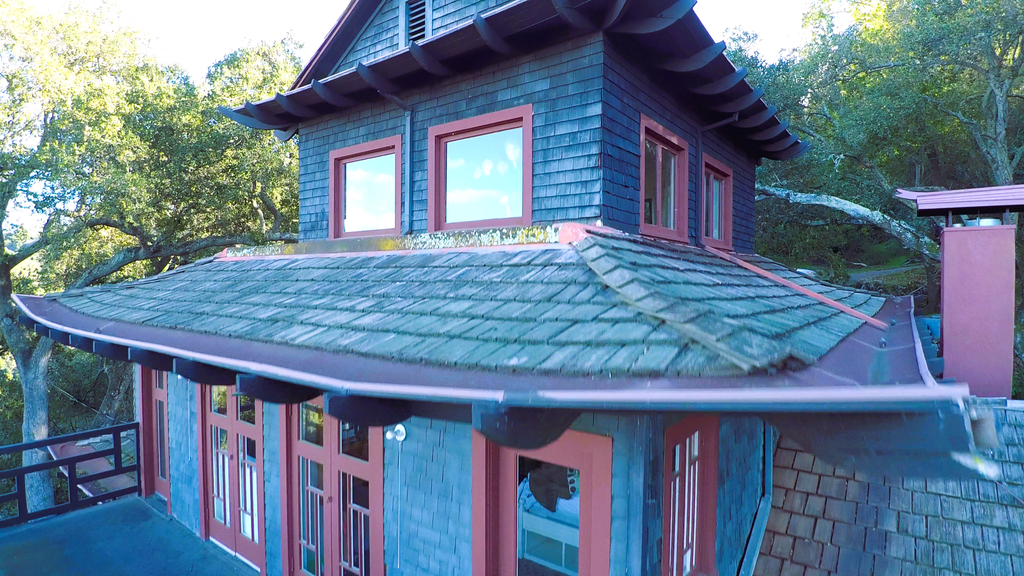
This is a picture of the top of the Yung See San Fong. Note the porch with six doors, this would have never been built today. And up top, there is a strange little cupola or crows nest. What and odd and strange place. Marcus Aurelius spoke to what we leave behind, and we see just the ash. The question is do we see only the ash or do we have the possibility of a tale to be told? Ruth Comfort Mitchell Young and Sanborn Young have a tale, but only if we look for it. And ater spending more than a decade digging through the remnants of her life, I have begun to understand just how little separates being famous from being forgotten. I want to mediate on this idea with you today.
It is difficult today to appreciate how well known Ruth once was. She wrote sixteen novels, as well as poetry, plays and short stories. Her work appeared in the great national magazines of her day, including the Ladies’ Home Journal, at a time when such publications reached millions of American homes. Newspapers followed her travels, reported her speeches, reviewed her books and printed her opinions. Her husband, Sanborn Young, served for more than a decade in the California State Senate and was deeply involved in the political questions of his time. Their friends and acquaintances reached across California politics, literature and society. Then there was the senator. Known throughout the nation for his work on the emerging drug trade, and sent to lead the USA in talks on this issue in Geneva. He was known on both the Caliornia and national level.
The evidence of those lives has not vanished. Quite the opposite. Over the years I have found thousands of newspaper references, photographs, letters, magazine stories, government records and other fragments. Ruth and Sanborn left exactly the sort of documentary trail that we might imagine would protect two people from historical oblivion.
What is remarkable is how little protection it provided.
Rose Wilder Lane
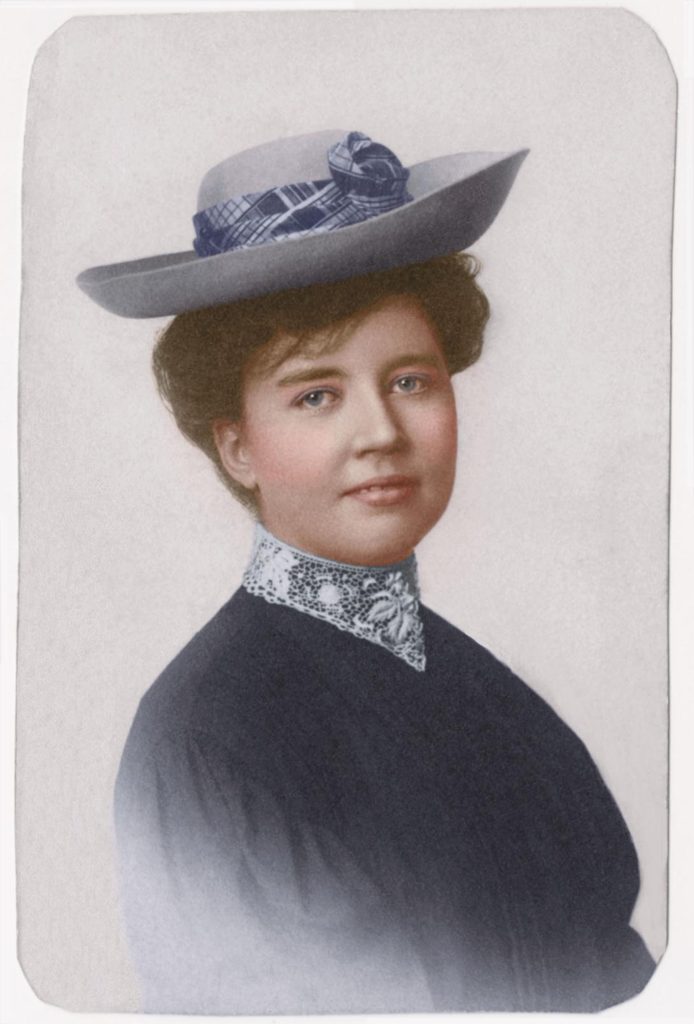
There is an extraordinary confirmation of this in William Holtz’s biography of Rose Wilder Lane, The Ghost in the Little House. Late in her life, Lane was struggling with the experience of growing old in a culture that increasingly seemed foreign to her. She wrote about generations passing “like waves in a sea,” each changing the world left by the generation before it. People who survived long enough, she thought, eventually found themselves out of step and out of context. Without Rose Wilder, we would not have the Little House on the Praire Books, as she was the conduit and editor for her mother. See had great fame, and lived a long time. She met Ruth Comfort and was impressed with her. As she aged, she wrote to her friend.
And she asked a remarkable question:
“What do you know about Art Young or Robert Minor, Floyd Dell, Ruth Comfort Mitchell, anybody whom everybody knew forty years ago?”
There is Ruth.
Not Ruth as an obscure regional novelist whom history somehow overlooked, but Ruth Comfort Mitchell as Rose Wilder Lane remembered her: one of those people whom everybody knew.
Lane understood what had happened because she was beginning to watch it happen to her own generation. Fame had not slowly diminished according to merit. The culture had simply moved on. New writers arrived. New political questions replaced old ones. New magazines appeared and old magazines disappeared. The people who had known the names died, and the people who replaced them had their own names to know.
Marcus Aurelius had reached much the same conclusion nearly two thousand years earlier. In the passage containing those words about “smoke and ash,” he looks back upon people who had once been conspicuous for their fame, wealth, arguments and accomplishments and asks, essentially, where they had all gone. Marcus was the emperor of Rome. He understood perhaps better than most people how large a human reputation could become, yet he also understood how little protection even the greatest reputation offered against time.
Ecclesiastes is equally unsparing: “there is no remembrance of the wise more than of the fool for ever,” because in the days to come “all shall be forgotten.” We readily accept the first part of mortality—that we will die. The second part is harder to contemplate. Eventually most of the people who remember us will die too, and then the people who remember them. The chain becomes thinner until, remarkably quickly, it breaks.
Ruth died in 1954. That is not ancient history. Yet today, outside a comparatively small group of historians, collectors and readers, few people would recognize the name Ruth Comfort Mitchell. Fewer still would recognize Sanborn Young. Rose Wilder Lane’s question has therefore become even more striking with the passing years. If you ask today, “What do you know about Ruth Comfort Mitchell?” the usual answer is nothing.
And yet one particularly strange part of Ruth and Sanborn’s life stubbornly remains.
It is a house.
In 1917 they completed an extraordinarily unconventional home in the hills above Los Gatos. They called it Yung See San Fong, generally translated as “Young’s Home in the Heart of the Hills.” The house combined the mass of a Western country home with Chinese-inspired roofs, decoration and furnishings. It was sufficiently unusual when it was built that newspapers wrote about it, and it remains sufficiently unusual more than a century later that people still stop when they see a photograph of it.
I have watched this happen repeatedly. Someone can know absolutely nothing about Ruth Comfort Mitchell or Sanborn Young, see the house, and immediately ask questions. What is that? Why is it there? Who built it? Why does a house like this exist in the hills of Los Gatos?
Those questions create a small opening into the past.
The house leads to Ruth. Ruth leads to her novels, plays and newspaper appearances. Sanborn leads into California politics. Their friends and visitors lead outward again into literature, government, art and the social world of early twentieth-century California. A photograph identifies a room. A room makes sense of something mentioned in a letter. An old newspaper article identifies someone standing in a photograph. One name leads to another, and gradually people who had become little more than names on yellowed paper begin to acquire personalities again.
This is one reason I have come to think differently about local history. We tend to imagine history as something that happens somewhere else, involving presidents, wars, great legislation and movements sweeping across nations. But all of those things eventually come down to particular people in particular places. Writers work at particular desks. Politicians argue around particular tables. Visitors arrive through particular doors. Children climb particular hills. People fall in love, become angry, make plans, plant gardens, write books and eventually die somewhere.
A surviving place gives all of that a set of coordinates.
John Ruskin understood this connection between buildings and memory particularly well. In The Seven Lamps of Architecture, he devoted an entire chapter to what he called “The Lamp of Memory.” “We may live without her, and worship without her,” he wrote of architecture, “but we cannot remember without her.” His point was not simply that old buildings are attractive or that everything old must therefore be preserved. Architecture possesses a peculiar ability to carry evidence of human lives across generations.
That becomes obvious when you live with an old house for long enough. A house contains things no biography records. There are worn steps, altered rooms, old trees, patched walls, abandoned pipes and pieces of hardware whose purposes have been forgotten. Then an old photograph or newspaper description suddenly explains one of them. A sentence written eighty or a hundred years ago can be compared with something still physically present, and for a moment the distance between then and now becomes remarkably small.
I have experienced that repeatedly at Yung See San Fong. After more than ten years of research, I am still discovering people, events and relationships associated with the house that I did not know existed. Sometimes a significant discovery begins with something almost trivial, a name in a newspaper column, a notation on a map, an object in an old photograph. The individual discovery may be small, but collectively those fragments restore the texture that disappears when a human life is compressed into a birth date, a death date and a short biographical paragraph.
There is something humbling about this because it also changes the meaning of ownership. Legally, a house belongs to whoever happens to hold the deed. Historically, that begins to seem like a temporary arrangement. Someone was here before us, and, if the building survives, someone will be here after us. For a certain number of years we are simply the people standing between those two groups, making decisions about what will be carried forward and what will disappear.
The purpose of preservation, at least for me, is therefore not to freeze a building in a particular year or to worship the people who lived there. Knowing the past is useful precisely because it gives the present some scale. People a hundred years ago were every bit as absorbed in their political arguments, careers, reputations, disappointments and ambitions as we are in ours. Many of those concerns that once seemed overwhelmingly important are now difficult even to explain.
Rose Wilder Lane understood that with increasing discomfort as she grew older. The world did not simply forget individual people; it changed the context that had made those people understandable. Even language changed around her. A person could remain alive while the world in which that person had been formed disappeared.
Perhaps that is why physical places matter so much. They cannot stop that process, but they can leave something against which later generations can push. A house says: people were here. They made choices. They thought this was beautiful. They argued about this. They built this room for some reason. They looked from this window at a landscape that was different from ours.
Then we can begin asking why.
Ruth and Sanborn could not possibly have known that more than a century after they built Yung See San Fong, someone would spend a decade searching newspaper archives, tracing their relatives and friends, studying old maps, examining photographs and trying to reconstruct the world that surrounded them. They could not decide what people in the twenty-first century would remember about them. None of us gets to make that decision.
Nor is the lesson that we should attempt to defeat mortality by becoming famous. Ruth and Sanborn are unusually good evidence that fame is a poor solution. Rose Wilder Lane remembered Ruth as someone “everybody knew,” and within a remarkably short period almost everybody did not.
The more interesting question is what we leave behind that might allow someone, someday, to begin looking.
For Ruth and Sanborn, one answer turned out to be a strange house in the hills. It did not make them immortal. It did something smaller, and perhaps more valuable. It left a thread that could still be picked up after the people who knew them were gone.
Most of us will leave no National Register landmark, nor should we expect to. The thread might instead be a book, a garden, a piece of furniture made carefully enough to survive us, a business that continues after its founder is forgotten, a collection of letters, photographs with the names written on the back, a family story recorded before the last person who knows it disappears, or some contribution to a community whose future residents may never know precisely who began it.
Marcus Aurelius was right. In the end there is smoke and ash, and sometimes there is a tale.
We cannot determine whether the future will remember us. But while we are here, perhaps we can leave the future something worth finding. And in that sense, the question I increasingly find myself asking is not how long any of us will be remembered, but something much simpler:
What will your house in the hills be?