A Hungarian sabreur escaped a revolution, crossed America with a band of refugee athletes, and found a second father in the hills above Los Gatos
One morning in the mid-1950s, when there were few houses on the steep roads above Los Gatos, three-year-old Richard Maddux heard a tremendous noise coming up the mountain. It began at a distance, gathered itself among the trees, and resolved into the unmistakable music of a pack of beagles. Richard ran down his family’s long driveway and found an elderly man approaching on horseback, with what seemed to the boy like thirty hounds boiling around him. The rider reined in, asked the child his name, and established that he belonged to the family up the road and had not wandered dangerously far from home. Then he smiled, said they would meet again, wished him good morning, and rode on toward the old Cypress Ranch at the top of the mountain. This was William Sanborn Young, retired California senator, gentleman rancher, widower, photographer, raiser of a champion beagle, and master of one of the most remarkable houses in the Santa Clara Valley. Richard had encountered him in the grandest possible manner, like a character making an entrance in a story by Rudyard Kipling, and for the next several years the old man and the small boy became friends.
They were separated by nearly eight decades and a few miles of wooded road, which did not prevent Richard, by the age of five, from running down to ring Young’s bell. The house that received him had been completed in 1917 for Sanborn and his wife, the novelist and playwright Ruth Comfort Mitchell. It rose in broad, low stages along the hillside, wearing Chinese-inspired roofs above the plan of an American country house, and looked east over the orchards and towns of the valley. The Youngs called it Yung See San Fong, a name associated with their home in the heart of the hills. Ruth had filled the place with writers, actors, political allies, and travelers, while Sanborn raised dogs, experimented with photography, entertained his own wide circle, and served in the California Senate from 1925 through 1938. By the time Richard began visiting, Ruth was gone. She had died suddenly in February 1954, leaving an eighty-year-old husband in a house whose rooms had been designed for two unusually expansive lives.
To a child, the place offered inexhaustible evidence that the ordinary rules had been suspended at the gate. Richard remembered a large green Buddha in Young’s office, its navel serving as the combination dial for a safe concealed in its belly. On the third floor was a room surrounded by windows, and there Young played Bach on an organ while the boy listened. Sometimes the senator turned off the lights, leaving only the pipes sounding in the darkness and the scattered lamps of the valley below. A federal architectural survey made in 1979 describes that upper story as a single sun room with windows on all four sides and commanding views, just as Richard knew it. The survey also records Young’s beagles, racing dogs, horses, and trails, along with the remarkable fact that the dogs had a swimming pool of their own. It says nothing of the organ or the ingenious Buddha, but official inventories have always been better at counting windows than at explaining the hold a house can exert over a five-year-old.
One summer, Richard found a young man practicing fencing in the living room. He watched for weeks as the visitor advanced and retreated, his weapon cutting bright lines through the air of a room better known for books, Chinese carvings, and conversation. Richard thought the fencer was Young’s nephew and understood that the senator was sponsoring him for the Olympic Games. The young man was actually George Christian Domolky, a Hungarian refugee who had arrived in Los Gatos in March 1957 and moved into the house on Cypress Way. The Olympic ambition was entirely real, and so was the connection Richard perceived without knowing its proper name. Domolky told the local newspaper that Sanborn Young was “like a second father” to him and that the senator’s residence had become a home.
George was born György Dömölky on July 23, 1931, in Szombathely, a western Hungarian city near the Austrian frontier. Fencing ran in the family. His younger sister Lídia became a world champion in foil and later an Olympic gold medalist, while George devoted himself to the sabre, a weapon descended from the cavalry sword and governed by conventions that preserve something of its martial ancestry. In foil and epee only the point scores, but the sabre may strike with its edge, and the valid target extends from the waist upward. A good sabreur attacks with the legs as much as the arm, governing distance through abrupt advances and retreats until an opening appears. The exchanges often end too quickly for an untrained spectator to understand what happened, which helps explain why a month of practice could fascinate a boy in a living room.
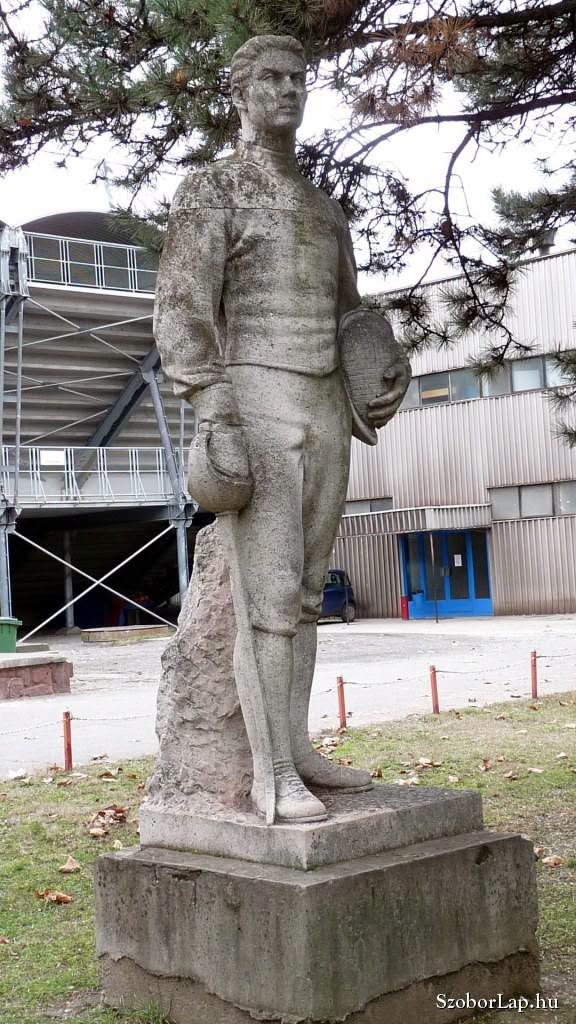
George’s skill had already given him an unusual place in Hungarian culture. According to a tribute from the Hungarian Fencing Museum, he posed for sculptor István Kamotsay’s monumental statue of a fencer and for another fencing sculpture, and his form was adapted for a porcelain sabreur made by the Herend manufactory. He also doubled the actor Iván Darvas in two films. Yet the government of Communist Hungary denied him admission to a university because of his family’s social background, a decision that sent him to work for the railway. The railway job could hardly have resembled the future he wanted, but it supplied a uniform, practical knowledge, and freedom of movement. Those advantages mattered after the country erupted in October 1956.
The Hungarian Revolution began with students in Budapest demanding political reform and independence from Soviet control. Demonstrations became an uprising, political prisoners were released, and for a few astonishing days it appeared that Hungary might loosen Moscow’s grip. Soviet forces returned on November 4 with tanks and artillery, crushing the resistance and driving nearly 200,000 people across the borders. George left about three weeks after the revolt. Traveling with another student and using railway clothing to avoid suspicion, he walked for three days through cold forests toward Austria. Near the frontier the two men found a family suffering from exposure, and George made two trips across a river to carry the children. Later accounts mention swimming and land mines, but all agree on the essentials: a dangerous winter crossing, strangers helped along the way, and a young man arriving in Austria with his mother and brother still behind him.
Sport offered an exit from the refugee camps. A group of prominent Hungarian athletes, some of them Olympians and world champions, came to the United States for the Sports Illustrated Freedom Tour, an enterprise that was equal parts athletic exhibition, relief effort, and Cold War pageant. From January through March 1957 the company traveled from New York to San Francisco, appearing at twenty-five venues and demonstrating sports in which Hungary had long excelled. George fenced in nearly every exhibition. Among his companions were the sabreurs Szabolcs Tamás Orley, known in America as Thomas Orley, and Daniel Magay, together with the renowned coach George Piller. Piller, an Olympic champion who had trained Hungary’s great military sabreurs, would soon turn a group of displaced athletes into the nucleus of a formidable California school.
When the tour ended, Domolky and Orley were admitted to Stanford, while Magay enrolled at the University of California. College could not begin at once for George, whose English and academic preparation needed attention, so he entered Los Gatos High School to study English and physics. The arrangement placed a twenty-five-year-old veteran of revolution among California teenagers who had never seen a Soviet tank, but he seems to have accepted the incongruity with good humor. Five days after his arrival, the Los Gatos Times-Saratoga Observer put him on the second page beneath the headline “Hungarian Athlete at High School.” The article described a prospective physician, an international athlete, and an appreciative newcomer astonished by American abundance. George called California, and especially Los Gatos, a wonderful place to live. He praised his classmates for their friendliness and, in a later interview, credited the girls with speeding his command of English by serving as “dictionaries on two feet.”
The old senator on Cypress Way was an improbable but well-suited guardian for him. Sanborn Young had made his living in business and agriculture before entering politics, and he possessed the confidence of a man accustomed to bringing causes and people before the public. He and Ruth had no children. Their house, however, had rarely lacked younger visitors, dependents, employees, artists, neighbors, and protégés, and Ruth had delighted in turning hospitality into a form of theater. After her death, the arrival of a young European athlete restored some movement to rooms that had gone quiet. Young could supply an address, introductions, tuition assistance, and a stable place from which George could master the customs of his new country. George, in turn, brought youth, ambition, and the daily discipline of training into the widower’s house.
There was also an appealing symmetry in the match. Young had spent much of his public career arguing that society bore obligations toward people whose circumstances had narrowed their choices, particularly children and those caught in addiction or poverty. George arrived not as an abstraction called a refugee, but as a specific young man with a quick intelligence, imperfect English, and an extraordinary right arm. The former senator appears to have recognized both the need and the promise. Newspaper accounts called him George’s sponsor, a dry word for a relationship that soon exceeded paperwork. When George said that Young had become a second father, he was describing the emotional fact of the arrangement more accurately than any legal category could.
Los Gatos first saw the results at the high school’s Public Schools Week open house in May, when Domolky and Orley gave a fencing demonstration. The newspaper introduced George as a likely prospect for the 1960 Olympics, a prediction that must have traveled quickly through the small community and furnished Richard Maddux with his explanation for the practice sessions in the living room. Within weeks the claim looked less like local boosterism. Piller, Magay, Orley, and Domolky bought a used car and drove to Milwaukee for the national championships, where the eastern clubs were expected to dominate. George asked his coach whether the Californians truly had a chance. “Don’t worry,” Piller replied, which was either supreme confidence or a coach’s economical way of ending a nervous conversation.
The Northern California trio won the United States team sabre title, ending approximately twenty years of New York supremacy. Magay also captured the individual championship after a nearly flawless tournament, but the team victory belonged to all three refugees and to the coach who had reassembled Hungarian excellence on the far side of the world. The news reached Cypress Way by telegram. On June 11 the Times-Saratoga Observer reported that Young had received word of the victory and that George hoped “to bring honor” to California and Los Gatos. The paper further announced that the team would represent the United States at the world tournament in Paris. Six months earlier these men had possessed no secure American future; now a California newspaper was claiming their triumph as a point of local pride.
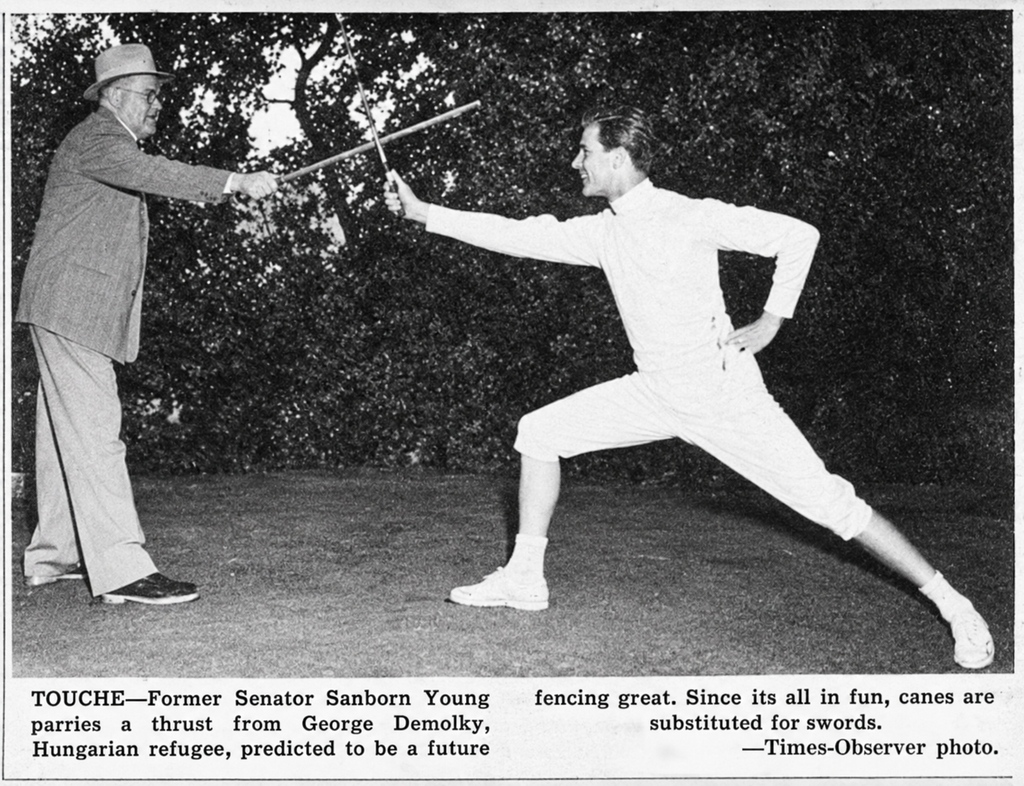
A photograph taken during George’s stay distilled the unlikely arrangement into a cheerful image. Domolky and Young face each other in the house, not with competition sabres but with walking canes. George lunges in shirtsleeves while the senator, more than half a century older, attempts a parry. It is the sort of picture a local editor appreciates because it requires no explanation to be amusing, yet the longer story gives it unexpected depth. The young man had crossed a river in winter and the old man had recently lost his wife; one was beginning again while the other was learning how to continue. For the instant of the photograph, neither burden shows. They are simply two residents of the same house enjoying the joke.
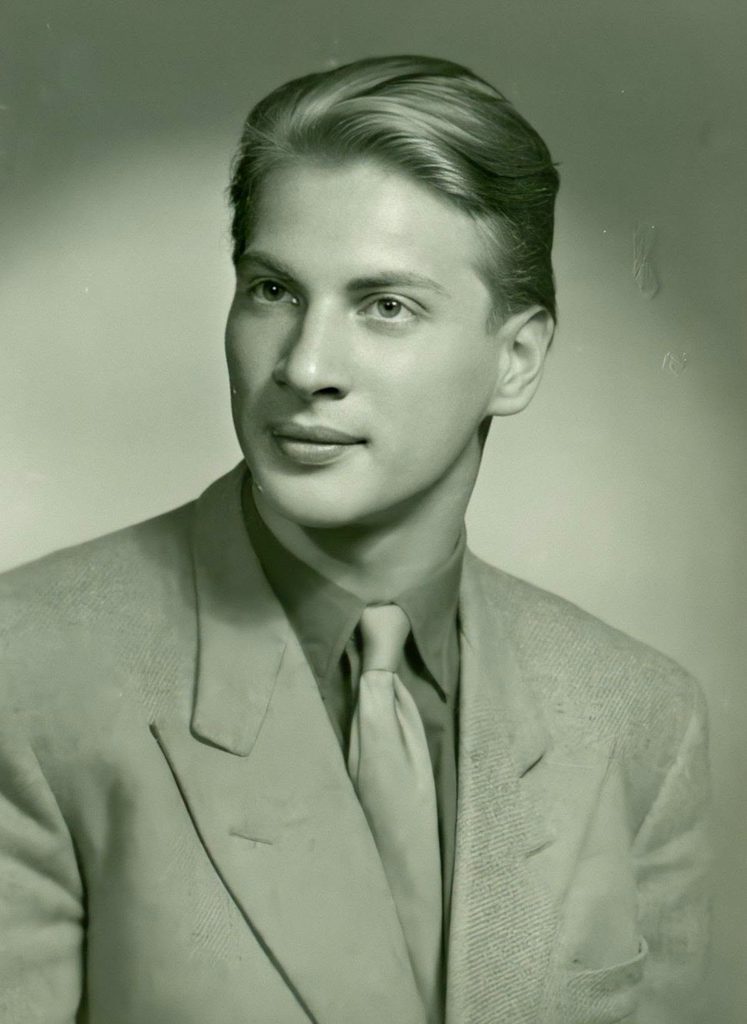
George entered Stanford in the fall, studied economics on an athletic scholarship, and lived in Toyon Hall. The 1959 Quad yearbook places him among the residents of El Tigre, a campus home less architecturally exotic than Yung See San Fong but filled with another set of customs to learn. He joined the fencing team during the 1957 and 1958 season under coach Elwin Bugge and helped Stanford gain notice in a collegiate sport dominated by Penn, Columbia, Yale, and Harvard. More than fifty years later George still remembered Bugge’s warmth. “It felt like home,” he wrote, unconsciously repeating the central word of his California experience. A refugee who had lost one home was building replacements in several places at once, among high school classmates, in a senator’s house, and on a university team.
The Stanford interview reprinted by the Los Gatos paper in October 1957 found a man alert to the differences between the world he had left and the one he was entering. Hungarians had risen for freedom of speech and freedom of the press, he explained, and the Soviet system had failed to win the young. He resented broadcasts from the Voice of America that seemed to promise assistance during the uprising, only to leave the fighters unsupported. Yet he did not permit politics to monopolize the conversation. He liked bridge, jazz, and small sculpture; San Francisco was his favorite city; Stanford impressed him with its spirit, social life, and high scientific standards. American young people seemed happy to him, and he said he could see it in their eyes. “Music is good propaganda,” he added, an observation with the light touch of a joke and the hard center of experience.
Fencing remained his most visible language. He reached the final of the 1958 United States individual sabre championship, and in 1959 he placed fourth in a field of fifty-one. The surviving results in American Fencing show how narrow the margins were: he defeated the veteran Tibor Nyilas 5 to 1, Alfonso Morales 5 to 1, and Csaba Pallaghy 5 to 4, while losses to Thomas Orley, Attila Keresztes, Allan Kwartler, and Robert Blum left him just outside the medals. That summer he fenced more than forty bouts over three days in the Olympic trials and reached the next-to-last stage of selection for the 1960 American team. The Los Gatos paper followed the campaign and noted that he was once again living with Sanborn Young. George did not make the final Olympic roster, but he had come close enough for the ambition to command years of work and the attention of two newspapers.
His uncertain immigration status proceeded beside his athletic and academic careers. On February 17, 1959, Representative Charles Gubser introduced H.R. 4668, a private bill “for the relief of Szabolcs Thomas Orley and George Domolky.” Such bills were once a familiar, if cumbersome, means of assisting individuals whose cases did not fit easily through the general immigration laws. The Congressional Record preserves the introduction and referral to the Judiciary Committee, though the available record does not establish a final enactment. For George, the episode meant that the right to remain in the country where he studied and competed had become a matter placed formally before Congress. A local sponsor could provide a bed and a college could provide admission, but only the federal government could secure the future implied by both.
By June 1960 the Times-Saratoga Observer could count Domolky among Stanford’s local graduates. The paper identified his advanced degree as a Master of Arts in Food Research, and later accounts report that he earned an M.B.A. from the University of California, Berkeley. The physician imagined in his first Los Gatos interview never emerged, but the combination of economics, research, and disciplined judgment led toward another demanding profession. George moved east and eventually entered investment management. In 1981 he joined Fidelity Investments, where he became one of the large company’s corps of analysts and fund managers. Peter Lynch later included him among the colleagues whose research supported the celebrated Magellan Fund, an association far removed from a Hungarian railway job but not entirely unrelated to the habits of observation, timing, and nerve required by a sabreur.
Domolky managed the Fidelity Canada Fund from 1987 to 1996 and later handled gold and precious-metals portfolios. Financial journalism occasionally caught him performing the less romantic work of his second career, discussing Canadian earnings, currencies, interest rates, mining companies, and the changing appetite of investors. In 1992, with Canadian shares lagging behind the American market, he told the Los Angeles Times that stocks north of the border had “some catching up to do.” By the end of the decade he was managing both Fidelity’s Select Gold and Select Precious Metals and Minerals funds. He had become an interpreter of another kind of border country, one measured in exchange rates and commodity cycles rather than rivers and patrols. The work suited a man who had spent his life assessing distance, risk, and the instant at which conditions changed.
Fencing continued to bind the scattered members of his family. George’s sister Lídia had remained one of Hungary’s great foilists, winning team silver at the 1960 Olympics, team gold in 1964, and another silver in 1968. Her husband, József Sákovics, was a world champion and one of the leading coaches of Hungarian fencing. In 1996 the couple spent a season coaching at Harvard and lived with George and his family in Wayland, Massachusetts. Four decades after revolution had separated their paths, the siblings were together in America because of the sport they had learned as children. George also became a supporter of Stanford fencing, and a university Legends Fund created in 2010 honored him along with three other important figures in the program.
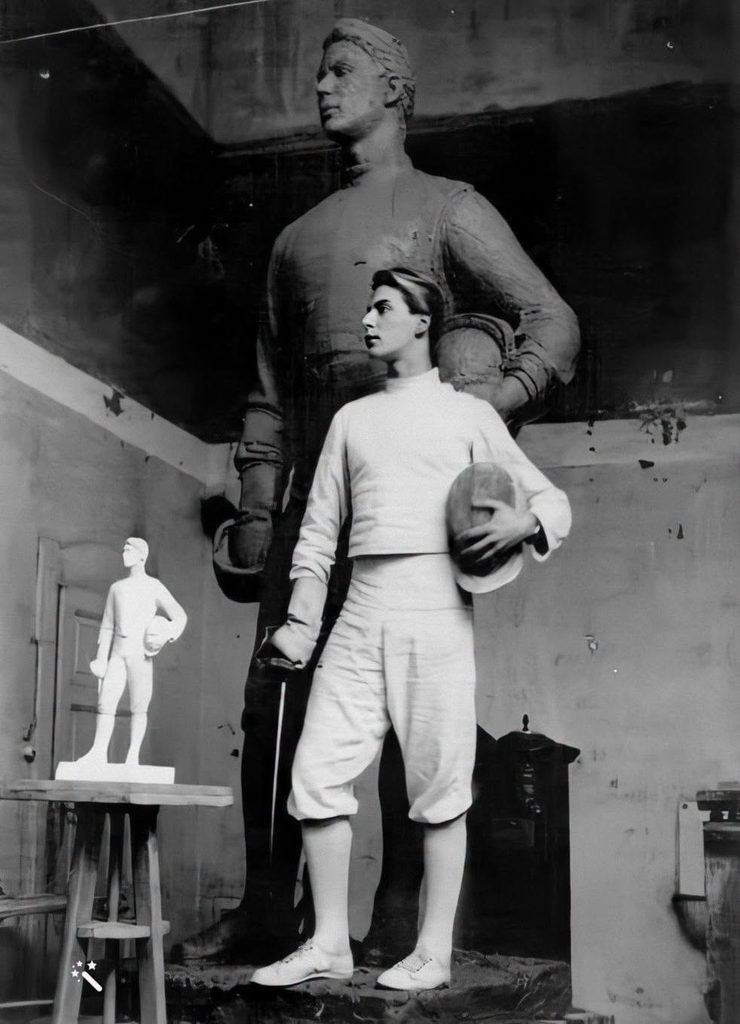
At eighty, George wrote to a new generation of Stanford fencers. He told them that victory mattered, but participation and contribution mattered more, and that he had always regarded fencing as a form of art expressed through style, speed, execution, and strategy. He was still working full time at Fidelity and summarized his philosophy in four words: “just keep running.” A Hungarian tribute published for his ninety-fourth birthday found that he had done exactly that. It recalled the statues, the porcelain figure, the films, the escape, and the American championship, and reported that swimming and tennis still occupied him. The young man fixed in the pose of a sabreur by Hungarian artists had lived long enough to become a figure of continuity himself.
Sanborn Young did not live to see most of that career. He died on February 14, 1964, ten years after Ruth, and Yung See San Fong passed out of the family. Its furnishings and collections were dispersed, its visitors grew old, and many of the stories that had accumulated in its rooms survived only because someone bothered to repeat them. Richard Maddux never forgot the senator. Seven decades after the mounted figure and his beagles came up the road, he still regarded Young as one of the mentors of his life and remembered the quality of his attention more clearly than the distinctions of his public career.
That may be the most revealing fact about the old senator’s final years. Sanborn Young had held office, argued legislation, cultivated famous friends, raised prize animals, and helped create a house important enough to enter the National Register of Historic Places. Yet two of the strongest testimonies about him came from people who met him when they were young and far from secure. To one he offered the grave courtesy of stopping on a mountain road; to the other he offered a bedroom, an education, and the standing of his name. The boy ran down from the neighboring hill, and the refugee arrived by way of a failed revolution, a river, and a touring athletic company. Both found the same door open.
The photograph of Young and Domolky fencing with canes looks at first like nothing more than a newspaper joke. Look longer and the room begins to fill. Beyond the edge of the picture are Richard watching the practice, the telegram from Milwaukee, the Buddha with its secret safe, the organ pipes, the moonlit trees, and the beagles announcing themselves somewhere on the road. The old man raises his cane, the young man lunges, and for a fraction of a second they hold a perfect distance between them. Fencers have a name for that distance, but the house supplied another. It was the small, hospitable interval in which a stranger ceased to be a stranger and began to feel at home.
Sources and further reading
- Los Gatos Times-Saratoga Observer, “Hungarian Athlete at High School,” March 21, 1957, p. 2: https://cdnc.ucr.edu/?a=d&d=LGT19570321.1.2
- Los Gatos Times-Saratoga Observer, “Hungarian Fencers to Demonstrate Here,” May 1, 1957, p. 9: https://cdnc.ucr.edu/?a=d&d=LGT19570501.1.9
- Los Gatos Times-Saratoga Observer, “Domolky to World Tourney,” June 11, 1957, p. 5: https://cdnc.ucr.edu/?a=d&d=LGT19570611.1.5
- Los Gatos Times-Saratoga Observer, Stanford interview reprinted in “Lil’ ol this…,” October 22, 1957, pp. 5 and 8: https://cdnc.ucr.edu/?a=d&d=LGT19571022.1.5 and https://cdnc.ucr.edu/?a=d&d=LGT19571022.1.8
- Los Gatos Times-Saratoga Observer, “Domolky May Be in Olympics with Sabre-Fight Team,” July 7, 1959, p. 5: https://cdnc.ucr.edu/?a=d&d=LGT19590707.1.5
- Los Gatos Times-Saratoga Observer, Stanford graduation report, June 13, 1960, p. 8: https://cdnc.ucr.edu/?a=d&d=LGT19600613.1.8
- Library of Congress, Historic American Buildings Survey, Yung See San Fong House: https://www.loc.gov/pictures/item/ca0933/
- Stanford University, The Quad, 1959, p. 401: https://www.e-yearbook.com/yearbooks/Stanford_University_Quad_Yearbook/1959/Page_401.html
- Stanford Fencing, “A Letter from George Domolky,” November 13, 2011: https://stanfordfencingblog.wordpress.com/2011/11/13/a-letter-from-george-domolky/
- American Fencing, August 1959, national championship results: https://www.fencingarchive.com/wp-content/uploads/magazines/af/AF%20Vol%2010%20Num%205%20-%201959-08.pdf
- USA Fencing historical national medalist records: https://cdn1.sportngin.com/attachments/document/eafa-2757153/Div_I_All_National_Medalists_By_Name_2023.pdf
- Sports Illustrated, “What Became of the 1956 Hungarian Olympians?,” June 13, 2012: https://www.si.com/more-sports/2012/06/13/hungary-sb
- West Coast Fencing Archive, “Daniel Magay, Part 2,” April 29, 2019: https://westcoastfencingarchive.com/2019/04/29/daniel-magay-part-2/
- Los Angeles Times, “Investors Who Make a Run for the Border,” August 24, 1992: https://www.latimes.com/archives/la-xpm-1992-08-24-fi-5500-story.html
- Hungarian Fencing Museum, birthday tribute to György Dömölky: https://vivomuzeum.hu/ma-unnepli-94-szuletesnapjat-domoky-gyorgy-kardvivo-ikonikus-vivoszobrok-modellje/
- Congressional Record, February 17, 1959, H.R. 4668: https://www.congress.gov/86/crecb/1959/02/17/GPO-CRECB-1959-pt2-10-3.pdf
- Richard Maddux, personal recollections, August 17, year not supplied.