Provenance
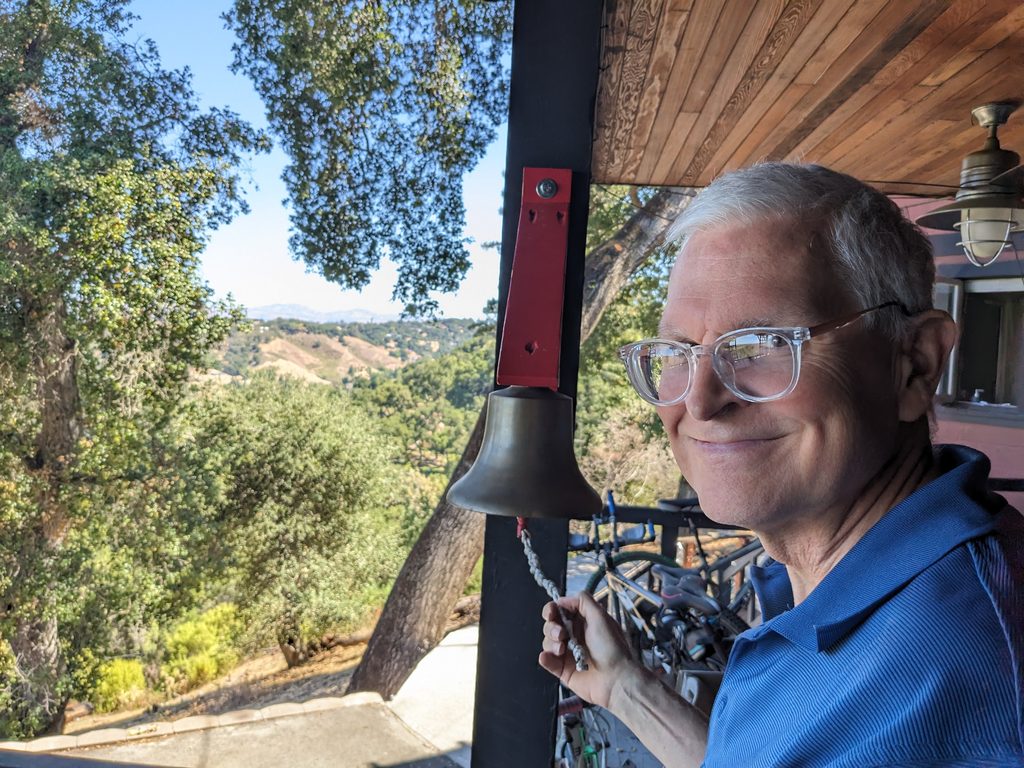
Most of what survives from the past does not arrive with paperwork. This bell arrived in a parking lot, handed across a tailgate by a man named Mark and his wife Judy, whose family had kept it for three generations and had finally run out of room for it. Mark’s grandfather acquired it in Oakland sometime in the 1950s. When Mark and Judy downsized there was nowhere left to hang it, and none of their children had a place either, so Mark listed it and then, by his own admission, regretted listing it. He told us it broke his heart to let it go. He was not looking for a buyer, he was looking for an address. When Judy understood where the bell was going she put her arms around Lauri in the middle of the lot, and both of them said they would be glad for people to know the bell had come from them. This bell is Mark and Judy’s gift to the house.
The family story was that it hung on one of Oakland’s horse-drawn fire apparatus and was rung to clear the street ahead of a running rig. Mark passed the legend along faithfully but did not entirely believe it, and said so in writing before we ever met: “It does not shine like a FD bell, so I suspect it was a marine bell.” Everything that follows is the work of finding out whether he was right.
Method
A bell is among the more thoroughly solved objects in acoustics. For a shell of fixed profile, the frequency of its modes varies as wall thickness over the square of diameter, while its mass varies as thickness times the square of diameter. Eliminating thickness between the two gives
W = C · f · D⁴
where W is weight, f is the strike frequency and D is mouth diameter. C is a constant that encodes the profile. Calibrating C against Chime Master’s published table of bell weight, diameter and pitch yields C = 2.4903 × 10⁻⁶ lb per hertz per inch⁴, a value that reproduces eight of the nine published rows, spanning 10 to 83 inches, within 18 percent. The ninth row is one the source itself flags as a deliberately heavy casting.
The practical consequence is that a bell can be interrogated. Fix any two of diameter, weight and pitch, and the third is very nearly determined. An object can be repainted, remounted, renamed and handed down with any history attached to it, and it will still declare what it is the moment it is struck.
Measurements
| Property | Value |
|---|---|
| Mouth diameter, outside at flare | 9.750 in / 247.7 mm |
| Height, body alone, crown to lip plane | 7.480 in / 190 mm |
| Diameter : height | 1.30 |
| Weight, casting alone | 15.5 lb / 7.03 kg |
| Weight, complete assembly | 18.5 lb (hardware 3.0 lb) |
| Sound bow thickness, 10 mm above lip | 15.7 mm |
| Mean wall thickness, derived from volume | ≈5.6 mm |
| Crown bore, machined | 38.1 mm = 1.500 in |
| Mounting stud | 0.500 in, bronze |
| Metal | Bronze throughout, except a replacement steel clapper and pivot pin |
Acoustic analysis
The bell was suspended free, struck once with its own clapper, recorded at 44.1 kHz, and the ring-down analysed by FFT over a 1.1 second window.
| Partial | Note | Cents | Ratio to f₁ | Level |
|---|---|---|---|---|
| 756.1 Hz | F♯5 | +37 | 1.000 | −3.1 dB |
| 1403.7 Hz | F6 | +8 | 1.857 | −8.7 dB |
| 1669.6 Hz | G♯6 | +9 | 2.208 | −7.5 dB |
| 2190.4 Hz | C♯7 | −21 | 2.897 | −0.2 dB |
| 2802.7 Hz | F7 | +5 | 3.707 | 0.0 dB |
| 3415.9 Hz | G♯7 | +48 | 4.518 | −18.9 dB |
| 4523.0 Hz | C♯8 | +34 | 5.982 | −18.9 dB |
No partial exists below 756 Hz. There is no hum note.
A tuned church bell runs 0.5 : 1.0 : 1.2 : 1.5 : 2.0 for hum, prime, tierce, quint and nominal. This bell has none of that structure. Its ratios instead fit two families of shell modes, the m = 2, 3, 4, 5 series landing at 1, 2.21, 3.71 and 5.98 against a thin-shell prediction of 1, 2.25, 4 and 6.25.
Two consequences follow. First, the bell was never tuned on a lathe, and its fundamental of 756 Hz sits 37 cents sharp of F♯5, in the crack between two piano keys. A bell built to a government specification does not do that; United States Navy bells of this era were tuned to A♭ by regulation, with a stated tolerance. Second, because there is no near-harmonic upper series, the ear has nothing from which to construct a virtual strike note, which is why the perceived pitch of this bell is genuinely ambiguous to listeners and why a chromatic tuner and a piano disagreed about it.
Mode splitting
Every strong partial arrives as a doublet.
| Partial | Frequencies | Split | Interval |
|---|---|---|---|
| f₁ | 750.84 / 756.09 Hz | 5.25 Hz | 12 cents |
| p₂ | 1403.67 / 1411.02 Hz | 7.35 Hz | 9 cents |
| p₅ | 2802.72 / 2807.97 Hz | 5.25 Hz | 3 cents |
A perfectly symmetrical shell produces single tones. Splitting occurs when the two orthogonal mode shapes see slightly different geometry, from a shell that is a little out of round or a little uneven in wall thickness. The 5.25 Hz split at the fundamental beats at roughly five times a second, which is the audible warble. It is less a defect than a fingerprint, since no two castings are asymmetric in the same way, and it is further evidence the bell was never trued.
Prediction and confirmation
Two quantities were computed from the acoustic and mass data before the corresponding measurement was taken.
| Quantity | Predicted | Measured | Error |
|---|---|---|---|
| Mouth diameter, from 15.5 lb at 756 Hz | 9.53 in | 9.75 in | 2.3% |
| Sound bow thickness, from pitch and profile | 14.6 mm | 15.7 mm | 7.5% |
Independently, 15.5 lb of bronze at 0.3143 lb/in³ is 49.3 cubic inches of metal. Distributed across the shell surface implied by the measured diameter and height, that gives a mean wall of about 5.6 mm, which is what a bell with a 15.7 mm sound bow and a light upper body would produce. Three routes, one geometry.
Class comparison at 9¾ inches
Scaling published weights of documented bells by the cube of diameter to the subject’s exact size:
| Class | Reference | Weight at 9¾ in | Subject |
|---|---|---|---|
| Fire apparatus | Brosamer’s, 10 in / 29 lb | 26.9 lb | 15.5 lb |
| Bell foundry ship’s bell | Olsen Nauen, Norway | ≈25 lb | 15.5 lb |
| Church or chapel profile | Chime Master, 10 in / 24 lb | 22.2 lb | 15.5 lb |
| US Navy foredeck bell | Actual, 9¾ in | 20 lb | 15.5 lb |
| Plain bronze ship’s bell | Skipjack, 9½ in / 16.5 lb | 17.8 lb | 15.5 lb |
The same comparison in the frequency domain is more decisive, because pitch is what a listener actually perceives:
| Class | Expected pitch at 9¾ in | Subject |
|---|---|---|
| Fire apparatus | 1194 Hz, D6 | 756 Hz, F♯5 |
| Church or chapel | 986 Hz, B5 | 756 Hz |
| US Navy, by specification | 830.6 Hz, A♭5 | 756 Hz |
The fire hypothesis fails by nearly eight semitones, an interval of a minor sixth. That is not a discrepancy to be argued over, it is a different instrument. A fire bell is cast thick because its job is to cut through street noise at close range, and thick metal rings high and hard. Inverting the relation, a fire apparatus bell that actually spoke at 756 Hz would measure about 15.4 inches across and weigh roughly 106 pounds. Nothing of that description ever hung on an engine.
The Navy hypothesis fails on four independent grounds: weight outside every specification class, absence of the required U.S.S. or U.S.N. marking, absence of the ribbed bands characteristic of pre-1950 Navy bells, and absence of a specification tone.
Construction grade
The bell hangs from a single bronze stud through the crown. Inside, riding on that same stud, is a separately cast bronze clapper hanger, a U-clevis carrying the clapper on a pivot pin. The clapper terminates in an eye for a lanyard.
The 1918 Bureau of Construction and Repair specification for ship and motor boat bells draws a hard line between two grades of construction, and the line is by class of vessel, not by date. A ship’s bell carries its clapper on a bronze lug secured by a through bolt, nut and washer. A motor boat bell hangs its clapper on a plain eyebolt. This bell has the lug. In the working vocabulary of the trade it is a ship’s bell, not a boat bell.
That grade was a real market category and it did not survive the 1920s. Perko, the largest American marine chandlery of the period and the only one whose catalogues from these years survive in readable form, offered a Heavy Pattern line in 1920, pure bell metal with bronze fittings, in eight sizes from 5 to 12 inches. By the 1927 catalogue the entire bell offering had collapsed to a single 8 inch casting. By 1929 it was 6 and 8 inch only, in medium and light weights, the heavy grade gone. That is one firm’s business decision rather than a law of the trade, but it shows the heavy, bronze-fitted, ship’s-grade cast bell was an ordinary catalogue item before 1920 and an unusual one by the late twenties.
Unit system
Two features of this bell were machined after casting, at tooling sizes, with no pattern contraction involved:
| Feature | Measured | Inch reading | Metric equivalent a metric shop would use |
|---|---|---|---|
| Crown bore | 38.1 mm | 1.500 in exactly | 40 mm |
| Stud | 12.7 mm | 0.500 in | M12 or M14 |
A German, Dutch, Scandinavian or French shop of this period bores 40 mm and fits M12. It does not bore 38.1 and fit a half inch stud. The mouth diameter is likewise a round inch fraction, while the 190 mm height is the dependent consequence of the profile and would fall near that value for any 9¾ inch bell regardless of the maker’s unit system. This bell was made in an inch shop, which confines it to America, Britain or the Commonwealth.
The marks
The crown is stamped U801, possibly U807. The clapper hanger carries U802. There are additional faint marks on the crown, worn by handling, not yet legible.
These match no catalogue from any American bell foundry, marine chandlery, fire apparatus builder or hardware maker: verified against Perko 1916, 1920, 1927 and 1929, Wilcox Crittenden, Merriman, Buck-Algonquin, Schaefer, McShane, C.S. Bell, the American Bell Foundry, Meneely and Rumsey. They are not Admiralty pattern numbers either; Admiralty patterns are bare integers under an “AP” system prefix, with letters only as trailing variant marks, and Admiralty bells use a cast-in crown staple rather than a machined boss and stud. There is no broad arrow.
More striking is a negative that spans every nationality searched. Across American, British, Continental, Scandinavian, Japanese and Canadian sources, museum collections and auction archives, there is no documented tradition anywhere of marking a ship’s bell with a letter plus three digits. Bells carry the ship’s name, or the founder’s name, or nothing. Continental founders in particular invariably signed: Keller of Zürich, Rosenlächer of Konstanz, Grassmayr of Feldkirch, van Hengel of Rotterdam.
This bell carries neither a ship nor a founder. It carries an industrial part number, and the two numbers are consecutive across two separately cast parts of one assembly. That is the signature of a pattern register, in which each new pattern takes the next entry as it is cut, so a two-piece job made at one sitting takes two consecutive numbers. Under the standard convention described in Perrigo’s shop management text, the letters I, O and X are excluded as designators, which means a shop that had reached U had already assigned roughly eighteen prior product lines.
Two conclusions follow. The maker was a substantial multi-product manufacturer with a drawing office and a formal pattern shop, not a jobbing foundry. And it was a general bronze foundry rather than a bell foundry, which is independently corroborated by mass: Olsen Nauen of Norway, founded 1844 and still casting, makes ship’s bells at 712 to 762 kilograms per cubic metre of diameter, against this bell’s 461. A bell founder’s bell of this mouth would weigh about 25 pounds.
The practical consequence of the pattern-register reading is that the number was never printed anywhere. It existed only inside the building where the patterns were cut, and registers of that kind went out with the rubbish whenever a foundry closed. That is why exhaustive catalogue searching on three continents has produced nothing, and why it never will.
Dating
Three lines of evidence bound the manufacture date.
| Evidence | Bound |
|---|---|
| Letter-prefix pattern registers described as settled shop routine, Perrigo 1906 | Floor ≈1900 |
| Metcalfe’s arsenal shop-symbol systems, 1880s, as arguable ancestor | Soft floor ≈1890 |
| Heavy, bronze-fitted, ship’s-grade cast bells ordinary before 1920, gone from the catalogue by 1927 | Centre of gravity 1900–1920 |
Service life supplies an independent check. Bay and coastal working craft of this generation ran roughly 30 to 35 years before breakup, and the documented local cases are consistent:
| Vessel | Built | Scrapped | Age |
|---|---|---|---|
| Alameda (ferry) | 1913 | 1948 | 35 |
| Santa Clara (ferry) | 1915 | 1947 | 32 |
| El Paso (ferry) | 1924 | after 1956 | 32 |
| Russian River (ferry) | 1924 | after 1956 | 32 |
Working backward from a purchase in the 1950s, allowing that salvaged bronze sits in a yard before it sells, a vessel broken up between roughly 1948 and 1955 was launched between about 1913 and 1925. Bells routinely outlive hulls and are carried from one vessel to the next, so the bell may be older than its last ship.
Taken together: manufacture most likely between about 1900 and 1925, with the evidence clustering in the first two decades of the century.
The vessel
Bells were sized in proportion to their vessels by long convention rather than by rule. The international collision regulations in force through this entire period specified only “an efficient bell,” with no dimension, weight, material or tone; the first size requirement anywhere appears in 1972. A 9¾ inch bell is a modest one, sitting between the sizes much later codified for craft of 12 to 20 metres and for vessels over 20 metres.
On proportion alone that points at a working boat of roughly 40 to 70 feet: a tug, a fishing vessel, a launch, a small coaster, a ferry tender. An operator who bought the good construction because that is what a serious owner buys, and who never once cared what note it made.
Reconstruction
A general bronze foundry working in inches, large enough to have reached the letter U in its pattern books, cast this bell around the turn of the century or in the two decades after, as a numbered assembly of parts to an engineer’s drawing. It went to sea new on a working craft of forty to seventy feet and stayed there for the twenty-five to forty years those hulls lasted. It came ashore in the long dismantling of that generation, which began when the Bay Bridge opened in 1936 and the Golden Gate in 1937 and continued through the war and into the 1950s. It sat in a salvage yard or a chandlery’s used bin until an insurance adjuster bought it in Oakland.
That man is the last piece. Mark’s grandfather traveled from place to place adjusting claims, which is precisely the profession that ends up holding salvage, and a man who worked fire losses spent his career walking in and out of fire stations. Mark says that is where his own lifelong interest in fire departments came from. The bell came off a boat. The fire story came off the man who carried it home. Both are true. They belong to different things.
Coda
None of the above is a demotion. A tuned parade bell is a lovely object, polished and correct and pitched to a standard. This is something else. It was made to be heard over an engine and a wind by somebody who needed information immediately. Nobody buffed it for inspection. It carries weather. It rang for a living, and it carries no name anywhere, only a number on every part, which is a manufacturer that thought in assemblies rather than in ornaments.
And if the dating holds, this bell was out on the water, working, through the entire span of the Youngs’ life in this house. Sanborn Young sat in the California State Senate from 1925 to 1939. Ruth Comfort Mitchell wrote her novels from these rooms through the twenties, the thirties and the forties. Every one of those years, somewhere on this bay or up this coast, somebody was standing a watch and striking this bell. The two of them never met. They have now.
Joan’s Porch
The bell will hang on the low porch at the back of the house, the one that looks out over the valley, and that porch has done this kind of duty before.
On 22 August 1919 the Saratoga Star ran a notice by Edith Daley of San Jose under the headline “Clever Kiddie Writes, Stages, Acts Playlet,” describing a performance given at the Sanborn Young hilltop home. A nine year old girl had conceived the plot, written the play, titled it “Timid Agnes and the Mouse,” and brought it out herself. She starred as Timid Agnes. Her co-star, Mary Frances Balch, daughter of Mr. and Mrs. S. D. Balch, carried the entire remaining company single-handed, doubling as the Wicked Aunt, the Green Mouse and the Fairy Prince. When the two of them announced the first matinee, Daley reported, there was not a vacant seat in what she called the “bald-headed row” of the lower balcony. That lower balcony is the porch in question. “Not for nothing is Joan, aged nine, the daughter of her famous parents,” Daley wrote, predicting that the child showed “every indication of following them up-stage to fame.”
She did. Joan Bennett went on from that porch to more than seventy films, to Little Women, to the Fritz Lang pictures that made her one of the definitive faces of American noir in The Woman in the Window and Scarlet Street, to Ellie Banks in Father of the Bride, and finally to a generation of television viewers as the mistress of Collinwood in Dark Shadows.
Houses accumulate names for their parts, usually by accident and usually from whoever used them hardest. This one has gone without a name for more than a century, which now seems like an oversight worth correcting. From here forward, in this house’s records and on every drawing and description that comes out of it, the low porch at the back is Joan’s Porch.
So this is not an empty ledge we are hanging a bell on. It is a stage, and it has been one since 1919, and the thing that has always happened there is that somebody stands on it and calls the rest of us to come and gather.
If the legend is right, this bell once rang to tell people to get out of the way. Hanging on Joan’s Porch, over the valley, at the back of a house that has always been in the business of bringing people together, it will ring for the opposite purpose. It will tell whoever is out on the property that they can come home.
Thank you, Mark and Judy. It is exactly where it should be.