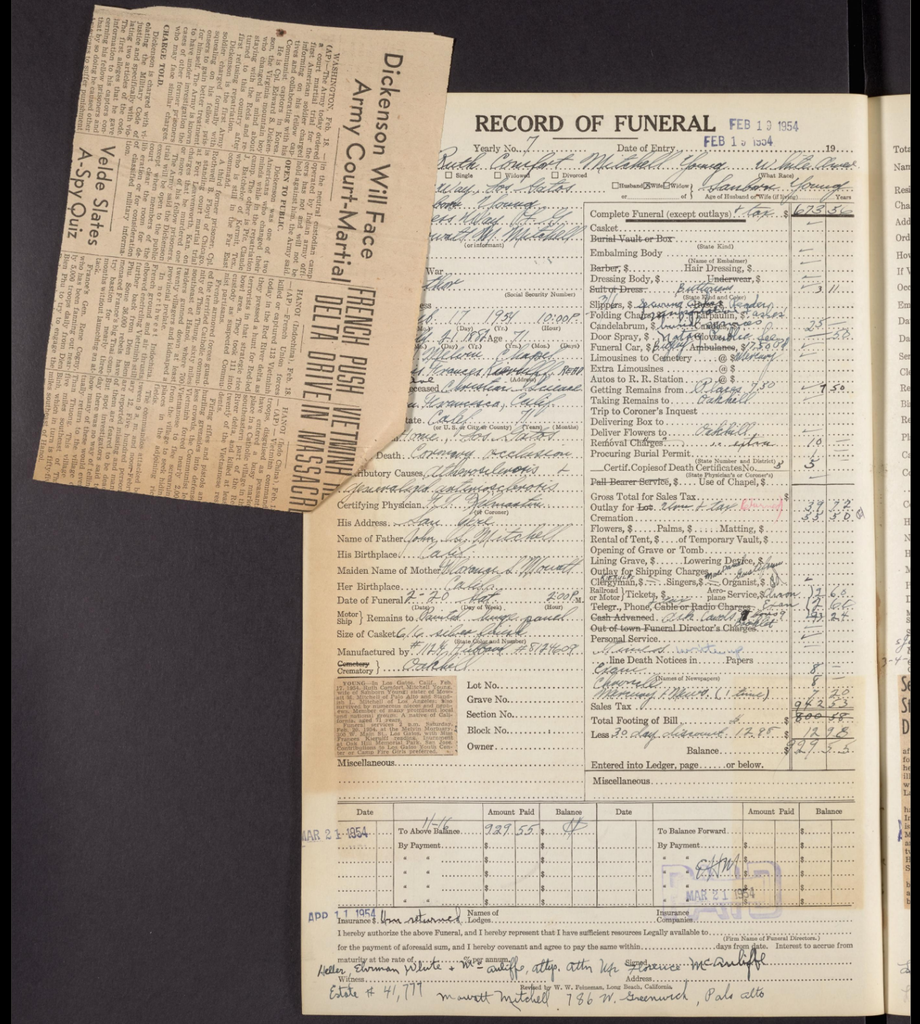
On the Melvin Mortuary record for Ruth Comfort Mitchell Young, one name is particularly difficult to decipher: T. F. Kilmartin, San Jose, entered in the space for the certifying physician or coroner. The name belonged to Thomas F. Kilmartin, Santa Clara County coroner, and following it leads well beyond Ruth’s death in February 1954. Kilmartin had spent decades in San Jose’s automobile business, served on the California Horse Racing Board, administered New Deal regulations, directed wartime rationing and bond drives, and only later entered county government. His appearance in Ruth’s final records marks a brief intersection between two very different Santa Clara Valley lives.
A remarkably useful account of Kilmartin’s earlier career appeared in the Campbell Press on April 11, 1946, when he announced his candidacy for coroner and public administrator. The newspaper reported that he had lived in Santa Clara County for 38 years, placing his arrival at about 1908, and described him as a familiar participant in county civic affairs. For twenty years he had operated his own automobile business in San Jose, leaving the motor-car field in 1939. Those years encompassed nearly the whole first great age of the automobile in California, from the period when cars were still transforming the streets of San Jose to the eve of the Second World War.
By the 1930s Kilmartin’s position in the automobile trade had carried him far beyond his own dealership. In 1934 he became code administrator for the automobile industry in 47 Northern California counties under the National Recovery Administration. The NRA was one of the Roosevelt administration’s early attempts to stabilize the Depression economy by establishing industry codes governing competition, wages, hours and other business practices. The experiment itself was short-lived, but Kilmartin’s appointment over nearly all of Northern California suggests the stature he had acquired in the automobile business.
At about the same time, he entered another expanding California industry. Kilmartin served on the California Horse Racing Board, one of three commissioners charged with overseeing racing after pari-mutuel wagering returned legally to the state. Racing in the late 1930s was not a minor amusement. Tracks, betting, licensing and state revenues had made it a substantial business, and surviving board reports show Kilmartin taking an active interest in its administration. He sometimes disagreed openly with his fellow commissioners, opposing additional bureaucracy and arguing for lower deductions from wagering receipts and straightforward regulation of the sport.
The Second World War brought another turn in his career. Kilmartin became chairman of War Price and Ration Board 32-1 in San Jose, part of the local machinery charged with administering wartime price controls and rationing. He later resigned that position to work for the United States Treasury Department, spending three years supervising war-bond campaigns in Santa Clara, Santa Cruz, San Benito, San Mateo and Monterey counties. These campaigns required far more than public speeches. Banks, employers, newspapers, schools, civic organizations and thousands of individual purchasers had to be coordinated, and Kilmartin was responsible for that effort across a large section of coastal California.
By 1946 he was serving as chief deputy coroner, appointed by Santa Clara County Coroner Jessie A. Spalding, who was preparing to retire. Kilmartin then ran for coroner and public administrator himself. The Campbell Press noted that, despite his long record in business and public service, this was the first elective office he had ever sought. He presented his candidacy in practical terms. Santa Clara County was growing rapidly, he said, and the coroner’s office was becoming correspondingly more important. Having left his automobile interests behind, he promised to devote his full time to the job.
The office Kilmartin sought was considerably broader than the modern title might suggest. The Santa Clara County coroner also served as public administrator, so the same official who investigated sudden or unexplained deaths could also become responsible for estates when no suitable private administrator was available. Kilmartin consequently appears in California court decisions not merely as coroner but as administrator of estates involved in probate disputes. He was not a physician, nor did the office then require him to be one. Medical examinations and autopsies were performed by physicians and pathologists; the coroner had legal authority over the investigation and certification of deaths that came within his jurisdiction.
That was the circumstance that brought Kilmartin into Ruth Comfort Mitchell’s story. On the night of February 17, 1954, Ruth died suddenly at Yung See San Fong, the Chinese-inspired house she and former State Senator Sanborn Young had built in the hills above Los Gatos. She was found in a bathtub, and drowning was initially considered. Her death therefore came under the jurisdiction of the Santa Clara County coroner. An autopsy the following day ruled out drowning and determined that she had died from a coronary occlusion. Melvin Mortuary’s ledger records T. F. Kilmartin, San Jose, as the certifying coroner. However, we look into the record, we see “Coronary occlusion; contributory: atherosclerosis & generalized arteriosclerosis.”
Ruth and Sanborn had no children, which raises an intriguing but presently unanswerable medical question. If Ruth had experienced infertility related to diminished ovarian function, an early menopause, or some other condition that reduced her lifetime exposure to estrogen, that could conceivably have contributed to her later cardiovascular disease; women with early loss of ovarian function are now known to have higher rates of coronary disease. But childlessness by itself is not evidence of low estrogen. A woman with entirely normal ovarian function might remain childless for many reasons, including infertility in either partner, reproductive problems unrelated to estrogen, circumstance, or simply choice. Modern research has also found that the relationship among pregnancy history, endogenous estrogen and later cardiovascular disease is complicated rather than a simple equation in which fewer pregnancies mean less estrogen and more atherosclerosis.
For Ruth, it was the end of a public life that had stretched across half a century. She had been a novelist, poet, playwright, lecturer and political figure, and for decades her name had appeared in newspapers across the country. Kilmartin had traveled a very different path through the same region: automobiles, horse racing, New Deal administration, wartime service and county government. Their lives touched only at the end of hers, through the ordinary machinery by which a sudden death became an official record.
Kilmartin’s own story had one unexpected postscript. In 1955, just a year after Ruth’s death, Santa Clara County Superior Court Judge William F. James published Saint Patrick of England through San Francisco’s celebrated Grabhorn Press in an edition of only 200 copies. The book grew out of an argument with Thomas F. Kilmartin, Santa Clara County coroner, over Saint Patrick’s birthplace: Kilmartin favored Scotland, while James disagreed strongly enough to research the question and turn their debate into a privately printed book.
The small entry in the Melvin ledger thus opens onto a much larger piece of Santa Clara Valley history. Kilmartin had arrived in the county when automobiles were still remaking California, remained through the Depression and the Second World War, and entered public office as the valley began the extraordinary postwar growth he himself had predicted in 1946. Ruth Comfort Mitchell belonged to another world of books, politics and Los Gatos society, yet their names came together on a single page in February 1954. Local history is full of such crossings: not grand coincidences, but the ordinary points at which one life passes through the records of another.