Ruth at the Shrine: The Night Her Words Filled a Cast of 400
Of all the stages Ruth Comfort Mitchell wrote for in her long career, none was bigger than the one she commanded on the night of Wednesday, January 15, 1930. That evening the Shrine Auditorium in Los Angeles presented “Hear, O Israel,” a pageant-play in twelve acts with a prologue and epilogue, performed once and never again. Ruth wrote it, and when the curtain went up, she had helped direct it too.
The occasion was the twelfth triennial convention of the National Council of Jewish Women, which brought more than six hundred delegates to Los Angeles that January. For its centerpiece the Council wanted something monumental: the story of the great women of Jewish biblical history, told with a cast of 400, a full symphony orchestra, a hundred-voice choir, and ballet companies borrowed from across the city. To write it, they turned to Ruth.
Why Ruth?
On paper the choice looks surprising. Ruth was not Jewish; she was a Christian Scientist, and the wife of State Senator Sanborn Young. But the Council was not looking for a member. It was looking for a dramatist, and Ruth’s whole career had prepared her for exactly this commission.
She knew live audiences from her years writing one-act plays for the vaudeville circuits, work that taught her pacing, spectacle, and how to hold a big house. She knew the movie business, which had been adapting her plays and stories since 1916. And above all, she knew the subject. Strong, capable women were the hallmark of Ruth’s writing, from her magazine stories for Ladies’ Home Journal and Woman’s Home Companion to the novels that made her name. A pageant celebrating Sarah, Michal, and the judges and queens of ancient Israel was not a departure for her. It was her signature theme, handed the grandest stage of her life.
Her collaborator was Lillian Burkhart Goldsmith, a former vaudeville headliner who had led the Los Angeles section of the Council for six years and brought the convention to the city. The Jewish press described their division of labor precisely: the pageant was conceived by Goldsmith and “transcribed into exquisite poetry” by Ruth. Two women of the theater, one supplying the vision, the other the verse.
Ruth the Director
Ruth’s name did not stop at the writing credit. The Los Angeles society pages reported plainly that “Mrs. Goldsmith and Mrs. Mitchell are directing the pageant,” assisted by Russell Stimmell, Redmond Flood, and Wharton James. That means Ruth spent the weeks around New Year’s 1930 in rehearsal halls and at the council house on South Loma Drive, staging twelve acts, a prologue, and an epilogue on four hundred performers, most of them council volunteers mixed with working professionals.
And what professionals they were. Mischa Auer, grandson of the violinist Leopold Auer, played David, King of Israel, six years before Hollywood made him a star character actor. Young Carla Laemmle, niece of Universal’s founder and already the ballerina of the 1925 Phantom of the Opera, danced Eve in the Garden of Eden scene. The Marion Morgan dancers performed a Persian ballet with dancers courtesy of Warner Brothers, Norma Gould staged sixty “Cloud and Moon children,” the Tandler Symphony Orchestra played under Adolph Tandler, and John Smallman conducted a choir of one hundred voices. Council women took featured roles as well: Mrs. Arthur Brin of Minneapolis as Sarah, “the first woman pioneer,” and Lillian May Ehrman of San Francisco as premiere ballerina.
The press promised the production would be “a distinct contribution to the literature and art of the day.” For one night, Ruth’s verse carried all of it.
A Bridge Between Communities
The pageant also shows a side of Ruth that her novels only hint at: her ease in moving across the civic and religious lines of her day. A Christian Science clubwoman writing and co-directing the flagship production of a national Jewish women’s convention, with a Protestant church choir singing and a Hollywood studio lending dancers, was the kind of collaboration 1930 Los Angeles made possible, and Ruth stood at the center of it. It is worth remembering when her name turns up, as it does, in the Jewish press of the era: she was there as an honored professional and a friend, doing the thing she did best, telling stories about strong women.
About Those Costumes
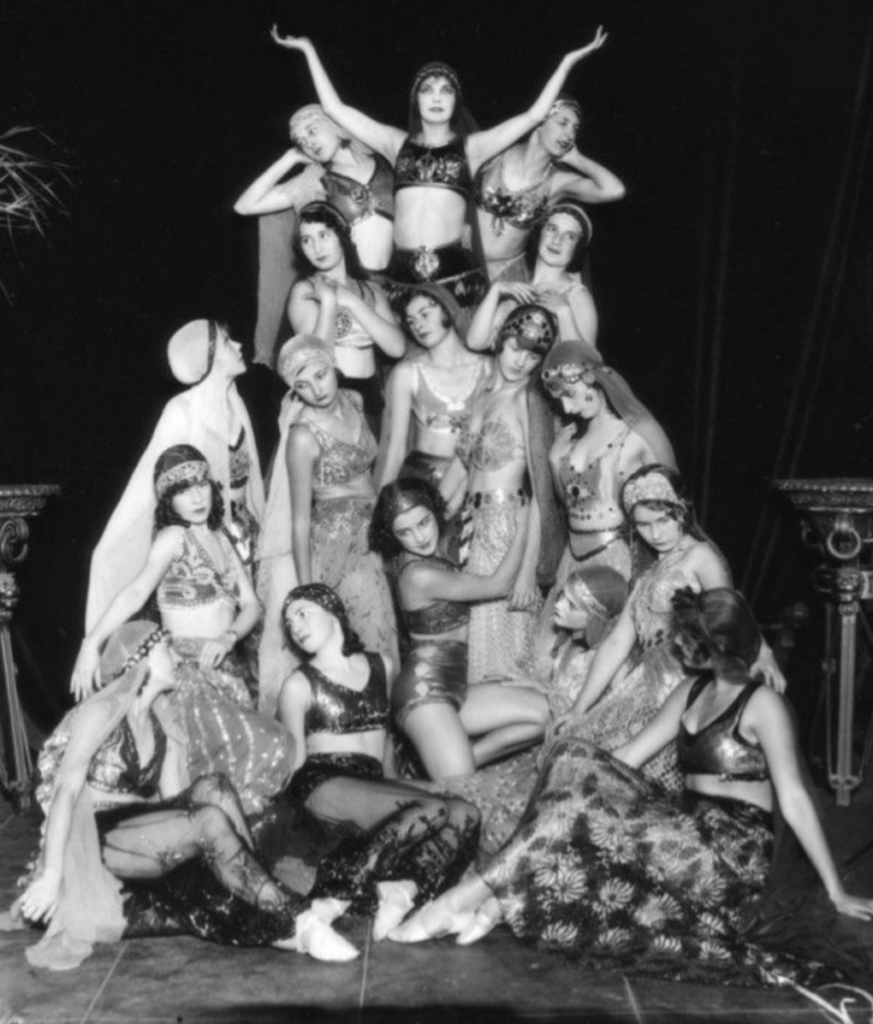
Modern viewers of the surviving photographs are often surprised by how much skin the dancers show: bare midriffs, bare arms, filmy drapery. It looks like more than we expect from 1930, and certainly more than we expect from a religious pageant staged by a women’s organization. But to the audience at the Shrine that night, the costumes read as tasteful, artistic, and entirely proper, and it is worth understanding why.
Theatrical dance in this era had its own dress code, one that ran well ahead of street fashion. For twenty years, American concert and pageant dance had been shaped by the “aesthetic” and Orientalist schools of Ruth St. Denis, Isadora Duncan’s followers, and companies exactly like the Marion Morgan Dancers who performed the Persian ballet here. Morgan’s troupe was famous for bare feet, bared waists, and poses copied from Greek vases and Egyptian friezes. On a dancer, that costume vocabulary said “art” and “antiquity.” A bare midriff on a girl playing a Persian court attendant was classical; the same outfit on a woman at a garden party would have been a scandal.
The subject matter licensed it too. Biblical and Oriental pageants were understood as edifying rather than daring, and the exposed skin was part of the scenery, signaling ancient Persia, Egypt, or Eden rather than modern permissiveness. One of the photographs shows Carla Laemmle and a partner costumed as Adam and Eve; there was no way to dress the Garden of Eden by street standards, and no one expected it. Churches, synagogues, and women’s clubs across the country staged productions like this throughout the 1910s and 1920s with similar costuming, under the supervision of thoroughly respectable committee chairmen.
The date matters as well. January 1930 falls in the permissive window before Hollywood’s Production Code crackdown of 1934 pushed American visual culture back toward modesty. The decades that followed were in many ways more buttoned-up than 1930 itself, which is partly why these images startle us now.
Finally, the photographs show a lot of skin. They are publicity stills, shot by the Eyre Powell press bureau to catch the eye of newspaper picture editors, and the photographer naturally posed the young dancers in the most striking costumes. The cast of 400 also included robed matriarchs, prophetesses, and queens played by council members. The Sarahs and Michals simply did not make it into the press packet the way the ballet girls did.
The Surviving Photographs
Six production photographs survive in the Los Angeles Public Library Photo Collection (Eyre Powell Chamber of Commerce Collection), all showing Carla Laemmle and her fellow dancers in costume:
- View 1: Carla Laemmle and her dance partner
- View 2: Laemmle solo, arms raised
- View 3: group of dancers, Laemmle at top left
- View 4: two dancers posed together
- View 5: group of women dancers in exotic costumes, Laemmle with arms outstretched
- View 6: two dancers as Adam and Eve, the Garden of Eden scene itself
Related images are also surfaced through Calisphere (second item).
Sources
- “Hear, Oh, Israel” pageant preview, Los Angeles press, January 1930 (society column, twelfth triennial convention coverage)
- “Brilliant and Colorful Pageant-Play to Be Staged at Triennial of National Council of Jewish Women,” Jewish press, January 3, 1930, via California Digital Newspaper Collection
- “Plans Complete for Council’s Twelfth Triennial Conclave,” January 3, 1930, via California Digital Newspaper Collection
- Winifred Martin, “Social and Club Life,” San Bernardino Daily Sun, January 1, 1930
- Lillian Burkhart Goldsmith, Wikipedia
- Los Angeles Public Library Photo Collection, Tessa digital archive