Two carved Chinese characters appear between the three tall windows on the exterior of Yung See San Fong. They are simple, direct and especially appropriate for a house that once received writers, politicians, actors and other visitors.
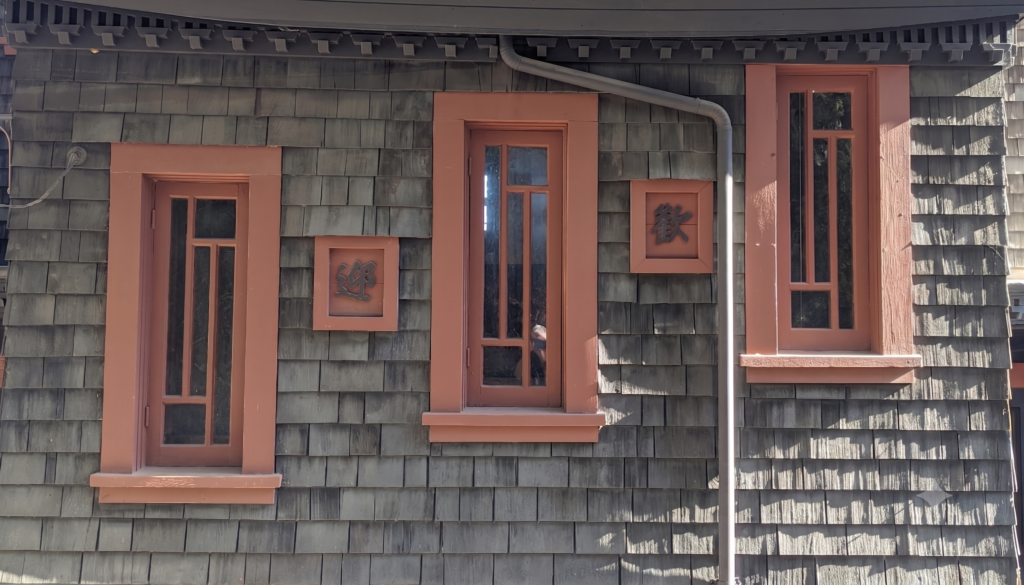
Together, the characters say:
歡迎
Huān yíng
Welcome
The character on the viewer’s right is 歡, pronounced huān. It conveys joy, pleasure or gladness. The character on the left is 迎, pronounced yíng. It means to meet, greet or receive someone who is arriving.
The two plaques are read from right to left, so 歡 comes before 迎. This follows the traditional Chinese arrangement in which written columns proceed from the right side toward the left. (The Metropolitan Museum of Art)
Taken literally, 歡迎 means more than the single English word “welcome.” It expresses the idea of greeting someone gladly or receiving someone with pleasure. Taiwan’s Ministry of Education dictionary defines the word first as happily greeting someone who has arrived. It also records the later and broader meaning of sincerely hoping for or willingly accepting something. (Revised Mandarin Chinese Dictionary)
The Historic Survey Identified the Message
The plaques were specifically documented in the 1979 Historic American Buildings Survey of Yung See San Fong, prepared as part of a Santa Clara County recording project conducted in cooperation with the National Park Service.
The survey describes the windows and plaques in unmistakable terms:
“Between each of the windows of the stair landing, there are plaques with Chinese characters which bid a welcome to guests.”
The description exactly matches the surviving arrangement. Three narrow windows are separated by two square plaques, with 歡 on the right and 迎 on the left.
The survey places the plaques within a larger decorative program. It describes the flared roof above the stair landing, the Chinese-style frieze beneath its eaves and the Chinese-patterned windows. Elsewhere in the house, carved panels, fretwork, furnishings and inscriptions continued the theme.
The National Park Service describes Yung See San Fong as a combination of Chinese-inspired decorative motifs and roof forms with a Western floor plan and massing. The house was completed in 1917 for the writer Ruth Comfort Mitchell Young and her husband, Sanborn Young, who later served in the California State Senate. (National Park Service)
The HABS report also connects the design of the house with Ruth’s Chinese-set play, The Sweetmeat Game. It states that the successful play opened in New York in 1916 and helped inspire her decision to combine what she understood as Eastern tastes and traditions with her own ideas of beauty and comfort.
The 1979 survey proves that the plaques were present and understood as a welcome by that date. It does not, by itself, prove that they were installed when the house was completed in 1917. Their integration into the stair-landing windows and surrounding architectural trim makes an original or early installation seem likely, but that should remain a probability unless an early photograph, construction record or contemporary description is found.
An Ancient Expression of Welcome
Although 歡迎 is familiar on modern signs, it is not a recently invented expression. The word has a documented literary history extending back more than fifteen centuries.
One of its best-known early appearances is in Tao Yuanming’s Return Home, traditionally known as the Guiqulai Ci or Return Home Rhapsody. Tao wrote of approaching his home after leaving government service:
僮僕歡迎,稚子候門
A natural translation is:
“The servants welcome me joyfully, while the young children wait at the gate.”
In this passage, the characters retain their almost literal meanings. 歡 supplies the happiness and 迎 supplies the act of coming forward to greet someone. The scene is not a formal ceremony. It is the intimate welcome of a household receiving someone home. (Chinese Text Project)
That makes the passage particularly relevant to the plaques at Yung See San Fong. Both use 歡迎 at the threshold of a home. The word does not merely announce that a visitor is permitted to enter. It says that the visitor’s arrival brings pleasure.
A Public Welcome in the Old Book of Tang
The same expression appears in the Old Book of Tang in the biography of the respected official Pei Huaigu:
吏人聞懷古還,老幼相攜,郊野歡迎
The passage relates that when the officials and people heard Pei Huaigu was returning, the old and young accompanied one another into the countryside to welcome him.
Here, 歡迎 describes a public reception rather than a private homecoming. People went out to meet an arriving official because they were pleased by his return. The essential meaning nevertheless remained the same. It was a greeting motivated by happiness at someone’s arrival. (Revised Mandarin Chinese Dictionary)
From Greeting a Person to Welcoming an Idea
Over time, 歡迎 acquired a broader meaning. It could describe not only greeting a person but also receiving an idea, proposal, contribution or opportunity favorably.
The Ministry of Education dictionary illustrates this meaning with expressions equivalent to “visitors are welcome” and “submissions are welcome.” It also cites the late Qing novel Lengyan Guan, or Observations Through Cold Eyes, in which the word refers to a person receiving an unusually favorable social reception. (Revised Mandarin Chinese Dictionary)
These examples show the development of a word that began with the physical act of going forward happily to meet someone. It eventually came to express acceptance and favorable reception more generally. The older meaning, however, remains embedded in the characters themselves.
More Than an Ornament
At Yung See San Fong, 歡迎 is not hidden inside the house or placed where only a scholar might notice it. The characters are displayed prominently between the windows, facing outward toward approaching visitors.
They therefore function as architecture as well as language. The windows illuminate the stair landing, the roof and frieze establish the Chinese-inspired design, and the two plaques give the composition a human message:
You are not merely allowed here. You are received gladly.
That message would have been appropriate for a house known for entertaining. The Historic American Buildings Survey describes Yung See San Fong as a gathering place visited by literary, political and entertainment figures. It records connections with President Herbert Hoover, California Governor William D. Stephens, Senator James D. Phelan, writer Robert W. Service and actors Joan and Constance Bennett.
Whether those particular visitors noticed or understood the characters is unknown. Nevertheless, each would have passed beneath a building whose exterior had already addressed them.
The Meaning Today
More than a century after the house was built, the plaques still perform their original purpose. Their paint has weathered, and the wooden shingles around them reveal the passage of time, but the message remains clear:
歡迎
Welcome.
Or, in the fuller spirit of the Chinese expression: