Somewhere between a Los Gatos estate sale and the present day, an entire artistic life disappeared. As the owner of the Yung See San Fong house, I’ve done some research on the Youngs, and the saddest thing for me is losing a bit of the Senator’s artistic side.
When the Historic American Buildings Survey documented the Young house in the foothills above Los Gatos in 1979, its report recorded a quiet catastrophe in a single line: a photograph album that had remained at the home “has disappeared.” After William Sanborn Young died in 1964, relatives held a house sale, and the possessions of one of Santa Clara Valley’s most consequential couples were scattered to strangers. No one wrote down who bought what. Today, not a single photograph anywhere online can be confidently identified as his work.
That would be an ordinary loss for an ordinary hobbyist. Sanborn Young was neither.
The senator who studied light
California remembers Sanborn Young (1873–1964) as a public man: the gentleman rancher who won a State Senate seat in 1924 on a platform of water conservation, child welfare, and women’s equality in public life, and who became one of the state’s most influential voices on narcotics policy. His wife, the author Ruth Comfort Mitchell Young, remains a fixture of California literary history. Their home above Los Gatos was a landmark of the valley’s cultural life.
What almost nobody remembers is that before Sacramento, Sanborn Young was a serious artist — a trained, exhibiting Pictorialist photographer working at the very center of the movement that fought to have photography accepted as fine art.
The evidence is contemporary and unambiguous. After marrying Ruth in October 1914, the couple moved to New York, where Young took up formal study of photography. In the summer of 1915 he enrolled at the Seguinland School of Photography in Maine — the summer school run by Clarence H. White, one of the founding figures of American art photography, whose students included some of the most important photographers of the twentieth century. Princeton University’s surviving class album from that 1915 session lists William Sanborn Young by name.
He learned quickly. By December 1915, “Young, Sanborn. American” appeared among the exhibitors in An Exhibition of Pictorial Photography at the Print Gallery in New York — a genuine juried showing in the country’s most competitive photographic city, barely a year after he had begun.
A California exhibition, and a reputation
The fullest surviving glimpse of his work comes from March 1919, when the California Camera Club in San Francisco hung what Camera Craft magazine called a “large and interesting collection of prints” by Young. The show included landscapes and portraits, with an unusually large number made by the gum-bichromate process — a demanding, painterly technique in which the photographer brushes light-sensitive pigment onto paper by hand, producing prints that shimmer somewhere between photograph and watercolor. It was the signature medium of the Pictorialist elite, and Young had made it his own.
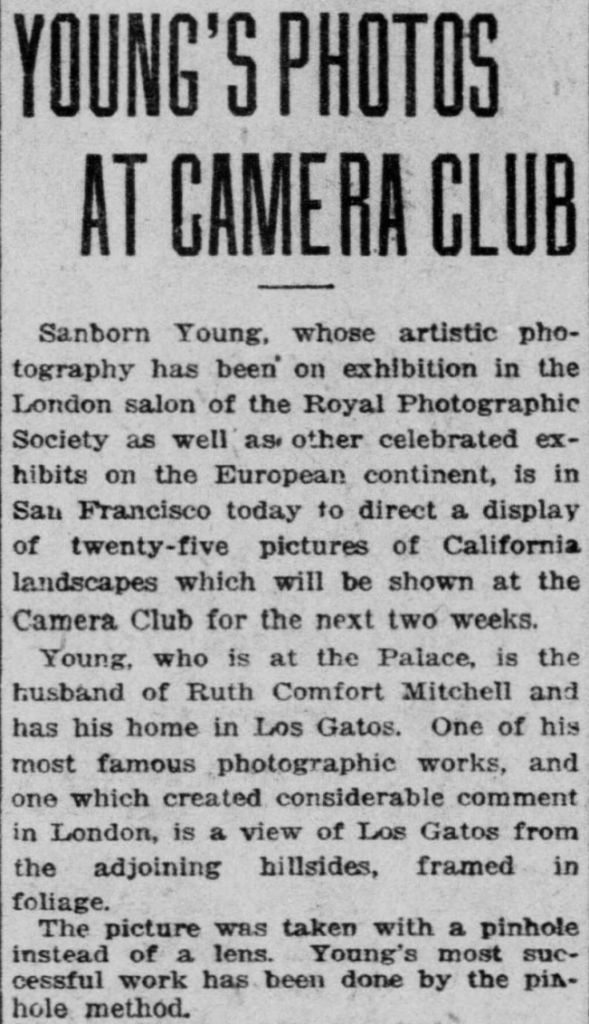
The same report identified him as a member of the Pittsburgh Salon, one of the most respected exhibiting societies in American photography. Family tradition adds that he showed in London as well. That claim remains plausible but unproven — the London Salon drew heavy American participation in those years, and the annuals that summarized its walls reproduced only a fraction of what hung there. His name has not yet been found in a London catalog; neither has his absence been established.
Then, sometime after 1919, the trail goes quiet. Politics absorbed him. The camera work that had carried him from a Maine summer school to New York gallery walls faded into the background of a public career — and after his death, into oblivion.
The shape of the mystery
Here is what makes the loss so strange: we know the photographs existed. We know some were good enough for New York and San Francisco exhibition walls. We know there were many of them — a “large collection” in 1919 alone. And we cannot currently point to even one.
The prints have not necessarily been destroyed. They may simply be unrecognized. The most tantalizing possibility surfaced in September 2025, when the Library of Congress acquired the historic collection of the Photographic Section of the Academy of Science and Art of Pittsburgh — roughly 700 exhibition prints from the very salons Young belonged to, along with a complete run of salon catalogs, much of it not yet cataloged item by item. A print signed “Sanborn Young” or “W. S. Young,” or bearing a Los Gatos address on its mount, could be sitting in those boxes now.
Other doors remain half-open. The Amon Carter Museum in Fort Worth holds the catalog of the December 1915 Print Gallery exhibition — which may record the title, process, and dimensions of at least one Young photograph, even if the print itself is gone — along with London Salon catalogs that could finally settle the London question. UCLA’s special collections hold two boxes of exhibition catalogs spanning the exact years of his career. The George Eastman Museum holds a copy of that same 1915 catalog. Princeton holds the Clarence H. White collection, including material from the 1915 Seguinland session, where unattributed student prints may yet carry his hand. And at UC Santa Barbara, the Ruth Comfort Mitchell papers hold uncataloged family photographs and scrapbooks from precisely the years he was working — any one of which might bear his signature, his handwriting, or his stamp: the Rosetta Stone that would let researchers recognize his exhibition prints wherever they surface. I haven’t been there yet, but I will in the future.
There are false trails, too. Newspaper photographs of Senator Young are not photographs by him. The HABS pictures of his house carry his name only because it was his house. Antique prints marked “N. C. Sanborn” or “F. P. Sanborn” belong to other people entirely. Even his name conspires against recovery: catalogs and scanning software render him variously as Sanborn Young, W. Sanborn Young, W. S. Young, and — thanks to a common OCR error — “Sanbom” Young. I have a photo of Ruth from the Mercury News, taken around 1918 during their interview with her, sitting in our living room. I think the name on the photo is “Young,” but I am unsure, as it seems to first say “CHAS S. YOUNG.”
What was lost
It is a peculiarly sad ending for a man who spent his public life on preservation — of watersheds, of children, of people struggling with addiction. He helped shape the California that came after him, and California, in return, misplaced the part of him that was most personally his: the landscapes he composed, the portraits he coaxed out of pigment and sunlight, the painterly gum prints that a San Francisco gallery once thought worth a wall.
Somewhere — in a Library of Congress box, a Pittsburgh catalog, a Santa Barbara scrapbook, a family album sold for pocket change at a 1960s house sale — Sanborn Young’s photographs may still exist, waiting for someone to turn a print over and read the name on the back. If somebody you know in the area has a box of photos that say “Sanborn,” please let me know. The house is large, with a lot of nooks and crannies, but it has been empty several times. While I got a large box of scraps and maps, I’ve never seen one of his photos.
Until then, one of early California photography’s genuine participants remains a ghost in his own archive: fully documented, and entirely invisible. A state senator that had an artist touch that has been lost.
Update
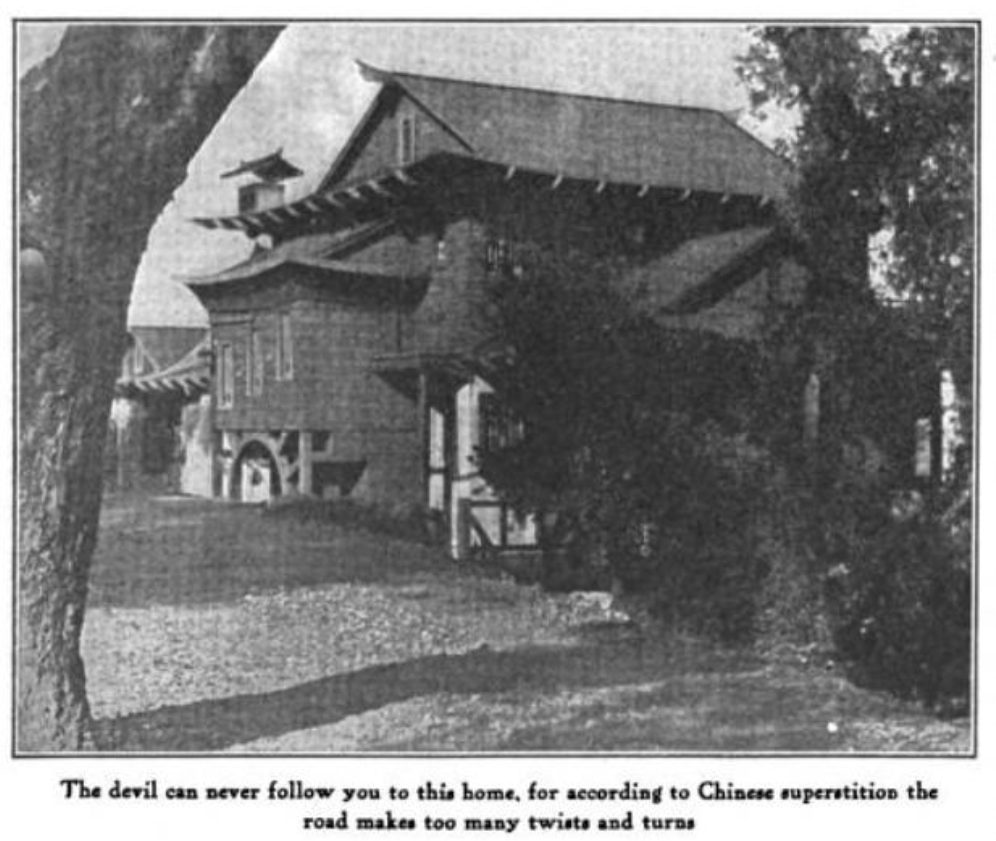
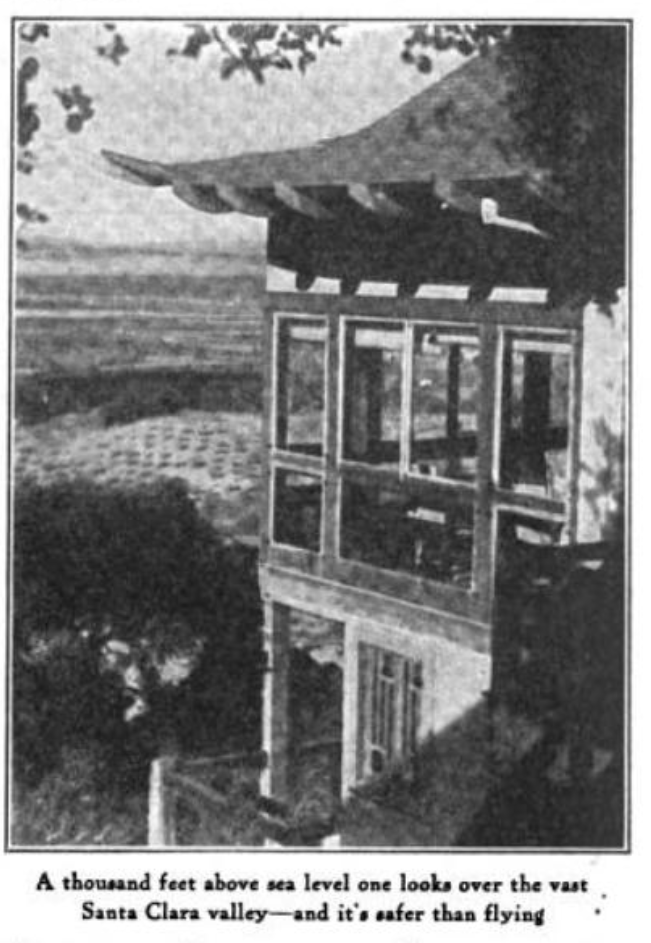
In 1918, Sunset magazine featured the house in a descriptive article. We just noticed that the author stated that the photos of the house were by Sanborn, so perhaps the only known photos are from a 1918 magazine. These are below.