Sanborn’s Last Stand
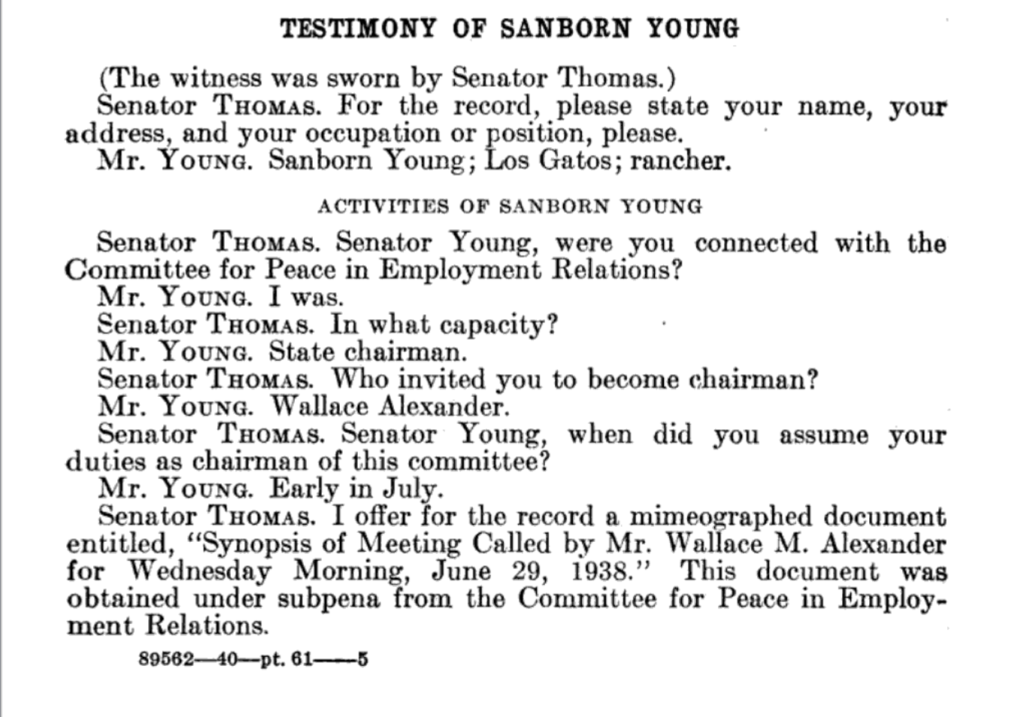
The page above comes from Violations of Free Speech and Rights of Labor, the immense United States Senate investigation that reached California after the political battles of 1938. Buried in its thousands of pages is something unusually valuable to the history of Yung See San Fong: Sanborn Young, near the end of his public career, sitting under oath while senators and investigators questioned him about the cause on which he had just spent the last of his political capital.
Recently a friend (Jack) came by. Jack majored in Political Science, and talk of politics filled the house, which was what belong in the house because it was a hotbed of political activity. So a modern meeting caused me to document lessons from almost 100 years ago. There is nothing new, and we forget the lessons of the past.
The depression was tough. Many had concerns over the economy, and none more than the Senator conviciton that the economy of California was on the road to ruin, which caused him to give up his Senate Seat and take on the chairmanship of Prop 1 that would stop the strikes destroying the economy during the depression. What followed was a series of mistep and over aggressiveness that resulted in a plan going bad.
It’s a message that the best solutions are not one party getting everything you want, and you must always address human misery in your plan.
This was a tough pill to swallow. His fourteen years in the California Senate were over. Proposition 1, the labor initiative he had chosen to lead instead of seeking another term, had been defeated. Now his correspondence was being read back to him and he was being asked why he had done it. For all the accusations surrounding the campaign, Sanborn does not appear in these pages as a man trying to run away from his decisions. He explains them.
The hearing should not be mistaken for a neutral camera that happened to be pointed at California. The committee had been built for a purpose. The Senate itself describes the La Follette Civil Liberties Committee’s work as an investigation of antiunion practices. Its chairman, Robert M. La Follette Jr., was a Wisconsin Progressive rather than a Democrat, so calling the inquiry simply a Democratic hit job would distort the history. But calling it politically neutral would distort it in the other direction. Historian Laura Weinrib has shown that prominent ACLU figures were instrumental in engineering the inquiry, that many committee staffers came from the National Labor Relations Board, and that the committee increasingly confined its investigation of civil liberties to labor relations. Its underlying premise was that the ability of workers to organize and bargain collectively was itself a civil liberty deserving affirmative government protection.
What is striking, pun intended, especially to a reader accustomed to the theatrical combat of modern congressional hearings, is the restraint with which that purpose was pursued. The committee knew perfectly well that it had opponents and consciously worried about appearing partisan. One staff instruction warned investigators away from addressing union meetings because doing so would damage the committee’s credibility. Weinrib describes an organization intent on preserving an “air of impartiality” even while pursuing a clearly defined conception of labor rights. The questioning of Sanborn has that character. Documents are produced, dates established, letters identified, and his own words placed before him. The committee was trying to build a case, but it wanted the case to rest on a record.
That is precisely why the testimony is so useful now. It lets us look past the slogans surrounding Proposition 1 and ask what Sanborn himself believed he was defending.
His answer begins with a fact so ordinary that it is easy to overlook: fruit rots.
More than this, if you visit the Yung See San Fong house, you will see an an incredible piece of hand dug work what looks like a miniature dam wall holding back an enormous embankment so that the free flow of water from a spring can come through. Mitchell family had given this piece of property to Ruth and Sanborn Young as a wedding gift. From the very moment that the property was constructed, there was a pressurized water system that fed the house.The tank is so large that the house was constructed around it. In today’s world, doing a project like this would be a massive undertaking, but with modern tools and things like that, it probably could be accomplished in months.
I suspect that if we take a look at the size and scale and everything that must have been in the hill before they even considered putting in a pressurized tank to build a house around in 1916, that the spring must have been in full, optimal and serviceable shape somewhere closer to 1910. This turns out to be important because at this time period in the surrounding hills of Los Gatos, it was not the oak trees that we see today. What it was was mile upon mile of prune or plum orchards. And we know by the time the Senator and Ruth moved into the House, they sold water to all of the orchards around the house as an income stream. While the senator had the title of being a rancher from a place far away from his main house, in reality, he knew fruit like the back of his hand because he sold every single year his water to all the farmers that lived underneath his house. And he knew that if the fruit rotted, all of those people would be devastated.
California had constructed one of the world’s most remarkable agricultural systems around crops that could not wait. The state’s “California Model” joined irrigation, specialized farms, packing houses, transportation, refrigeration, finance and distant markets into a system capable of moving enormous quantities of high-value produce across the country and overseas. By the 1930s California agriculture was increasingly distinguished by fruits, vegetables and other specialty crops whose value depended upon harvesting and moving them at the proper moment. A factory could stop during a labor dispute and manufacture its product after the strike ended. An orchard did not have that option. The peach continued to ripen. The grape stayed on the vine. The lettuce remained in the field. Once the harvest window closed, a considerable part of the value could disappear with it.
For a grower, the harvest therefore represented the end of a financial chain that had begun months earlier. Land had been cultivated, trees pruned, water purchased or pumped, equipment maintained, loans carried and labor hired before the crop produced income. In the Depression those calculations became even more precarious. Farm prices had collapsed, credit mattered enormously, and California’s agricultural economy connected growers to canneries, packing sheds, railroads, banks and the businesses of the towns around them. A strike timed to the harvest was effective for exactly the same reason it was terrifying to the grower: there was a clock running that neither side could stop. Sanborn understood that arithmetic, and his surviving speeches show that he came to see the repeated labor conflicts not merely as disputes over wages but as a threat capable of moving outward from one field into the larger California economy.
He and Ruth were not detached from that world due to the water they sold every year. This was the real understanding they had. The fruit orchards were right next door and completely visible from their living room, dining room, bedrooms and virtually every single room in their house. This is where he spent all his time, sold water, and saw these trees every single day. He loved to talk and ride his horse along these roads, and I am sure that a large reason was his friends and neighbors were telling him that a strike would ruin their lives.
However, marketing existed in the 1930s, and he never mentioned what we know from his house. He was not positioned as the Senator with the Orchards by his house. He was positioned as the Senator rancher. Something that Ruth later stated never created a cent for them and was not a good investment. They had bought ranch land in Fresno County in 1926, a fact that helped place them personally inside the agricultural economy Sanborn defended. I believe they bought this place to market the rough and tumble life of Ruth Comfort Mitchell as the author of a novel every year as this was the peak of her image as the rough and tumble country girl. As often in life, what is marketing and real versus the story you hear is different.
From his point of view, the grower facing a harvest strike was not necessarily a caricatured baron sitting comfortably behind a desk. He might be someone who had borrowed against a crop and had perhaps ten days to get it picked and sold.
Sanborn stated the economic cost of California strikes exceeded the cost of state government and relief combined. A labor dispute involving a highly perishable crop really could destroy an extraordinary amount of value in a very short time.
This is the part of Sanborn’s argument that deserves more sympathy than it generally receives. He was not wrong to recognize the danger. The failure came in the distance between recognizing the danger and deciding how much power government should use to eliminate it.
In 1938 Sanborn chose not to seek another Senate term and instead became the working statewide chairman of the campaign for Proposition 1. The initiative was presented as a way to restore order to labor relations, and some of what it prohibited was easy to defend: seizure of private property, intimidation, obstruction of roads and interference with access. But Proposition 1 was not confined to violence or occupation. Its twenty-six sections reached into picketing, boycotts and other forms of concerted economic pressure. The California Supreme Court’s pre-election description makes clear how extensive the measure was. Workers could still strike, but the state would sharply define the surrounding methods by which organized labor could make that strike economically effective.
That was Sanborn’s overreach. He saw a perishable crop being used as leverage and wanted to protect the productive system from destruction. But Proposition 1 tried to settle much more of the labor question than the public was prepared to surrender to one initiative. Sanborn and his allies were asking voters to distinguish between the right of workers to withhold their own labor and the broader ability of a union to exert pressure on customers, neutral businesses, transportation and other workers. Organized labor had a much simpler answer: the powers Sanborn proposed to restrict were precisely what made collective action meaningful.
The timing could hardly have been worse. Californians going to the polls in November 1938 were not comfortably looking backward at the Great Depression. They had just experienced the frightening recession of 1937 and 1938, when real GDP dropped about 10 percent and unemployment returned to roughly 20 percent. The larger Depression would not end until the wartime economy. Millions of people had therefore lived through almost a decade in which banks had failed, savings had disappeared, unemployment had become a mass condition and old age could mean genuine destitution.
The New Deal had changed what those people expected from government. It had not ended their anxiety, but it had encouraged the belief that public policy could do something about it. California showed how strong that belief remained when voters elected Culbert Olson governor in the very election in which they rejected Proposition 1. Olson was an open supporter of Roosevelt’s New Deal, and in his inaugural address he spoke of the failure of the old economic order, defended collective bargaining and called for a broader government role in providing economic security.
Sanborn was therefore trying to persuade an electorate still frightened by economic helplessness that one of its urgent problems was the excessive power of organized workers. Many voters were looking at the same economy from the opposite end. Their questions were more immediate: Would I have a job next month? What happens if I get sick? What happens when I am fifty-five or sixty and nobody wants to hire me? How do I live if my savings are gone?
Out of that anxiety came one of the strangest political movements in California history, Ham and Eggs. Its name concealed a serious mass movement for old-age income security. The proposal promised “$30 Every Thursday” to qualifying unemployed Californians over fifty through a system of state-issued warrants. Its economics were questionable and its leadership often controversial, but those weaknesses did remarkably little to diminish the appeal. The Social Security Administration estimates that the movement had more than 300,000 members and many additional supporters. In 1938, 1,143,670 Californians voted for its proposal. The Social Security Administration points to the movement’s extraordinary popularity as evidence of just how hungry Californians were for some answer to insecurity in old age.
That political force entered the Proposition 1 fight on labor’s side. This is one of the more easily overlooked reasons Sanborn lost. Ham and Eggs did not have to turn its members into experts on secondary boycotts or the fine distinctions of picketing law. It only had to place Proposition 1 inside the emotional world its supporters already inhabited. Organized labor was saying that workers had finally acquired some ability to defend themselves and should not have it taken away. Ham and Eggs was saying that older Americans still had nowhere near enough economic protection. Sanborn was asking both groups to worry that organized workers had acquired too much leverage. In the political atmosphere of 1938, the first two arguments fit together more naturally than the third.
Sanborn had understood the importance of mass politics. His own campaign correspondence shows him deliberately proposing that agricultural organizations be brought to the front while the leaders of business and industry moved to a “less conspicuous place.” Asked later why, he explained the electoral arithmetic with remarkable candor: agriculture represented a huge aggregate of voters, and the campaign needed them. He thought that if Californians could see the farmer facing the destruction of his crop, they would understand Proposition 1 in human rather than corporate terms.
The opposition found a larger human constituency. Union members feared losing collective power. Pension activists feared old-age poverty. The unemployed feared that the recovery could disappear again. New Dealers believed government had only recently begun building protections against economic catastrophe. Sanborn was warning them about what a strike could do to a farm. Many of them were still consumed by what the economic system could do to a family. Proposition 1 went down by roughly 58 percent to 42 percent.
Five months later, John Steinbeck published The Grapes of Wrath.
The chronology matters. Steinbeck’s novel did not defeat Proposition 1. The election was already over. Nor did Democratic politicians invent Steinbeck’s concern for migrant labor. His Harvest Gypsies newspaper series had appeared in October 1936, and by the end of that year he already knew that the migrants’ story would become his next major book. He went into the camps, observed real poverty and found conditions that should disturb anyone who reads about them. When The Grapes of Wrath appeared on April 14, 1939, it sold more than 83,000 copies in its first month and almost immediately became something larger than a novel.
Steinbeck was brilliant because he could do what a Senate report, a farm ledger and an economic argument could not. He could make suffering particular. The growers could explain the crop loan, the harvest window and the financial chain that depended upon getting fruit to market. Steinbeck gave America the Joads. That did not make the growers’ economic problem imaginary, but it changed the moral scale on which the public weighed it. A discussion of secondary boycotts had little emotional chance against a hungry family living beside the road.
This is where Steinbeck became enormously useful to the political side that had just won the argument over Proposition 1. Not because Democrats controlled what he wrote, and not because he was secretly taking instructions from a party. There is no evidence for that. But once The Grapes of Wrath entered public life, the novel became a political object that other people could use. Eleanor Roosevelt praised it. Franklin Roosevelt referred publicly to the conditions surrounding the migrant controversy. Labor sponsored “Grapes of Wrath Players” who toured the West and Southwest. Newspapers, politicians and reformers spoke of the fictional Joad family almost as though the Joads were actual witnesses before the country. American Heritage’s history of the controversy shows how completely the novel entered the political battle surrounding California agriculture.
If we use the chess metaphor, Steinbeck was not a pawn when he wrote the book. He became a piece once the book was placed on the board. The political players did not create his talent or manufacture the misery he had found. What they could do was move the immense moral authority of his story into a larger argument about labor, poverty, growers and the New Deal. The Library of Congress credits The Grapes of Wrath with helping ignite pressure in Congress for legislation benefiting farmworkers. That is the extraordinary power of a successful cultural narrative: it can escape the intentions of its creator and begin doing political work of its own.
The timing could hardly have been more punishing for Sanborn’s side. Proposition 1 had just lost. Culbert Olson had just brought the New Deal coalition into the governor’s office. Carey McWilliams soon published Factories in the Field, an indictment of California agribusiness that appeared only months after Steinbeck’s novel. Contemporary conservatives sometimes imagined coordination between the two books, but the evidence shows that Steinbeck and McWilliams barely knew one another and their works were independently produced. Yet, as the American Heritage account observes, the two books fit together almost perfectly. Steinbeck supplied the unforgettable human story. McWilliams supplied the structural accusation.
Then the La Follette investigation arrived with the authority of the United States Senate. It subpoenaed correspondence, reconstructed employer organizations and exposed the machinery behind antiunion campaigns. Much of what it found was real and ugly. California farmworkers had endured poverty, intimidation, violence and living conditions that no honest history should minimize. The committee was not wrong because it had deliberately chosen to investigate that side of the struggle. Steinbeck was not wrong because he had deliberately chosen to look at the people near the bottom of it. Their power came precisely from the fact that they found things that were true.
What disappeared was proportion.
The farmer with the rotting crop was real too. The grower carrying a bank loan was real. So was the dependence of packing houses, transportation and agricultural towns upon a successful harvest. There were large corporate growers with enormous power, but there were also smaller farmers whose margins were thin and whose entire year could stand exposed in a field. Sanborn became so focused on the destructive potential of labor power that his surviving campaign material gives remarkably little attention to the wages, camps, hunger and health of the workers themselves. That was a serious blind spot. But it is different from evidence that he or Ruth knew the suffering was fictitious or secretly wished to conceal it.
Ruth’s later answer to Steinbeck, Of Human Kindness, arose from that same collision of perspectives. She believed the California she knew contained kindness, local assistance, government relief and farmers who were being flattened into villains by a national narrative built around the worst parts of the agricultural system. Steinbeck had made one truth impossible to ignore. Ruth tried to restore another. Neither picture was complete.
History then did something inconvenient to anyone who wants this to be a simple story about Sanborn being proved wrong. California voters rejected his broad Proposition 1 in 1938, but four years later they approved a much narrower law prohibiting “hot cargo” and secondary boycotts by 55.3 percent to 44.7 percent. Then, in 1947, Congress enacted the Taft-Hartley Act nationally. It was not Proposition 1 reborn, but one of its central principles had moved into federal labor law: unions could possess a legitimate right to organize and bargain collectively while still being legally restrained from using certain forms of secondary economic pressure against people outside the primary dispute.
That later history changes the meaning of Sanborn’s defeat. He had not imagined the problem. America eventually decided that organized labor could overreach and that some limits were necessary. What Sanborn and his allies misjudged was the breadth of the remedy and the political moment in which they tried to impose it. In 1938, with unemployment again near 20 percent, with the New Deal still representing hope to millions, and with more than a million Californians willing to vote for the extraordinary Ham and Eggs pension experiment, the center of the electorate was not ready to be told that ordinary people had accumulated too much economic power.
That may be the clearest lesson in Sanborn Young’s last stand. He saw a real danger and allowed the reality of that danger to persuade him that the public would follow him as far as he believed necessary to stop it. The voters would not. They were living with a different fear, and successful politics rarely permits a movement to forget what the people in the center are afraid of.
The same period taught politicians another lesson. Old-age insecurity was not a marginal concern that could safely be dismissed. Ham and Eggs itself faded, but Social Security grew into one of the central commitments of American government. Generations of politicians in both parties learned to approach the economic security of older voters with extraordinary caution. At the same time, the country eventually accepted restraints on some of the union practices that Sanborn had been trying to curb. The durable political settlement did not wholly vindicate either camp. It moved toward protection and restraint.
Political cycles repeat themselves in that way. A genuine injustice produces a correction. The correction creates new institutions and new power. Someone eventually sees damage being produced by that power and demands another correction. The danger comes when certainty about one genuine problem blinds a movement to the anxiety that still governs everyone else.
That is why the old Senate page seems worth putting at the beginning of this story. It is not the final judgment on Sanborn Young. It is an unusually clear window into his mind at the end of his career. The investigation itself had been engineered to expose one side of the labor struggle, although it pursued that purpose with a documentary restraint that makes its record immensely valuable. Steinbeck then gave that same side of the struggle a human story of almost unmatched power. Neither the investigators nor the novelist invented the suffering they found. But neither suffering nor truth exists in politics without someone deciding what it means.
Sanborn saw fruit that could rot before a labor dispute was settled. Steinbeck saw families who could go hungry while an agricultural economy continued to function. Both were looking at California. Both saw something real. The political tragedy was that each truth made it easier for its champions to stop looking at the other.
From Yung See San Fong, nearly ninety years later, that feels less like a verdict on one senator than a warning about politics itself. Sanborn lost the vote. Steinbeck won the memory. The truth was larger than either of them, and the people in the center decided when each side had gone too far.