The Symbols Surrounding the House Name
In the first part of this story, we looked at the four Chinese characters placed above the fireplace:
楊氏山房
They identify the house as the Young family’s mountain retreat.
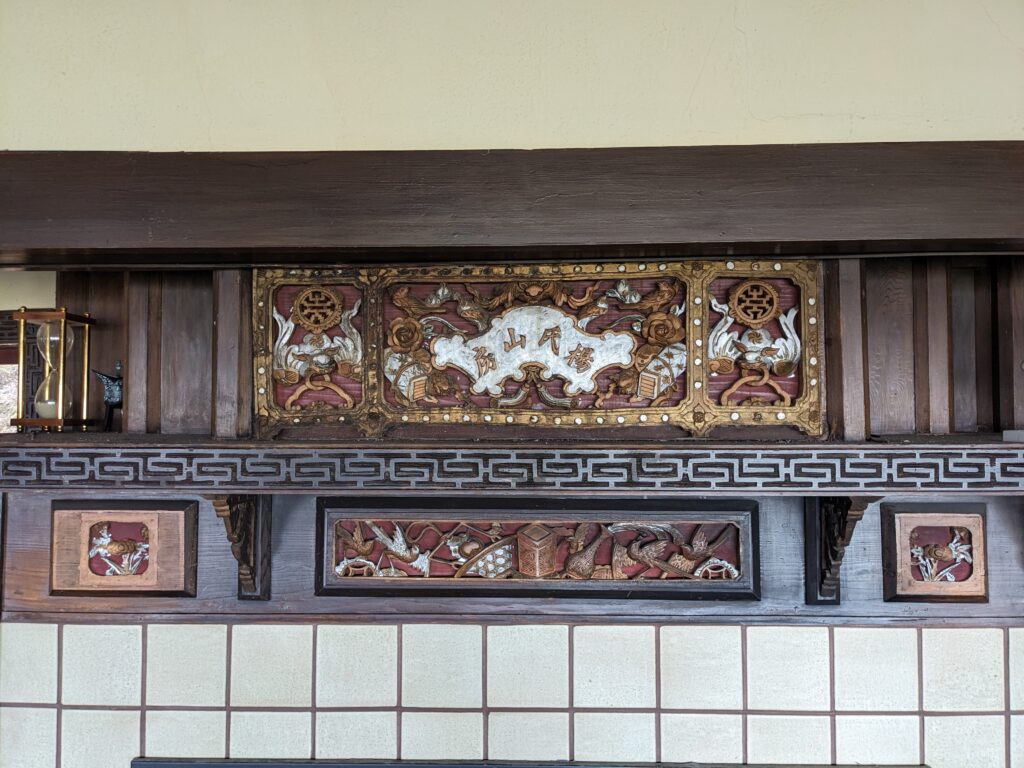
The larger view of the fireplace reveals that the inscription was never intended to stand alone. It sits at the center of an elaborate arrangement of animals, flowers, household objects and geometric patterns. Together, these symbols turn the name of the house into something more. They surround the Young family home with traditional wishes for good fortune, long life, prosperity and domestic harmony.
Longevity on Both Sides
The most obvious additional symbols are the two matching round medallions at the upper left and right.
Each contains a highly stylized form of the Chinese character:
壽
The character means longevity or long life.
It was frequently reshaped into circular and geometric designs for use in architecture, furniture, ceramics and textiles. Here, it appears twice, framing the house name from both sides.
The arrangement can almost be read visually as:
Longevity. The Young family’s mountain retreat. Longevity.
The repetition makes the wish feel protective, as though the home and the family within it are being enclosed by a blessing for a long life.
The Bats Mean Good Fortune
Directly beneath the longevity medallions are two winged animals. At first glance they might be mistaken for mythical creatures, but they appear to be stylized bats.
In Chinese decorative art, bats are among the most common symbols of good fortune. The reason is a play on words. The Chinese word for bat, 蝠, is pronounced fú. The word 福, meaning blessing, happiness or good fortune, is also pronounced fú.
Because the two words sound alike, the image of a bat became a visual way of expressing a wish for good fortune.
There also appears to be another bat at the top center of the panel, directly above the house name. Its position makes it seem as though good fortune is descending toward the home.
When bats and longevity symbols appear together, the meaning becomes especially clear:
Good fortune and long life.
Flowers and Prosperity
Large layered blossoms appear on both sides of the central inscription. They most closely resemble peonies, although the age and stylization of the carving make an exact identification difficult.
In Chinese art, the peony was associated with prosperity, honor, beauty and abundance. It was sometimes called the king of flowers.
If these are peonies, their placement beside the house name adds another wish to the composition. The home is not merely to endure. It is also meant to flourish.
Smaller flower panels appear at the lower left and right. These echo the larger blossoms above and help carry the same theme across the entire fireplace surround.
Paired Birds and the Life of the Household
Birds appear throughout the carving.
Several are perched among the branches and flowers in the upper panel. More birds fly across the long panel below. They are not carved with enough anatomical detail to identify every species confidently. They may represent swallows, magpies or generalized auspicious birds.
Their arrangement is more important than their exact species.
The birds in the upper panel appear in pairs. Paired birds often suggested companionship, marital harmony and a peaceful household. Birds among flowering branches could also represent spring, renewal and a home filled with life.
The result is a much softer and more domestic image than the bold house name at the center. The inscription identifies the place. The birds suggest the relationships and activity that give the place life.
The Objects in the Lower Panel
The long rectangular carving below the geometric band contains birds flying around an assortment of household and decorative objects.
Among them are what appear to be baskets, covered vessels, boxes, jars and containers. Some may represent valued antiques or scholars’ objects.
This type of arrangement resembles a Chinese decorative tradition often called the Hundred Antiques. The name did not require the artist to show one hundred objects. It referred more broadly to compositions of prized vessels, antiquities, books, flowers and objects associated with culture, learning and refinement.
The exact meaning of each object in this carving is difficult to establish from the photograph. Some may have been selected for symbolic reasons. Others may have been included because they created an attractive and balanced composition.
Taken together, however, they suggest a household of abundance and cultivated taste. They add the idea that this mountain retreat was not only a shelter, but also a place for art, learning and gracious living.
The Geometric Border
The long horizontal band between the upper inscription and the lower panel is not a line of writing.
It is a repeating geometric fret or meander pattern. Some sections resemble squared Chinese characters, especially the character 回, but the band functions as ornament rather than as a sentence.
The repeated pattern creates continuity. It visually connects the different panels and gives the fireplace surround a sense of order and structure.
It may also suggest continuity without end, although that interpretation should be treated cautiously. In this setting, its most certain purpose is architectural and decorative.
A Household Blessing Above the Hearth
The location of this carving is significant.
It is positioned above the fireplace, traditionally the gathering place and emotional center of an American home. The combination of a Chinese house name with bats, longevity symbols, flowers, birds and valued objects transforms the fireplace into a family statement.
The four central characters say:
The Young family’s mountain retreat.
The surrounding symbols add:
May this home be blessed with good fortune, long life, prosperity, companionship and abundance.
That combined message helps us understand the artwork as more than decorative carving. It is a nameplate, a family emblem and a household blessing.
It also adds another layer to the complicated cultural history of Yung See San Fong. The overall room reflects the early twentieth-century American fascination with an imagined and theatrical version of China. Yet many of the individual symbols appear to come from genuine and longstanding Chinese decorative traditions.
The result is a mixture of interpretation, adaptation and authentic symbolism.
At the center is the Young family name. Around it, the carving builds an entire vision of what the home was meant to be: a retreat in the hills where the family could live long, prosper and enjoy a harmonious life together.