“But isn’t it nice I don’t have to prove it for a long time to come!” The grandfather’s clock which had belonged to a Bob Lee Tenafee three generations earlier struck seven and she came swiftly to her point. “You know, Cousin ‘Gene, I’ve been thinking a lot about Nancy, lately.”
Ruth Comfort Mitchell, The Wishing Carpet (1926), written while she lived in this house
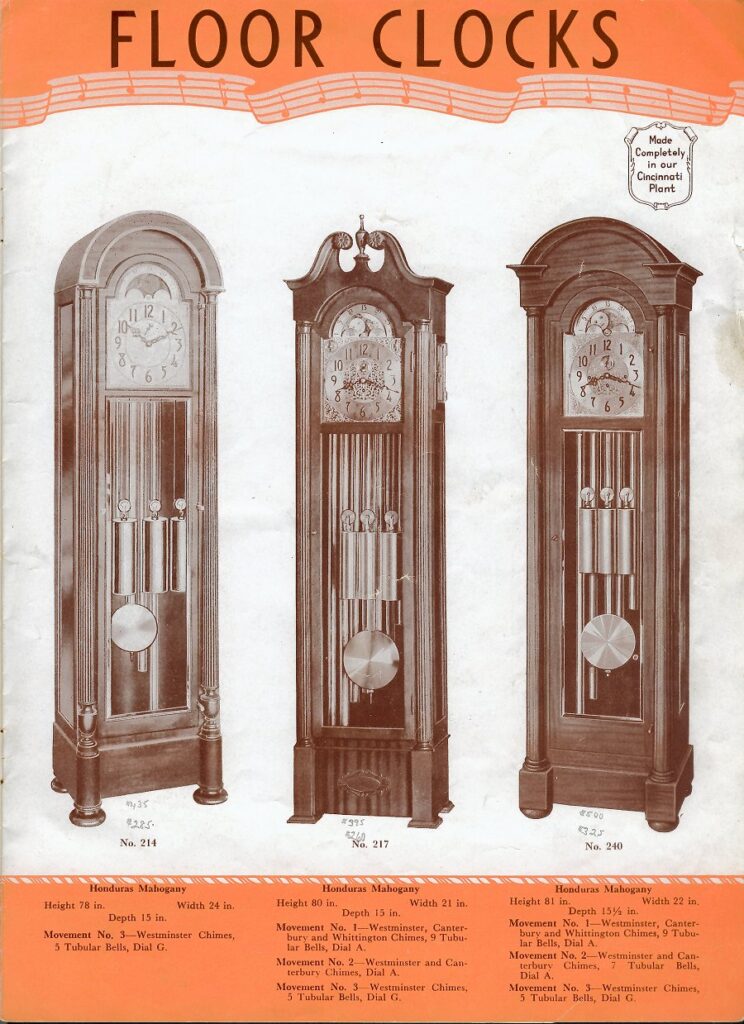
Catalog page 1936, Herschede Hall Clock, Model 217
Undoubtedly Ruth understood the importance of the clock in any household of distinction. In the novel, the grandfather clock presides over a gracious and hospitable family home, kept by Mary-Lou Tenafee, a charming young widow raising her small son. The clock holds its place in her late husband’s study, where guests are welcomed and entertained; it had belonged to a Bob Lee Tenafee three generations earlier. When Ruth needed to furnish a fictional household of standing, hospitality, and deep family roots, the grandfather clock is what she reached for, striking the hour just as the conversation turns to the family’s future.
Considering that she specifically talks about the sound of the clock and the chimes, it would be completely expected that this is something that she would have recognized from the household that she was trying to create in her own life. In her early novels, she described young women, who would have no need for something like a clock to center the home. But by the time she wrote this book, she had been setting up her own household. In this light, we can expect that Ruth and her husband Sanborn, would have expected that any grand house would have a grandfather clock.
Of all the clock makers, there was none so American as the Herschede company. And in this light, we have placed a wonderful example into the living room of the Yung See San Fong.
A Tribute to a Missing Piece
When the Youngs began this house in 1916, knowing the time was not simple. There was no radio and there were no electric clocks; time came secondhand, from the railroad, a telephone operator, or a watch set at the jeweler’s in town. Every fine household needed one clock good enough to be believed, and a precision hall clock was the proudest technology a living room could hold.
The Youngs’ own furnishings were sold and dispersed after the estate was settled. This clock stands in for that missing piece. In a house that was at once a writer’s workplace, a senator’s base, a working farm, and a stage for guests up to and including a president, the hall clock was the timekeeper of record. Accurate to about a minute a week, better than the watches set by it, and checked against the radio time signal, it chimed the quarter hours by which everything went out on time. It is not their clock, but it is true to their character and their time.
The Clock
Herschede Hall Clock Company of Cincinnati, Ohio: Model 217, a mahogany tubular-bell hall clock. Movement serial 437,834 dates it to 1947 (Murray/NAWCC serial chart), within the Youngs’ years here. The model itself belongs to their era: introduced in the early to mid-1930s and documented in Herschede’s 1936 catalog, it remained in production for nearly fifty years. (The collector’s name “Whittier” was added around 1963.) When new, a clock of this grade cost approximately the price of a new automobile.
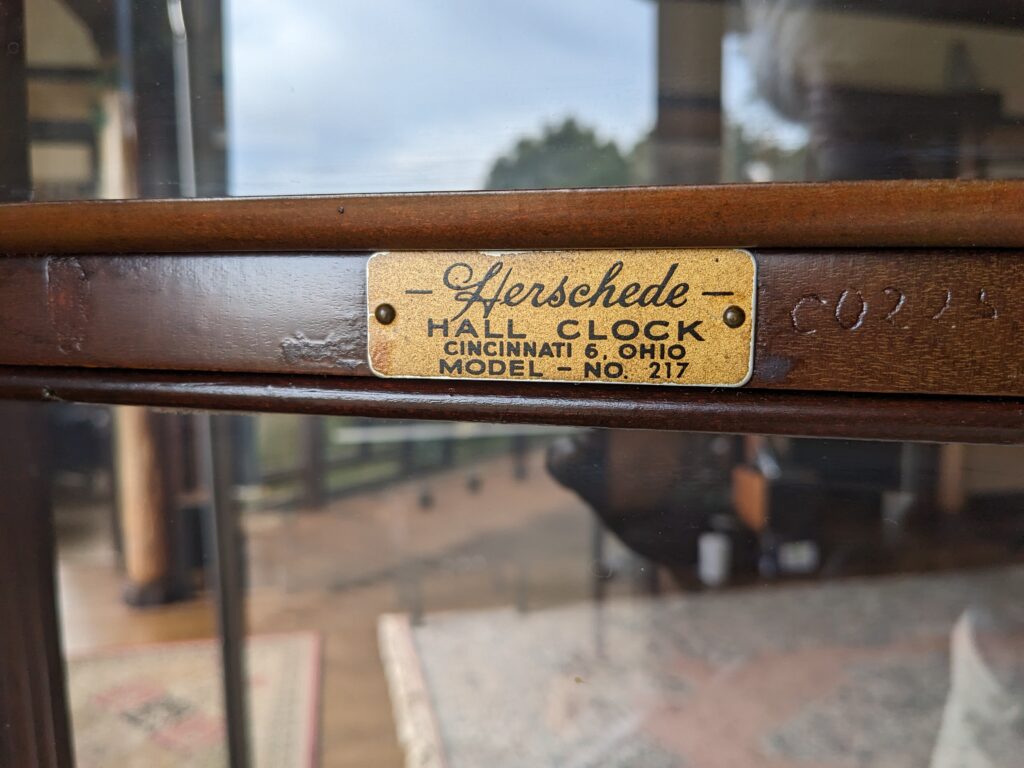
Herschede, founded 1877, was the finest American maker of chiming hall clocks, grand prize winner at the 1915 Panama-Pacific Exposition in San Francisco, and the only maker to build the entire instrument, case to chime, while competitors cased imported movements. The company left Cincinnati for Mississippi in 1960 and closed in 1984; this is a true Cincinnati Herschede, from the period collectors regard as its finest.