The Thousand-Gallon Tenant in My Basement
Every old house keeps something from a previous owner. Ours keeps a thousand gallons of the early twentieth century.
It sits in the basement, fourteen feet long and three and a half feet across, a riveted steel cylinder with the heft of cast iron and the patience of a glacier. It has outlived its usefulness, outlived the people who installed it, and will very likely outlive my attempts to figure out what to do with it. Someday we’ll solve that problem. For now, it stays, and honestly, once you know its story, you don’t mind it quite so much.
What it is
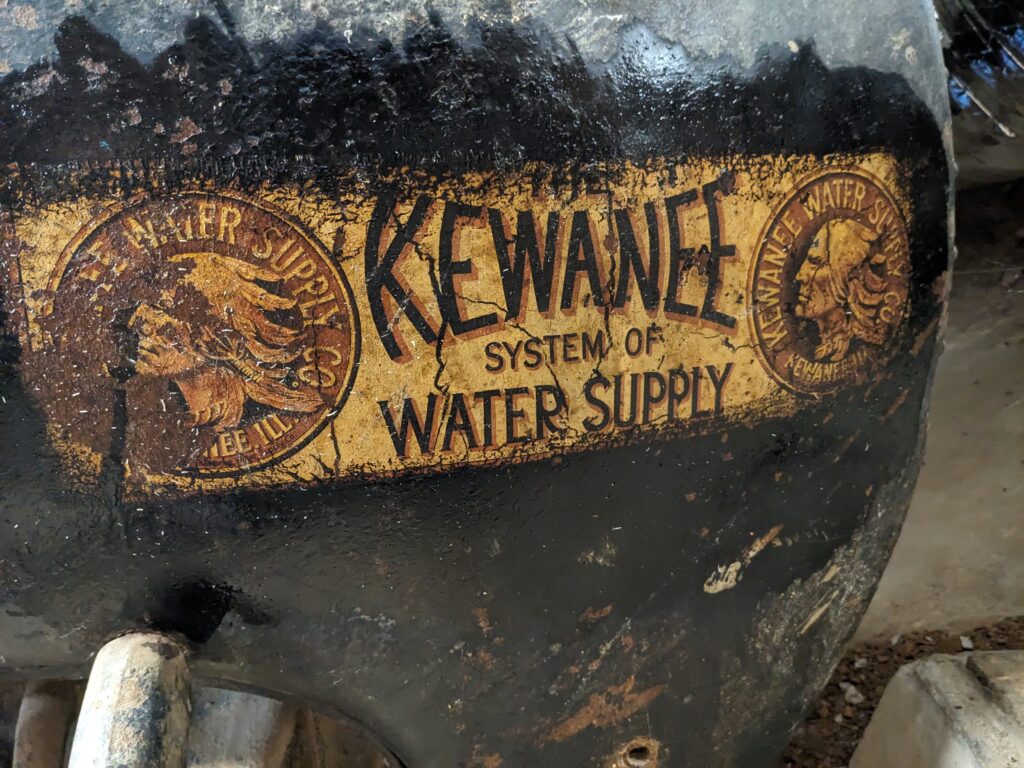
The black paint on its flank is cracked and flaking, but the original decal underneath is still legible: The Kewanee System of Water Supply, flanked by two medallions bearing an Indian-head profile, the “Indian Brand” trademark of the Kewanee Water Supply Co. of Kewanee, Illinois. The fine print on their period ads warned that this trademark “on all genuine Kewanee tanks and machinery protects the public and honest dealer.” Counterfeit water tanks were apparently a thing worth worrying about in 1916.
Kewanee billed itself as the maker of “the original air pressure water supply system,” and by the mid-1910s claimed over 20,000 systems in operation. Their ads promised country homeowners something radical: “private water supply plants that equal the best city service.” Compact. Durable. Dirt proof. Germ proof. And my favorite, almost fool proof.
Why it’s here
This is the part I find most touching. When the Youngs built their life up here on the hill, there was no city water and never would be. The choice at the time was between a wooden tank on a spindly tower (or in the attic) that leaked, froze in winter, went warm and stagnant in summer, and occasionally collapsed through the ceiling, or this: a sealed steel tank in the cellar, fed by a spring, delivering real pressure to real faucets, day and night, all year.

They chose independence. The Kewanee system was tied into the spring, and an electric pump pushed the water down into the tank. The pump is long gone, unbolted and carried off decades ago, leaving only its plumbing stubs behind. But the tank it fed never went anywhere. At a solid ton-plus of riveted steel, where exactly would it go?
How it worked
The engineering is elegant enough that I’ll forgive it for being immovable. A Kewanee tank is not just a water tank. It’s an air spring. The tank was never filled completely; the pump forced water and air into the sealed cylinder together, compressing an air cushion in the top of the tank. That trapped air did the work a forty-foot tower would otherwise do, pressing down on the water and pushing it up through the house plumbing at 60 to 75 pounds per square inch. Better pressure, the company liked to point out, than most city mains, and their larger systems were rated to 150 psi, “equal to a tower over 300 feet high.”
No tower to rot. Nothing exposed to freeze. Water at an even cellar temperature the year round. The ads said a Kewanee tank “will last indefinitely,” and the specimen in my basement is doing its best to prove the claim.
The construction shows its age beautifully: overlapping steel plates stitched together with rows of rivets, domed heads on each end, and near the bottom a small elliptical manhole, a plate held by heavy nuts on a yoke, sized so that a determined and skinny maintenance man could pass the cover through its own opening and, in theory, himself along with it. The cover seals from the inside, so the tank’s own pressure once held it shut tighter than any bolt.
John Had It Figured Out
By the way, an important contributor to the property is John and his wife Donna. I call them my property architects. They’re my people in California that are helping watch and come up with the future improvement roadmap for the property when I move out of state and give up control. John is an amazing combination of hands-on maker and artist. He spent many years in commercial HVAC, and he just understands how things are put together. I took John down to the basement and he started to run his hands over the tank. He found a couple tap holes, looked at it, and started to describe me what he believed was a series of gauge and water levels that would be installed on the tank to make the system useful. Now, mind you, John does not have a background in this particular item. Matter of fact, once City Water was put in, these systems were all but removed everywhere. But what I find absolutely fascinating is John’s description of what he saw in his mind’s eye as being the way the water tank must be laid out is actually in the following advertisement picture.
You can see in the line drawing a gauge sticking out of the front of the tank, and you can see a large tube in front of it. This is where you could actually see the water level. Even though these things had been removed for many years, John’s native capability was instantly able to predict how these things had been operated almost 100 years ago.

Why it’s still here
Beyond the obvious (it weighs as much my minivan and came into this basement before some of the walls did), there’s a modern complication: paint. Steel tanks of this era were protected with red lead primer, the gold standard of 1916 rust prevention, and any cutting or torching of that coating today is a genuine lead-safety project, not a Saturday chore. Grinding and burning through century-old lead paint fills the air with exactly what you’d guess. So dismantling it isn’t impossible, but it’s a job that demands respirators, containment, and more resolve than I currently possess. Or, I am considering stripping the paint to bare metal, then cutting on this. There isn’t a manual for this type of thing, and this is where engineering comes in.
Which is fine. The engineers who built it thought harder about lead than we give them credit for. The water side may be clean steel; I’m hoping it’s only the protective armor on the outside that bites. And the tank isn’t hurting anyone lying there in the dark. However, I would like to confirm what is on the inside.
The next experiment
Which brings me to my next task: those big nuts on the bottom of the tank. They hold the cover of the manhole (or, with a wink and a nod to the modern era, the people hole cover), and I want to back them off and see if I can get it open. The cover was designed to drop inward, turn sideways, and come out through its own opening, which is a clever trick when it was serviced regularly. The encouraging news is that the bolts show almost no rust. This basement has kept the tank bone dry for a century, so the hardware may surrender to nothing more than a big wrench and a steady pull, though the old gasket will probably have opinions of its own. A look inside would tell me how the tank was coated, what shape it’s in, and what exactly the Youngs’ spring left behind.
So I made an invite on a local history based Facebook group, I ask and said if they are curious, and want to help me wrestle a hundred-year-old people hole cover loose, message me. I’ll supply the basement, the flashlights, and the storytelling afterward. I warned that nobody is climbing inside; a tank with one small opening is a textbook confined space, and we’ll be doing our exploring with a flashlight and a phone camera through the hatch.
A monument, for now
So it remains: a thousand-gallon monument to the Youngs’ declaration of independence on this hill. It held their water, their pressure, their promise of “the comforts of city life” out in the country. As one satisfied Kewanee owner put it in a 1916 advertisement, he was happy to “help someone else get a good thing.” I suppose that 100 years and a bit of lead paint makes it less good, but it certainly is historic. Maybe the only tank left in existence from it’s time period. I don’t see how anybody would want it.
Someday we’ll figure out what to do about it. Until then, it’s not junk in the basement. It’s the oldest working idea in the house, the air spring that made this hill livable, resting quietly on its riveted laurels. At least until the wrenches come out.