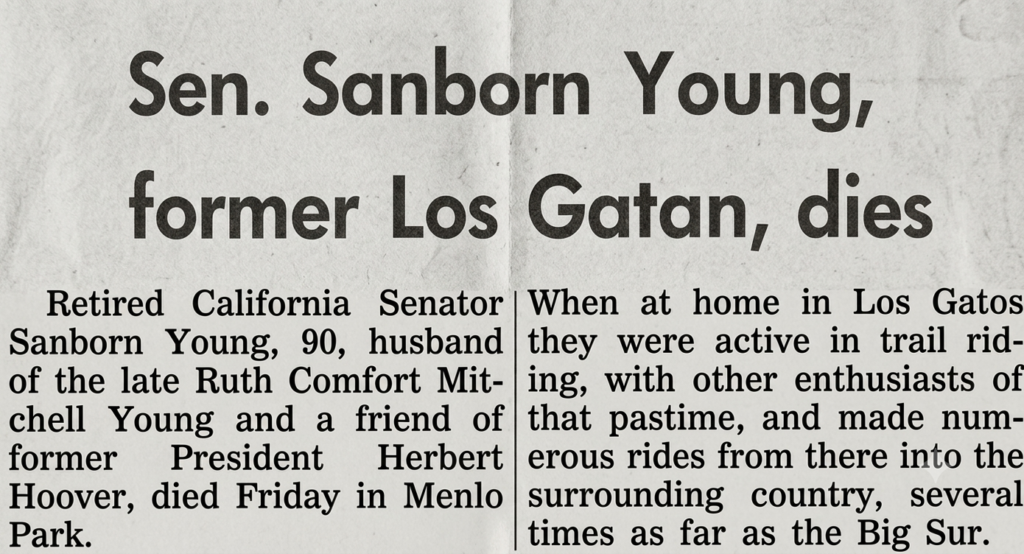
This is what you would have seen in the newspaper. But there is a story that runs deeper behind it. A love story. A sad story. A story to teach our children.
The rest of the article paints a formal portrait, and this one has every button fastened: Chicago and the Board of Trade, Northwestern, the State Senate, the show place of Chinese architecture on Cypress Way, the famous friend in Herbert Hoover.
All of it is true, and none of it is the story. The Times could not print what the hill knew.
It did not know about the small boy from up the road who understood Mr. Young not as a retired senator but as the keeper of a rosewood cabinet full of candy, price of admission one conversation. It did not know about the popovers, or the pigs’ feet, or the standing joke about his girlfriends, or what happened to his dogs, or the dozen red roses that never reached his room. And it did not look twice at the dates, where the tenderest part of the story was hiding. In February of 1954, just days after she and Sanborn had marked their last Valentine’s Day together, a housekeeper walked into Yung See San Fong and found the love of his life gone. Ten years later, four days short of that anniversary, he died on Valentine’s Day.
The people who were there told that story into a tape recorder sixteen years later, in the living room of the house itself. This is what they remembered.
The title was his: Senator Sanborn Young from Los Gatos, the Sacramento record books, the narcotics laws. But the fame was hers. Ruth Comfort Mitchell ran in the great national women’s magazines; in May of 1922, Woman’s Home Companion put her on page one, mounted on her horse Snort beside the little cabin where she pounded out her novels, before more than a million readers. Magazine editors made the trip west just to visit her. The title was half hers too, and nobody said so more readily than he did. He ran on his name, but she was the engine of the campaign, out talking for him at every stop, and Sanborn credited his success to her wit and wisdom ever after. She had a political standing of her own besides, rising to national president of Pro America, the Republican women’s organization.
For nearly forty years Yung See San Fong ran on her voice: the pageants, the poems, the green ink, the famous guests laboring up the drive to see her.
And she was funny. The outgoing center of his universe, she could talk your ear off and did, gladly, and she kept whole rooms in stitches, with her husband as her favorite subject. She had a running joke that never wore out: any woman she wanted him to like was introduced, on arrival, as his new girlfriend, so that every time they came, that was his girlfriend, and the room laughed, and the quiet senator got a warm welcome made for him by his wife. It was the kind of teasing that is only possible in perfect safety, without a grain of truth in it and both of them knowing so.
She went first, and without warning. On the morning of February 18, 1954, the housekeeper arriving for work found her dead in the house. She was seventy-one. Sanborn had been bedridden for some months that winter, and he told the coroner’s men the simplest, hardest fact there was: he had spoken with his wife the night before, when she retired.
He never sought to marry again.
Her death left a hole in the middle of his life that nothing arrived to fill. The house went quiet in a way it had never been. The senator kept the house himself now, and he went at the silence the way he went at most things, practically. He began inviting everybody in. Salesmen, deliverymen, anyone who rang the bell on any errand at all was pressed to stay for lunch. He was, as Irene Board put it, so downright lonely, so hungry for company that a stranger with a sample case was worth setting another place at the table.
The children of the hill knew it too. A small boy from a couple hundred yards up the road, DeEtte Richmond Sipos’s brother, was perhaps three years old when his mother first brought him down. He discovered that the old man kept an ornate rosewood octagonal bonbon display, its many covered drawers each hiding candy. The terms were simple and solemnly honored: chat with Mr. Young a while, and you could take two. Within a couple of months the boy was finding his own way there. Mr. Young was in poor health by then, but he enjoyed the company, and the boy enjoyed the mystery of it all, and the candy.
There were small mercies. He had a church habit to lean on, and there was a story behind it. He had never attended any church until Thanksgiving of 1943, when Irene talked him into coming along to the Christian Science service. Her son Bob had shipped overseas that October, and week after week no letter had come. The day Mr. Young went to church, the first one arrived. “That was for going to church,” Irene told him, and whether he believed it or just liked the arithmetic, he went every week from then on. So it mattered that the housekeeper he hired, Mrs. Boardman, turned out to be a Christian Scientist like Ruth had been. The Sunday habit could go on unbroken. She learned, in time, about the pigs’ feet. Ruth had always instructed the help that once in a while they were to cook pigs’ feet for his breakfast, his one odd craving, indulged on schedule without his having to ask. The instruction outlived her, passed along from cook to cook, so that every plate of them set in front of him was Ruth still looking after her husband. Mr. McDaniel, the church soloist, came up Sunday evenings with his slides and his songs. Mrs. Boardman got to giving neighborhood dinners, and once, when Irene came up to help serve, it pleased him no end.
Then the in-laws took over, the Mitchells, family by marriage. Irene called Mrs. Mitchell “the Belgian,” and never warmly. It was she who sent every one of the dogs to the veterinary to be put to sleep. Not one was left, and nobody ever told him. As far as the old man knew, his dogs were simply somewhere else, being kept from him, and the household let him go on believing it. And of course, Irene said, right away he got sick.
Irene still came up on Thursdays, her regular day to relieve Mrs. Boardman. On one of those Thursdays she was making the popovers he loved when he stood up in his coat and announced, “I’m going out to see my dogs.” She had to tell him no. He was too weak, and if he fell, she could never have lifted him. So she slipped the coat off his shoulders and settled him back in his chair. That evening he ate a good supper, mostly popovers. Then, getting ready for bed, he stayed so long and so silent in the bathroom that she finally knocked and asked if he needed help. “Yes, I do, Mrs. Board,” he said. He had gone in, sat down, and simply stayed there, unable to manage the rest. She helped him undress and into bed, and as she settled him he said, “Oh, I don’t know what I’d do without you.”
He would have to. The nurses came around the clock after that, and the relatives closed the door. They were afraid, Irene guessed, of what she might tell him. She was allowed up once more, at Christmas, carrying bottles of her raspberry juice. He looked so sad. He said something she never forgot: “I used to have dogs. I don’t know what they’ve done with them.” She couldn’t dare tell him. She kissed him goodbye.
In the end they had Dr. Jones come and give him a shot, and an ambulance carried him, sleeping, past Palo Alto to a rest home in Menlo Park, convenient to the family. He had nothing to say about it at all. Irene sent a dozen red, red roses to the rest home, for him to enjoy. He never saw them. He was gone before they arrived, and the roses never reached his room at all: Mrs. Mitchell wrote Irene to say she had taken them to her own house, to enjoy. “I was so mad,” Irene remembered.
The Mitchells’ claim to all of it was simple arithmetic. Ruth and Sanborn had no children, so when he died there was no one closer than the in-laws to inherit. Yung See San Fong passed to people with no attachment to the house, and they promptly sold it off, and everything inside it: the Chinese furnishings, the books, all of it scattered to buyers across the country. Nothing was left with the house but the house itself. The scattering was not quite complete, though. Sixteen years later, when the neighbors gathered in the living room to tell these stories into a tape recorder, one of them reported that a set of the Youngs’ salt shakers was still sitting in a neighbor lady’s cupboard, and that she would love to bring them home to the house.
Up the road, the boy came down for his chat and his two candies and found the house empty. “One day he was not home any more,” he remembered, some sixty years on. “I think I was told he had moved.”
The church he had come to by way of a wartime letter had a teaching about all of this. In Christian Science there is no death; there is only passing on, an incident in a life that does not stop. Heaven is not a far place but a harmony a soul grows into, and love, being of God, is never lost. Whether he held the doctrine strictly or held it the way he held Irene’s arithmetic about the letter, gladly, it turned his loss into a promise: Ruth had not ended. She had only gone on ahead, talking, no doubt, all the way.
Nine Valentine’s Days he spent without her. He declined a tenth.
He died seventeen days short of ninety-one, on the day set aside for love. So he went out following her at last, ten years behind, almost to the day.
Drawn from the recollections of Irene Board, recorded at Yung See San Fong ca. 1980; from a childhood memory of DeEtte Richmond Sipos’s brother, which she shared in a Los Gatos history Facebook group in reply to Theo Deffenbaugh; and from the Los Gatos Times front-page obituary of Sanborn Young, which reports that he died in Menlo Park at ninety and was inurned with Ruth’s ashes at Oak Hill Cemetery, San Jose. He died February 14, 1964, Valentine’s Day, at 90 years and 349 days, seventeen days short of his ninety-first birthday; the tape remembered him as ninety-one. Ruth died February 18, 1954, found at home that morning by the housekeeper, with Sanborn bedridden and having spoken with her the night before (Oakland Tribune, February 18, 1954, front page); the tape and Sanborn’s 1964 obituary both misremember the year as 1953. The Mitchells who cared for him in his final illness were his in-laws, described on the tape as “her sister-in-law and her brother.” Some characterizations of family members reflect Mrs. Board’s perspective alone.
If not for the will of Scotty McEwen, who made this recording of their history happen and was the person driving recognition of the property, their legacy could have been lost forever. The house sold and torn down, thus causing us to forget the face of our forefathers and mothers.