A White Stone, Sunset, and the strange new power of KGO
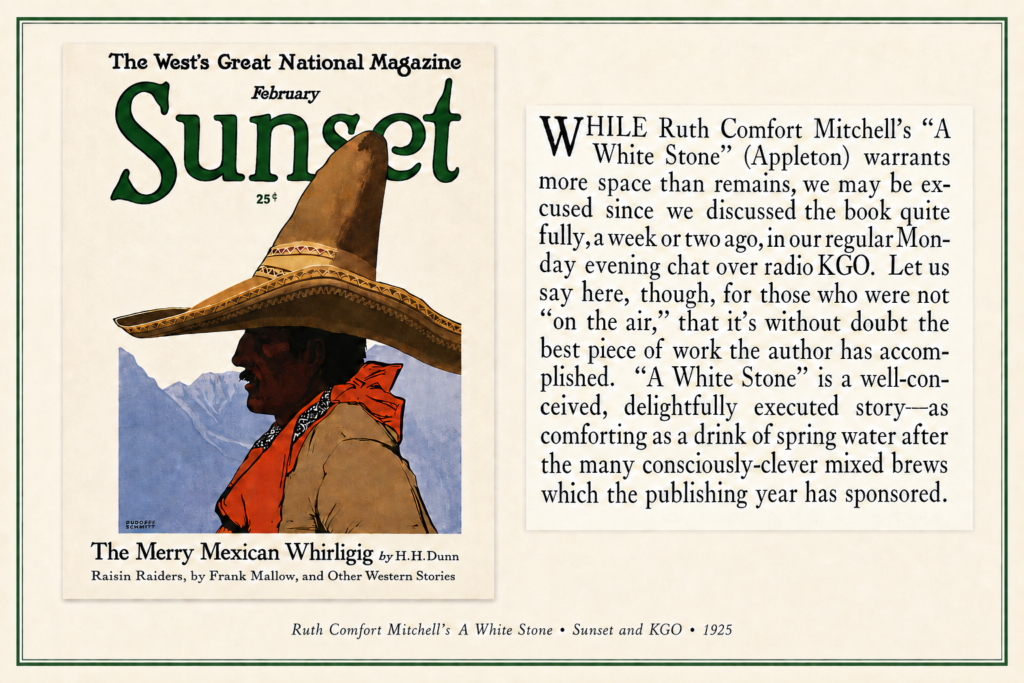
In February 1925, Sunset did something more significant than give Ruth Comfort Mitchell’s A White Stone a short review. It acknowledged that the novel had already received substantial attention through another medium: radio.
The magazine told its readers that the book “warrants more space than remains,” but this was not an admission that the editors had overlooked it or failed to give it proper consideration. They explained that they had already discussed the novel “quite fully” a week or two earlier during their regular Monday evening broadcast over KGO. The short printed notice was not the review that Ruth had been left with. It was a follow-up to the fuller review already carried over the air.
For readers who had not been “on the air,” Sunset supplied the verdict in print. A White Stone was “without doubt the best piece of work the author has accomplished,” a “well-conceived, delightfully executed story” that felt like “a drink of spring water” after the more self-consciously clever books of the season.
At first glance, this is simply a glowing notice. It is much more than that. It shows the pull Ruth Comfort Mitchell possessed at the height of her career, and it captures the moment when literary criticism was moving deliberately between the printed page and the microphone.
The Man Behind the Microphone
The connection between Sunset and KGO was Joseph Henry Jackson. Jackson served as an associate and managing editor of Sunset from 1920 through 1926 before becoming its editor. He later became one of the West’s best-known literary critics, but he was already experimenting with radio while working at the magazine. Contemporary schedules identify his Monday KGO feature as “Chats About New Books” and identify him as the literary editor of Sunset.
This was not an occasional appearance. Jackson began reviewing books over KGO in 1924. The State Library of Oregon preserves a group of 39 mailers announcing books scheduled for his KGO program during 1925 and 1926. The surviving notices show that publishers and editors had begun treating a radio discussion as a distinct literary event, something to be announced and promoted in advance.
Ruth therefore did not merely receive a passing mention. Jackson discussed A White Stone “quite fully” on his regular Monday program, and then Sunset returned to the book in print. The magazine was not compensating for an oversight. It was acknowledging the earlier broadcast while making sure that readers who had missed it still received the essential judgment. It was a second endorsement for a second audience.
KGO Was a New Kind of Power
It is difficult now to recover how extraordinary KGO seemed in 1925. The station had gone on the air in Oakland only on January 8, 1924. General Electric built it as the Pacific Coast member of a planned group of powerful broadcasting stations, alongside WGY in Schenectady and the future KOA in Denver. A contemporary engineering description called KGO the most modern and powerful broadcasting station yet placed on the air and said it was intended to serve the entire Pacific Coast.
The physical plant matched the ambition. KGO had two purpose-built studios, a control room staffed by three operators during broadcasts, duplicate equipment to keep the station on the air after a failure, two 150-foot towers, and a separate transmitter building. It began at 1,000 watts. Its power rose to 1,500 watts in December 1924 and to 2,000 watts in January 1925, just as A White Stone was being discussed.
The San Francisco press had announced the coming station as the biggest in the West, powerful enough to throw a human voice a third of the way around the world. That claim was publicity, but it accurately conveys how the technology felt. A person speaking quietly in an Oakland room could suddenly address listeners scattered across cities, farms, mountains, and distant coastal communities.
KGO was not merely another local platform. It was one of the West’s great new cultural gathering places.
The Microphone Hidden in a Floor Lamp
The microphone itself had such psychological power that KGO hid one in plain sight.
In the station’s smaller “speaker’s studio,” the microphone was disguised to look like a floor lamp. The purpose was not secret recording. It was to lessen what broadcasters called “mike fright,” the nervousness that overcame people when they faced the unfamiliar instrument and understood the size of the unseen audience beyond it.
That detail is wonderfully revealing. KGO’s engineers could amplify a human voice and send it across the West, but they still had to manage the very human fear of speaking into the machine. The microphone was made to look like an ordinary object in an ordinary room so that a guest might forget, at least for a moment, the enormous reach waiting on the other side.
This was the world into which Ruth’s novel was launched. Radio was still new enough to frighten a speaker, yet powerful enough for Sunset to recognize that some readers might already have heard a book review before encountering it on the printed page.
The Pull of Ruth Comfort Mitchell
What makes the notice important is not simply that Sunset liked the book. Ruth had reached the point where a major Western magazine could treat her work across two forms of media, first through an extended radio discussion and then through a concise printed acknowledgment for those who had not heard it.
Her novel moved through a remarkable chain. It was published in New York by D. Appleton and Company. It was carried into homes by KGO. It was praised again in Sunset, which called itself “The West’s Great National Magazine.” Behind all of it was a writer based at Yung See San Fong, the hilltop Los Gatos home she shared with Sanborn Young.
Ruth’s later political life and her response to John Steinbeck have often overshadowed the scale of her earlier popular career. This small clipping helps restore that scale. By 1925, she was not simply a local writer who had managed to publish a book. She was an established Western literary figure whose new novel could command an extended radio discussion and a second, exceptionally warm endorsement in one of the region’s defining magazines.
The surviving paragraph is short by design. It points backward to the fuller radio discussion and outward to the audience that had already heard it. The story behind it is large. Ruth Comfort Mitchell had crossed from the page to the air, and KGO was carrying her name far beyond the hills of Los Gatos.
Historical Sources
- The History of KGO Radio, Bay Area Radio Museum and Hall of Fame
- Pacific Coast Station KGO, a March 1924 engineering description
- Joseph Henry Jackson Papers, The Bancroft Library
- Book-review mailers for Jackson’s KGO program, State Library of Oregon
- KGO’s 1924 speaker studio and its disguised microphone
- A White Stone, Huntington Library catalog record