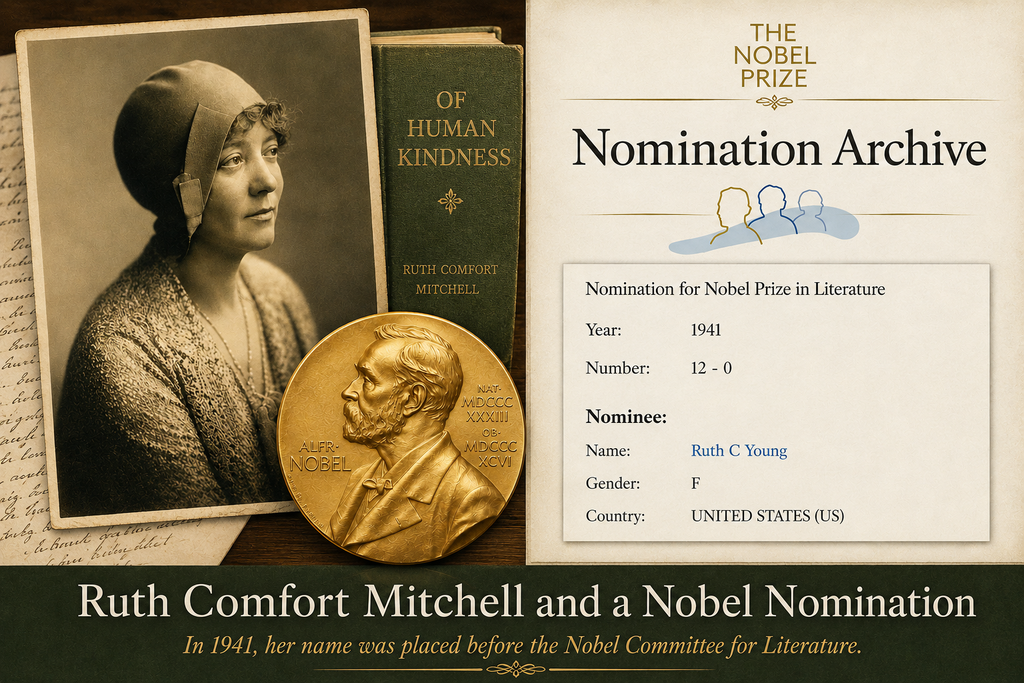
Ruth Comfort Mitchell, John Steinbeck, and the Strange Nobel Nomination of 1941
“I sent JS [John Steinbeck] a copy from a ‘Los Gatos wild cat to a literary lion,’ and he sent me IN DUBIOUS BATTLE.”
Ruth Comfort Mitchell wrote that privately to a friend in 1940.
The exchange is worth beginning with because it tells us something that gets lost in the later political story. Ruth had sent Steinbeck her new novel, Of Human Kindness. Steinbeck sent her In Dubious Battle in return. Ruth told her friend that it was her favorite of his books, called Of Mice and Men “a gorgeous pattern,” and said that she yielded to no one in her admiration for Steinbeck’s genius.
Yet Of Human Kindness would soon be widely described as Ruth’s answer to The Grapes of Wrath.
We now have unusually good evidence that this was not how the book began.
Months before Of Human Kindness was published, Ruth addressed the Lindsay Woman’s Club. The Lindsay Gazette reported her remarks on February 23, 1940, under the headline:
“Mitchell Novel Presents ‘Other Side’ Of Migrant Situation; Not Answer To Steinbeck, Says Author.”
Ruth explained that the idea that she had written the novel as a rebuttal to Steinbeck had originated with a reporter. The reporter learned that Ruth’s new book dealt with California migrants and assumed it was intended as an answer to The Grapes of Wrath. According to Ruth, that assumption then entered the publicity surrounding the book.
She gave a much more specific account of its actual origin.
Her publishers had suggested that she write a companion to her earlier novel Water. This time, they proposed that she build the story around milk. Ruth developed a dairy ranch in the San Joaquin Valley as the setting and said that the outline for the novel existed at least a year before she had even read The Grapes of Wrath.
That public statement is important because it came before the novel was published.
And it agrees with what Ruth later wrote privately to her friend: Of Human Kindness, she said, had been “planned, plotted, named” before she read Steinbeck.
So there are now two separate contemporary statements from Ruth, one public and one private, saying essentially the same thing.
That does not mean Steinbeck had nothing to do with what Of Human Kindness eventually became.
By 1940 Ruth was openly challenging the picture of California that readers were taking from The Grapes of Wrath. At Lindsay she complained that Steinbeck had written fiction that the world was accepting as fact. She said that in researching her own novel she had traveled through migrant areas, visiting camps, schools and hospitals, and that she intended to present conditions as she believed they actually existed.
By the end of 1939 she had also appeared before the Associated Farmers of California. Newspapers were already describing her remarks as “California’s answer” and “her version of ‘The Grapes of Wrath.’”
The distinction matters.
The evidence now strongly supports Ruth’s claim that Of Human Kindness was conceived independently of Steinbeck. But once The Grapes of Wrath appeared, Ruth deliberately entered the argument over what California agriculture looked like and what the rest of the country was being told about it.
And while that disagreement was taking place publicly, Ruth and Steinbeck were exchanging books privately.
That is a considerably more complicated relationship than the familiar picture of two writers simply attacking one another from opposite political camps.
Then, in 1941, something much stranger happened.
Ruth Comfort Mitchell was nominated for the Nobel Prize in Literature. Twice.
The nominations survive in the Nobel archive under her married name, Ruth C. Young. They were submitted under the names of Victor W. Bennett and Benjamin Beisel.
There is no evidence that Ruth initiated the nominations, and she probably did not even know about them. Nobel nominations were secret for fifty years. Ruth died in 1954, long before the 1941 records became public, and so far no letter, newspaper account or other contemporary record has surfaced showing that either man told her.
That would already make the nomination an interesting footnote.
But the identities of the nominators make it something more.
A Nobel nomination in Literature was not something any admirer could simply submit. The process was restricted to people holding specified positions, including university professors in certain fields such as literature and history.
The Nobel archive describes Victor W. Bennett as a professor of English and history at the University of Maryland.
Contemporary records tell a different story.
Bennett was associated with Maryland, but his documented professional world was marketing, commerce and agricultural economics. He had worked in areas involving agricultural credit and later taught marketing.
That background is especially interesting given the subject of Of Human Kindness. Bennett’s actual interests put him much closer to the economic and agricultural issues surrounding Ruth’s novel than the Nobel archive’s description of him as an English and history professor would suggest.
The second nominator raises an even larger problem.
The Nobel archive identifies Benjamin Beisel as a professor of history at Cornell University.
Independent records appear to identify him as Benjamin Raymond Beisel. He had indeed been at Cornell, but he taught mathematics. By 1941 he appears to have been teaching mathematics at Allegheny College in Pennsylvania.
So the Cornell connection was old, and the subject was wrong.
Yet in the Nobel record, Beisel appears as a history professor at Cornell.
That matters because history was one of the fields that could make a university professor eligible to submit a Literature nomination.
We therefore have the same problem twice.
Bennett, whose contemporary record points to marketing, commerce and agricultural economics, appears in the Nobel archive as a professor of English and history.
Beisel, whose record points to mathematics and an institution other than Cornell by 1941, appears as a professor of history at Cornell.
In both cases, the Nobel description moves the man into a field that appears to solve the eligibility problem.
That is not something I think can simply be shrugged off as an archival curiosity.
We still do not know exactly where those descriptions originated. They may have been supplied by Bennett and Beisel themselves. Someone else may have helped prepare the nominations. There may have been an intermediary. The surviving Nobel database could also reflect information copied or altered somewhere inside the Academy’s own process.
But something was being presented to Stockholm that does not line up with the contemporary record of the men involved.
And somebody understood the Nobel process well enough for the nominations to get through it.
The committee considered Ruth’s candidacy and left this assessment:
“content to give a brief idea of the absurdity of [her] only published work and thus also of the absurdity of a prize proposal, for which there were not many parallels in the Committee’s papers.”
That sentence creates yet another problem.
Ruth did not have an “only published work.”
By 1941 she had been publishing for decades. She had written numerous novels, stories, plays and poetry and had reached a huge popular readership, particularly women.
That readership is important in understanding her career. Ruth was not primarily writing for an academic literary establishment. She wrote popular fiction and romance, frequently using those forms to tell stories about young women making choices, gaining independence and entering worlds that had traditionally belonged to men. Her work tended toward optimism rather than despair, and her messages were usually carried through character and story rather than literary theory or political manifesto.
She does not look like a writer who had spent years positioning herself for the Nobel Prize.
Yet immediately after Of Human Kindness became involved in a major national argument about agriculture, migration and Steinbeck’s portrayal of California, two academics on the East Coast placed her name before the Nobel Committee.
And the committee’s reference to her “only published work” suggests that whatever arrived in Stockholm may have presented a remarkably narrow picture of Ruth, perhaps centering almost entirely on this one recent book.
That leaves a set of questions I would very much like to answer.
Why did Bennett and Beisel choose Ruth?
Did they know one another?
Why do the academic descriptions attached to them in the Nobel archive differ so sharply from their documented careers?
Who understood the nomination rules well enough to present them as viable nominators?
And was Ruth being nominated because of a lifetime of popular fiction, or because someone believed that Of Human Kindness, and its alternative picture of California agriculture, deserved an international hearing?
The original nomination papers may answer some of that.
Ruth herself probably knew none of it.
No Nobel Prize in Literature was awarded in 1941 because of the war. Her nomination disappeared into records that remained secret for half a century.
Twenty-one years later, in 1962, the Nobel Prize in Literature went to John Steinbeck.
But the part I find most useful in understanding Ruth comes back to that letter she wrote in 1940.
While newspapers, farmers, political organizations and perhaps even distant academics were turning these books into part of a much larger argument, Ruth sent her novel directly to Steinbeck from a “Los Gatos wild cat to a literary lion.”
And Steinbeck sent a book back.