Central Carving
The most important inscription at Yung See San Fong may be the one placed directly above the living room fireplace.
Set within an elaborate carved screen of clouds, branches, flowers, birds and geometric ornament are four Chinese characters:
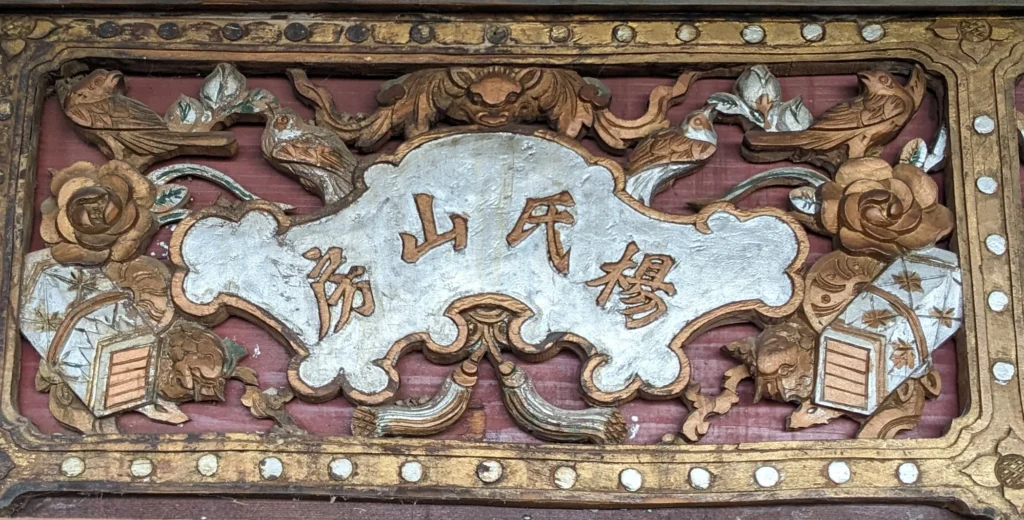
楊氏山房
The characters are read from right to left. In modern Mandarin they are pronounced Yáng Shì Shān Fáng.
楊 is the Chinese surname Yang, used here as the counterpart to the Young family name. 氏 means family or clan. 山房 can mean a house, study or retreat in the mountains. The clearest English translation is therefore:
The Young Family’s Mountain Retreat
The circular emblems at either side appear to be stylized versions of 壽, the traditional character for longevity.
This inscription occupies the central position above the great living room hearth. The National Register documentation describes the hearth as a complex, asymmetrical composition faced with gray-green tile and surrounded by carved woodwork. Above the mantel is the large multicolored screen seen in the photograph. Historic accounts say that the fireplace enclosure and carving were specially ordered for the Youngs through merchants in San Francisco’s Chinatown and carved by hand in China.
How Yáng Shì Shān Fáng Became Yung See San Fong
The familiar name Yung See San Fong is not really an English translation. It is an early twentieth-century attempt to write the sounds of the Chinese characters in English letters.
In today’s standard Mandarin pinyin, the name would be written:
Yang Shi Shan Fang
In the older Wade-Giles system once commonly used by American libraries and scholars, it would be closer to:
Yang Shih Shan Fang
A Cantonese pronunciation would be closer to:
Yeung Si Saan Fong
The familiar form, Yung See San Fong, falls somewhere among these systems. It is not standard Mandarin, standard Cantonese or standard Wade-Giles. It appears to be a loose American phonetic rendering, possibly influenced by Cantonese as spoken in San Francisco, with the first word deliberately made to resemble the family name Young. I have not found a surviving document identifying exactly who selected the spelling, so that last part remains a reasonable inference rather than a documented fact. The Library of Congress notes that older American renderings of Chinese names were often inconsistent and did not always follow a systematic form of romanization. (The Library of Congress)
The historic English explanation, “Young’s Home in the Heart of the Hills,” takes the adaptation even further. It is a beautiful phrase, and it has been repeated by the National Park Service and the Historic American Buildings Survey. But it is a poetic interpretation rather than a literal translation. None of the four characters means “heart.” The Chinese dictionary definition of 山房 includes a dwelling, study or retreat in the mountains. (Ministry of Education Dictionary)
A Name From Its Time
To modern ears, Yung See San Fong can have the sound of the generalized, theatrical “Chinese” language used by Americans during the early 1900s. That is partly because it does not belong to one recognizable Chinese pronunciation system. It reshapes Chinese sounds into an exotic-sounding English phrase.
That quality is inseparable from the history of the house.
Ruth Comfort Mitchell Young’s play The Sweetmeat Game opened in 1916 with a San Francisco Chinatown setting and toured nationally. Historic records state that its success inspired Ruth to combine what she considered Chinese tastes and customs with her own ideas of beauty and domestic comfort when designing the house. Construction began in 1916, and Yung See San Fong was completed in 1917 for Ruth and Sanborn Young. The result combined Chinese decorative motifs and pagoda-shaped roofs with the layout and massing of an American country house.
Chinese-themed American theater of that period frequently relied upon broad stereotypes and imagined versions of Chinese life. Recognizing that context does not require us to accuse every participant of deliberate hostility. It does require us to understand that much of what Americans called “Chinese” was being interpreted through theater, fantasy and decoration rather than through close knowledge of Chinese language and culture. (JSTOR)
The house can therefore be appreciated on more than one level. It contains remarkable craftsmanship, including woodwork apparently produced in China. It also reflects the cultural limitations of the era in which it was created. The name Yung See San Fong is part of both stories.
What is especially interesting is that the Chinese characters themselves are less theatrical than the English name that developed around them. They do not proclaim an exotic palace or a mysterious “heart of the hills.” They simply identify this place as the Young family’s mountain retreat.
Placed above the hearth, at the center of the home’s principal gathering room, the inscription quietly tells us what the house was intended to be. It was a family home in the hills, made distinctive by the imagination of its owners and by the complicated American fascination with China during the early twentieth century.