Before the Novels: Ruth Comfort Mitchell Enters Adventure
Long before Yung See San Fong became Ruth Comfort Mitchell’s Los Gatos home—and before she married Sanborn Young or became a nationally known novelist—she was already building a career in the magazines.
Her short story “Enter, the Hero” appeared on pages 264–270 of the June 1911 issue of Adventure. Ruth was 28 years old, one month short of her twenty-ninth birthday. Born on July 21, 1882, she was still Ruth Comfort Mitchell, unmarried and three years away from meeting and marrying Sanborn Young. Yung See San Fong would not be completed until 1917.
This was also years before the works that established her reputation. Her first book, The Night Court and Other Verse, appeared in 1916; her first novel, Play the Game!, followed in 1921. Yet “Enter, the Hero” shows that Ruth was already producing polished commercial fiction for a national audience.
Ruth Was Already Appearing in Sunset
“Enter, the Hero” was not Ruth’s first appearance in a major magazine.
In September 1904, when she was 22, Sunset published her humorous poem “To a Health-Food Girl.” Then, in the February 1909 issue of Sunset, Ruth published another poem, “Across the Street: A Valentine,” on page 152. She was 26.
The surviving page establishes an important step in her development:
It’s the somber end of a dull gray day,
And up in the window across the way—
One story nearer Heaven—
I see a chap in an old arm chair
Who reads in the fading daylight there—
For the lights aren’t on till seven.
The poem is already recognizably Ruth. It is visual, conversational, romantic, and lightly comic. A woman watches an unknown man through the window across the street. He looks back. Social convention prevents either of them from acknowledging what has happened, but the woman imagines a future introduction and wonders which one will confess, “I think we have met before!”
The parenthetical asides give the poem the feeling of a private conversation with the reader. Ruth is also playing with the restrictions placed upon women. Her speaker cannot walk across the street and introduce herself, but she can look, imagine, and quietly enjoy the shared secret. “Cats at kings, they say, may look!” becomes a playful defense of a woman’s right to observe the man who has caught her interest.
“Across the Street” is a tiny urban romantic comedy. It contains no revolution, chase, or physical danger, but it already has the structure Ruth would repeatedly use: two people see each other, social conventions stand between them, and the possibility of romance creates an opening into a larger life.
The poem appeared in a magazine that was then owned by the Southern Pacific Company and promoted the scenery, culture, and possibilities of the American West. Its publication confirms that Ruth was not waiting for marriage or a move to New York to begin her career. She was already successfully placing work in a nationally distributed Western magazine. Read “Across the Street” in the February 1909 Sunset
Two years later, “Enter, the Hero” carried her from romantic verse into a very different part of the magazine world.
A New Magazine Looking for Adventure
Adventure was barely established when Ruth’s story appeared. The Ridgway Company had launched it late in 1910, making the June 1911 number only its eighth monthly issue. Trumbull White was still its editor. Arthur Sullivant Hoffman, who would later turn Adventure into one of America’s most respected pulp magazines, did not become editor until 1912.
From the beginning, however, the magazine wanted more than indiscriminate excitement. It specialized in danger, travel, historical adventure, and distant settings, but it also encouraged writers to make their geographical and historical details convincing. That combination made Ruth’s story—with its Mexican trains, villages, political tensions, hacienda, revolutionaries, and privileged American travelers—a natural fit.
The issue contained approximately 192 pages of fiction and purportedly true adventure. Ruth appeared alongside John Buchan’s serialized Prester John, Marion Polk Angellotti’s historical story of Sir John Hawkwood, accounts of trouble in the Gulf of California, and stories bearing titles such as “The Emerald Buddha,” “The Fight of Patsy McGlynn,” and “Looking for Trouble.”
Ruth was not the only woman represented in the issue, but Adventure was emphatically different from the women-centered magazines in which much of her later fiction would appear. A story accepted by Adventure had to move rapidly, create danger, and appeal to readers who came looking for action. Ruth demonstrated that she could do all three.
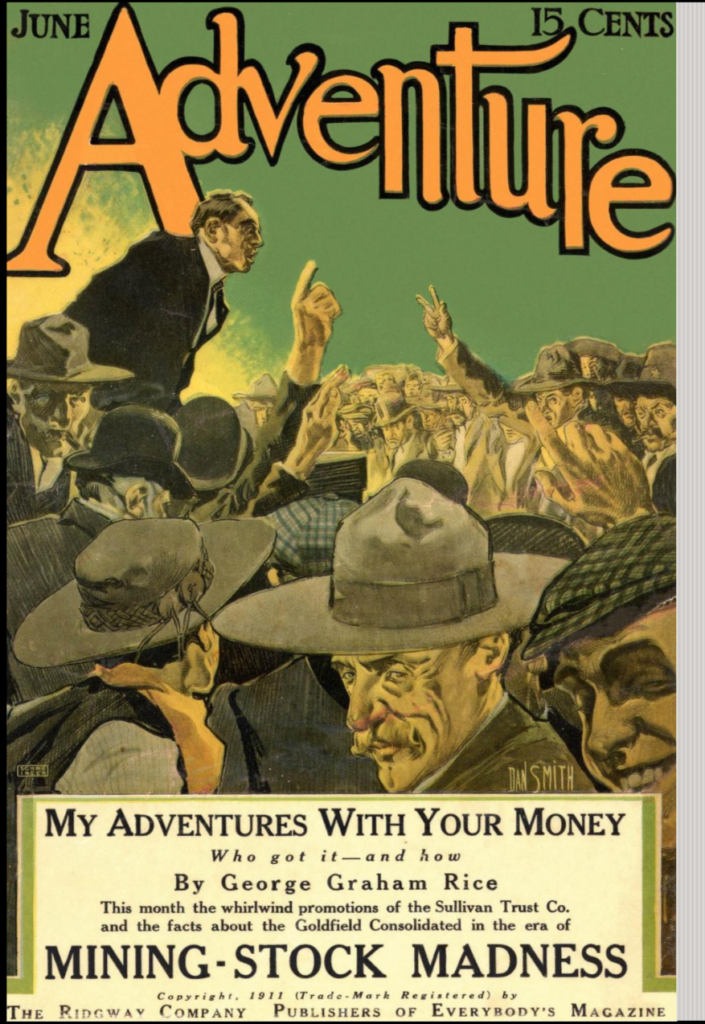
What the Cover Was Selling
The dramatic front cover, created by illustrator Dan Smith, does not depict “Enter, the Hero.” It advertises the issue’s leading feature, George Graham Rice’s serialized “My Adventures with Your Money—Who Got It and How.”
Rice was recounting the frantic promotion of mining stocks and the fortunes made and lost through speculation. The June installment dealt with the Sullivan Trust Company and Goldfield Consolidated during what the cover calls the era of “Mining-Stock Madness.” Smith’s picture of a speaker confronting an agitated crowd of men visualized financial promotion as a form of public combat.
That tells us something about the magazine Ruth had entered. Adventure was selling excitement wherever it could be found—in war, travel, crime, financial scandal, exploration, revolution, or romance. The cover promised the uproar of American speculation; Ruth’s story delivered danger aboard a private railroad car in revolutionary Mexico.
Her story received a respectable but secondary position. It occupied seven tightly printed pages, with a small opening illustration but no separate author profile. It began on the same page on which the preceding story ended and concluded just before “The Fight of Patsy McGlynn” began.
This was the compact, disciplined world of commercial magazine fiction: Ruth had only a few pages in which to introduce her characters, create a romance, start a revolution, stage an escape, and send her hero galloping after the heroine.
Ruth at Twenty-Eight
In 1911, Ruth was best described as Los Angeles-based while remaining deeply connected to Los Gatos.
Her father, John S. Mitchell, was vice president and manager of the Hollenbeck Hotel in downtown Los Angeles. His 1913 biographical entry lists the Mitchell family residence as 301 Alexandria Avenue, and a 1914 newspaper account explicitly describes Ruth as formerly of San Francisco and then a resident of Los Angeles.
No 1911 directory entry under Ruth’s own name has yet been found, so it would be too precise to claim that she was physically at the Alexandria Avenue house when the June issue appeared. Ruth traveled extensively as a young woman, spending eighteen months in Europe and making long journeys through Canada and Mexico. Los Gatos, meanwhile, remained the Mitchell family’s beloved summer and weekend retreat.
The safest conclusion is that Los Angeles was her principal family base, Los Gatos was already an important second home, and travel supplied her with much of the wider world that she transformed into fiction.
The Los Angeles connection may also explain why the private railroad car in “Enter, the Hero” carries a party that has traveled from Los Angeles into Mexico. Ruth knew the social world of prosperous hotel guests, wealthy travelers, private cars, elaborate manners, and people accustomed to being served. She also knew enough about that world to make fun of it.
“Across the Street” and “Enter, the Hero” together show how much range Ruth already possessed. In 1909 she could compress a complete romantic encounter into a few light verses set between two city windows. In 1911 she could turn a Mexican railway journey into a fast-moving story of wealth, revolution, courage, and romantic choice.
“Enter, the Hero” remains the earliest prose short story by Ruth that we have identified so far. But it did not appear out of nowhere. It grew from years of writing and publishing poetry, including the witty romantic voice already heard in “Across the Street.”
A Mexican Revolution Happening in Real Time
The story’s timing is remarkable.
Ruth’s characters travel through Mexico during the final days of the long regime of President Porfirio Díaz. They discuss revolutionary unrest, exploited laborers, government executions, and the island prison of San Juan de Ulúa. The wealthy Herman Gelbhauser praises Díaz for bringing order to Mexico. Edgar Blythe-Masterson, the English hacienda owner, acknowledges Díaz’s accomplishments but warns that people willing to die for Libertad will continue to rebel.
The tourists confidently assume that the government will suppress any uprising. The Englishman predicts that the rebels will be shot and their leader imprisoned. Instead, Gelbhauser fires into a crowd, wounds the revolutionary leader, and nearly gets his entire party killed.
The story must have been written, purchased, edited, and typeset months before publication. But history overtook it. Porfirio Díaz resigned on May 25, 1911, and departed Mexico through Veracruz on May 31. Readers opening the June issue of Adventure therefore encountered Ruth’s fictional discussion of the Díaz regime at almost the exact moment that regime collapsed.
Even the geography was uncannily current. Ruth’s travelers were moving toward Veracruz—the port through which Díaz himself left Mexico for exile.
What had probably been purchased as a colorful romantic adventure had suddenly become topical fiction. It captured the uncertainty of a government that still appeared powerful but was already losing its grip.
Ruth’s Style Was Already Ruth’s Style
Nearly everything that would characterize Ruth Comfort Mitchell’s mature writing can already be found in “Enter, the Hero.”
She begins visually:
Down through the endless miles of maguey fields, gray-green and dusty under the glare of the hard turquoise sky…
Within a few lines, the reader sees the fields, villages, pyramids, distant Mount Orizaba, and the private railroad car snapping behind the train. Ruth does not wait for the story to get moving. It is moving before the first character speaks.
She also writes like a dramatist. Young Tommy Jerrolds spots the Englishman standing in a station doorway and announces, “Enter the Hero!” Characters make conspicuous entrances and exits. The American tourists function like a comic chorus. The private car becomes a stage on which their manners and pretensions are exposed.
The title is therefore playful. Blythe-Masterson enters exactly when a conventional romantic hero should enter: tall, fair-haired, dressed in worn English riding clothes, and immediately interested in Diana Millard. Ruth knows the formula and lets Tommy announce it openly.
Tommy provides the rapid comedy that would remain one of Ruth’s strengths. He describes himself as a “Human Barbed Wire Fence,” calls himself “T. Columbus Jerrolds” for discovering the Englishman, and punctures the dignity of every wealthy adult around him. His slang keeps the story light even as its political situation becomes dangerous.
The same pleasure in watching strangers that animated “Across the Street” is present here in a larger form. Ruth observes how people look at one another, how quickly attraction is recognized, and how much can be communicated before anything is openly admitted. Diana studies Blythe-Masterson. He watches her. Tommy notices both of them and gleefully interprets what they are unwilling to say.
The romance is also a test of character. Diana is being pushed toward wealthy men who regard marriage as a transaction. Herman Gelbhauser has money, a private railroad car, and polished manners, but the crisis reveals him as cowardly, violent, and contemptuous of people beneath his social position. Blythe-Masterson possesses courage, practical ability, sympathy, and the willingness to protect others.
Diana is not simply waiting to be rescued. She recognizes the moral difference between the men before the violence begins. When the tourists swarm into Mexican homes, step on dogs, pick up babies, examine cooking pots, and laugh at the inhabitants, Diana recoils:
We’re the barbarians!
Later, as a crowd gathers outside the private car, she observes that the sight of affluent Americans consuming their fifth meal might reasonably irritate people who struggle to obtain two.
That is an important element of the story. The Mexican crowd is not violent merely because Ruth needs a convenient danger. The immediate crisis is caused by an entitled American who calls the people “cattle” and fires into them. American arrogance, not simply Mexican disorder, turns political tension into disaster.
The story nevertheless carries the limitations of its period. Mexico is frequently presented as an exotic spectacle. Mexican villagers sometimes become a “comic-opera chorus,” while Romaldo’s elaborate servility is played for humor. Blythe-Masterson is an idealized English hacienda owner whose paternal sympathy for his workers helps establish his goodness.
Yet Ruth does not simply endorse her travelers’ prejudices. She gives the sharpest criticism of their conduct to Diana, the character whose judgment the story ultimately vindicates. The privileged tourists repeatedly misunderstand what they are seeing, while Diana and Blythe-Masterson recognize that poverty, political repression, and personal dignity cannot be dismissed.
The Beginning of a Pattern
The conclusion is unmistakably Ruth. Danger exposes false values. Courage proves more important than money. The heroine rejects a future based on social calculation, and the hero races toward Veracruz after learning that she is “not, not, NOT engaged” to Gelbhauser.
The ending is romantic and optimistic, but it is not passive. The characters must act, choose, run, resist, and declare themselves before happiness becomes possible.
That same pattern would appear throughout Ruth’s later writing. She frequently placed a woman inside a familiar romantic structure, then used the story to explore larger questions of courage, work, class, politics, loyalty, and personal responsibility. The romance made the story inviting; the conflict allowed Ruth to say something more.
“Across the Street” gives us the playful romantic observer Ruth at 26. “Enter, the Hero” gives us the adventure writer Ruth at 28. Together they show that well before marriage, New York, Yung See San Fong, or literary fame, Ruth Comfort Mitchell had already found the voice that would carry her through the next four decades: visual, witty, socially observant, hopeful, and always alert to the moment when an ordinary life might suddenly become an adventure.