On January 12, 1918, the San Jose Mercury Herald devoted a full editorial-page feature to a single house call: “We started, on that Sunday afternoon to call on our first celebrity.” The celebrity was Ruth Comfort Mitchell: the poet, playwright, and short story writer living in her Chinese-styled hillside home above Los Gatos, Yung See San Fong.
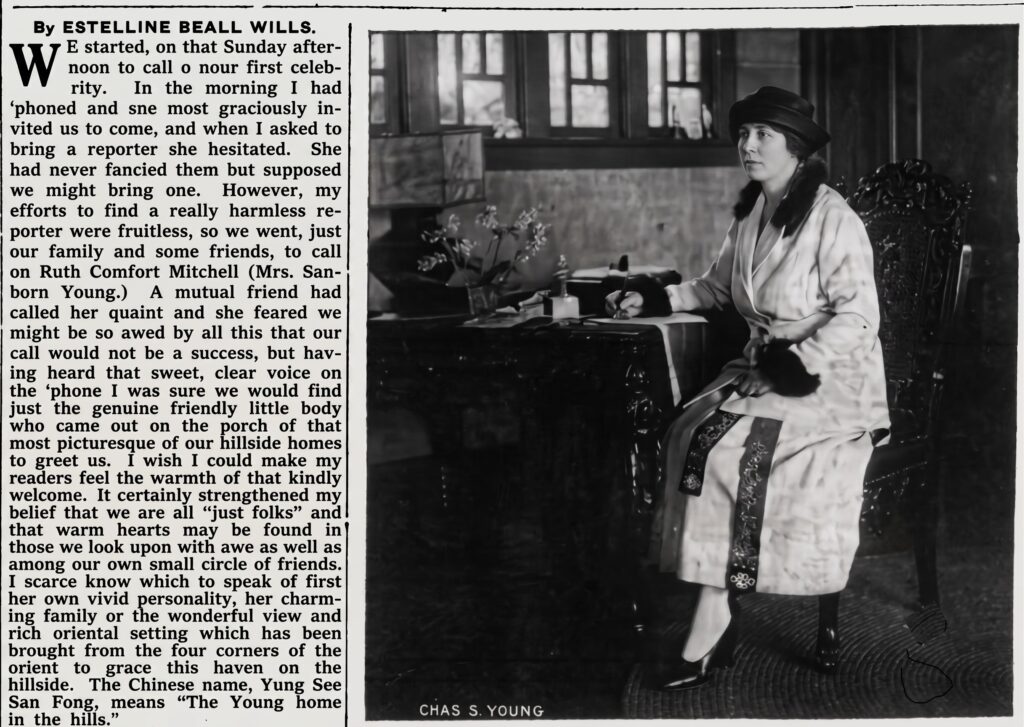
The Picture Above Is AI resharpening Of The Original Article. (Original scan missed characters, and these are not corrected.)
The Mercury Herald was San Jose’s leading morning daily, serving a city of roughly 40,000 and a Santa Clara County of about 100,000. No audited circulation figure for 1918 survives in accessible records, but a dominant county-seat morning paper of that size typically printed on the order of 10,000–15,000 copies a day. With newspapers routinely passed through households of four or five readers, the article plausibly reached 40,000–60,000 people — a substantial share of the entire valley. Placement mattered too: she shared the editorial page with the woman’s suffrage amendment and the war in the air. That was the company her celebrity kept.
If you read any of her books, you will find women are the heroes of her novels. And what runs deep inside of these books is the thought that one must stay true to themselves, and cling to the upmost of high standards. She would talk about unwed mothers, dope fiends, and adopted children that smoked, and yet her women protagonists always rose above with enduring drive to conquer the odds.
A National Author, Not a Local One
Her fame was not manufactured by hometown pride. The article notes her stories ran “in so many of the best magazines, Woman’s Home Companion, Century, Good Housekeeping… McCalls and others” …the Century among America’s most prestigious literary monthlies, the women’s magazines reaching millions of households. Her plays had been “running most successfully” in Boston, Chicago, and New York, “one, in New York for over a year.” Publishers were demanding stories faster than she could write them; she had “promised herself and her publishers to put in less hours of actual work.”
How She Was Regarded
The paper’s verdict was unambiguous: “She is generally recognized as one of the best short story writers, playwright and poets of the present time.” Her unpublished poem “Steerage”, called “the most wonderful sermon on immigration”, was “rightfully considered a masterpiece.” The lecturer Lillian Burkhart Goldsmith, who alone performed it, refused all encores: “I never have found anything I could give after it… It is so big, so vital, nothing could follow it.”
Yet what struck the writer most was that fame hadn’t hardened her. Through “all of Mrs. Young’s brilliant successes she has remained the same sweet-hearted child of yesteryear,” and the profile closes by declaring her “doubly crowned by the literary critics a genius, and by those who know her ‘a friend.'”
The Verdict
In 1918, Ruth Comfort Young was that rare thing: a woman writer working from a California hillside whose words reached millions through the nation’s top magazines and Broadway stages, and whose local paper considered a Sunday visit to her home front-section news. Her fame proved to be of her era rather than enduring, but within that era it was national, critical, and popular all at once.
History is a fickle thing in that those that often have enormous impact on the cultural DNA of a society can be forgotten. But the idea that a woman can be young, smart, successful, and independent is very much part of the legacy that she created.
Sources: “A Visit with Ruth Comfort Mitchell,” San Jose Mercury Herald, January 12, 1918, pp. 6, 9. Population figures from the 1920 U.S. Census; circulation estimated from city size and era norms.