We are the stewards of a house, and of a statue, that ask hard questions.
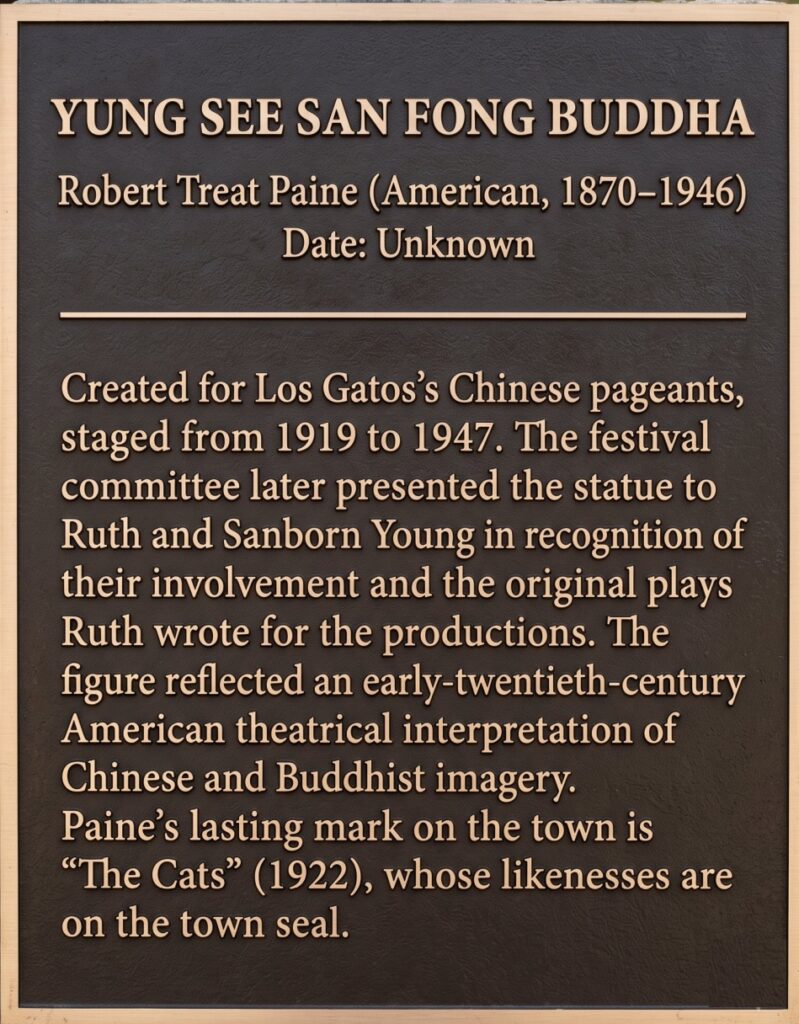
Yung See San Fong was built by Ruth and Sanborn Young in the Chinese style, and on its grounds stands a Buddha carved by Robert Treat Paine for the Chinese pageants Los Gatos staged from 1919 to 1947. Neither the house nor the statue was made by Chinese hands. Both were created by white Americans potentially borrowing the imagery of a culture not their own, in an era when that borrowing was fashionable on stage and painful in life. These were the decades of the Chinese Exclusion Act, when Chinese Americans in California faced discrimination their admirers rarely acknowledged. We recognize that by today’s standards, the house and the statue carry attributes of cultural appropriation.
We do not intend to argue our way around that. We say it plainly because we believe it.
But recognition is not the same as condemnation, and history deserves to be read in context. The Youngs, by every record we have found, acted from admiration rather than mockery. They left no track record of abuse or hostility toward the Chinese community. What record exists suggests the opposite: they sought the advice of the Chinese members of their staff and asked for authentic representations. We have invited Chinese guests to share their view of the engravings and signs on our house, which stand near the statue, and by and large they do not find them offensive. They note that the script is of an older variety, uncommon in modern writing, which suggests the Youngs sought out artists trained in the tradition. The Youngs built, wrote, and celebrated in the idiom of their time, and their time saw no contradiction in loving a culture’s forms while allowing its modification. That blindness belonged to the era; the affection, as far as we can tell, was real. We think both facts can stand together.
The historian Annette Gordon-Reed, writing about America’s monument debates, drew a distinction we find useful: intent matters. “No one puts a monument up to Washington or Jefferson to promote slavery,” she observed, separating artifacts made in honor from those made to demean. The Buddha at Yung See San Fong was not made to diminish anyone. It was made, imperfectly and earnestly, in tribute. Andrew Young, the civil rights leader who marched with Dr. King, cautioned during the same debates that “we should focus on substance and not symbols,” and that it is “too costly to refight” old wars. We take his point not as permission to ignore the past, but as an invitation to spend our energy where it does the most good.
For us, that means three commitments. We will keep this history standing and tell it honestly, including the parts that are uncomfortable. We will work inside the culture rather than around it, seeking out Chinese American historians, artists, and neighbors to help us understand what these objects mean from the other side of the story, and letting what we learn change how we present them. And we will stay in the conversation. We know this subject is debated in good faith by thoughtful people on all sides, and we do not expect everyone to land where we have. We ask only that our viewpoint be understood as we offer it: not a defense of the blindness of the past, but a belief that the past teaches best when it is allowed to stand, in full view, with nothing hidden.
The statue is here. The house is here. We would rather they be understood than erased, and we would rather be questioned than left alone.
With that written, this statue may be the only other surviving piece of artwork left by Robert Treat Paine other than the Cats of Los Gatos. It is of significant historical importance.