Reading the Inscriptions at Yung See San Fong
One of the pleasures of studying a historic house is discovering the small, intentional details that shape the experience of entering it. At Yung See San Fong, that experience includes a pair of vertical Chinese inscriptions placed on bamboo shaped posts beside an opening placed their by the Youngs when they made this special place.
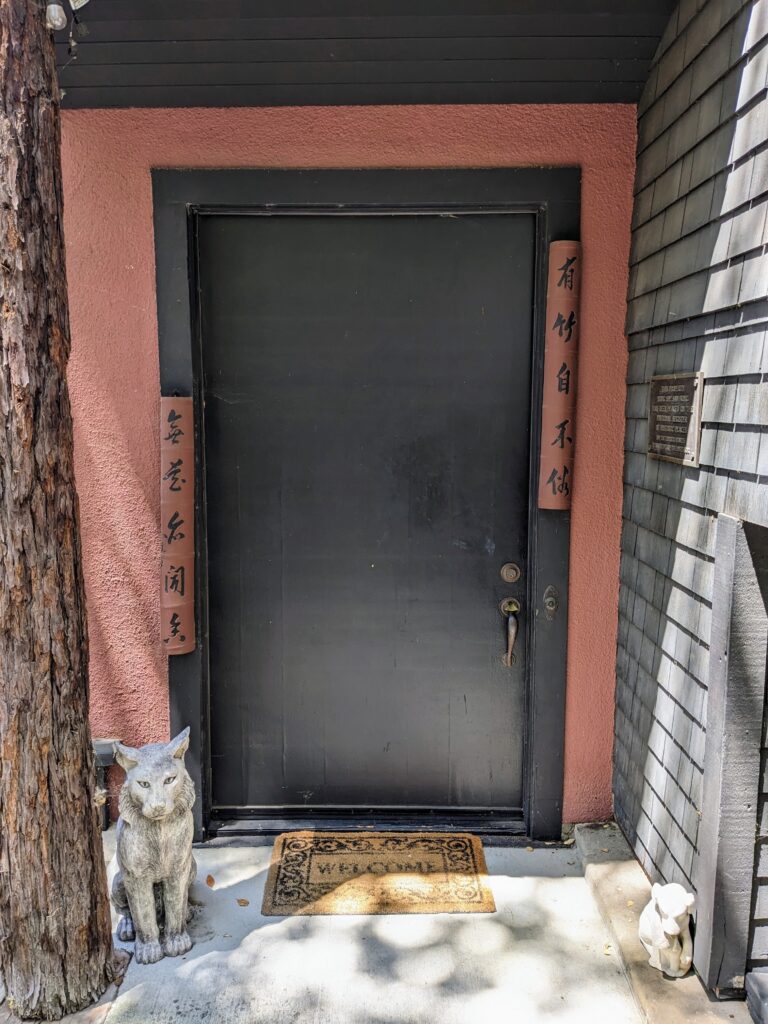
Completed in 1917 for writer Ruth Comfort Mitchell Young and her husband, Sanborn Young, Yung See San Fong combined Chinese decorative traditions with the plan of an American country house. Historic documentation notes the presence of split bamboo plaques bearing Chinese characters at the portals of the living room.
The inscriptions read:
莫惹凡間氣
Mò rě fánjiān qì
“Leave the vexations of the ordinary world outside.”
and:
有竹自不俗
Yǒu zhú zì bù sú
“With bamboo, refinement comes naturally.”
Together, these ten characters turn an architectural opening into a psychological threshold.
Leaving the Ordinary World Behind
The first inscription has several possible shades of meaning.
凡間 refers to the ordinary human world, the realm of ambition, irritation, noise, and daily entanglement. 惹 means to invite, attract, stir up, or become involved with something. 氣 can mean air or atmosphere, but it can also suggest temper, agitation, or emotional energy.
A literal translation might be:
“Do not invite the atmosphere of the mundane world.”
At a doorway, its meaning feels more immediate:
“Leave worldly agitation at the threshold.”
The inscription does not necessarily ask visitors to reject ordinary life. Instead, it invites them to pause before carrying its distractions into the room.
Bamboo and the Meaning of Refinement
The companion inscription offers an answer:
有竹自不俗
“With bamboo, refinement comes naturally.”
Here, 不俗 means more than simply “not vulgar.” It describes a person or place that is cultivated, elegant, uncommon, and free from conventional pretension.
Bamboo has held an important place in Chinese literature and art for centuries. Its upright growth, hollow interior, strong joints, and ability to bend without breaking made it a symbol of integrity, humility, resilience, and cultivated restraint.
The doorway wording also recalls a famous line by the Song Dynasty writer Su Shi:
無竹令人俗
“Without bamboo, one becomes vulgar.”
The inscription at Yung See San Fong expresses the same idea positively. Where bamboo is present, refinement follows naturally.
A similar thought appears in an inscription on a bamboo painting made by the Yuan Dynasty artist Wu Zhen in 1350:
有竹之地人不俗
“Where there is bamboo, people are refined.”
The words at Yung See San Fong therefore belong to a long literary tradition connecting bamboo with cultivated character and freedom from the commonplace.
The Small Inscription: 元之
Beside the larger writing are two much smaller characters:
元之
Yuánzhī
These characters offer a fascinating clue.
Yuanzhi was the courtesy name of Wang Yucheng, a Northern Song poet, essayist, and government official who lived from 954 to 1001. Wang is especially remembered for his essay Record of the Bamboo Tower at Huanggang, which describes a modest bamboo building that offered a retreat from political frustration and worldly distraction.
In the essay, Wang writes about burning incense, sitting silently, and allowing worldly concerns to fall away. The connection with the doorway inscriptions is striking. Bamboo provides the setting in which the pressures of ordinary life can be set aside.
Still, the small inscription should be treated as a clue rather than a confirmed attribution. The two principal lines do not appear word for word in Wang’s essay. The characters 元之 might identify Wang as a literary inspiration, but they could also represent the name or courtesy name of a later calligrapher, designer, owner, or craftsman. They may also have been copied from an earlier inscription.
Until a dated source, commission record, seal, or matching original is found, it is safest to say that the doorway may allude to Wang Yucheng, but the connection has not been proven.
A Sanctuary in Ten Characters
The inscriptions do not require a known author to retain their power.
Together, they describe a movement from ordinary life toward cultivated calm:
Leave worldly vexations outside.
With bamboo, refinement comes naturally.
The words, the bamboo on which they are written, and the act of crossing the threshold all reinforce one another. The result is more than decoration. It is a quiet instruction about how to enter the house and about the state of mind in which the house was meant to be experienced.
At Yung See San Fong, the threshold does not simply divide one room from another. It marks a passage from agitation to repose, from the commonplace to the cultivated, and from the noise of the world to the possibility of sanctuary.
Post Script: You will also notice at the door two more modern additions. As many house in our area, we love the name Los Gatos or The Cats. This is the common statue that many residents place to remind themselves of the Cat of Los Gatos, by Robert Treat Paine. The other is a small ceramic set of dogs, to envoke the love the Youngs had for the dogs that they raised.