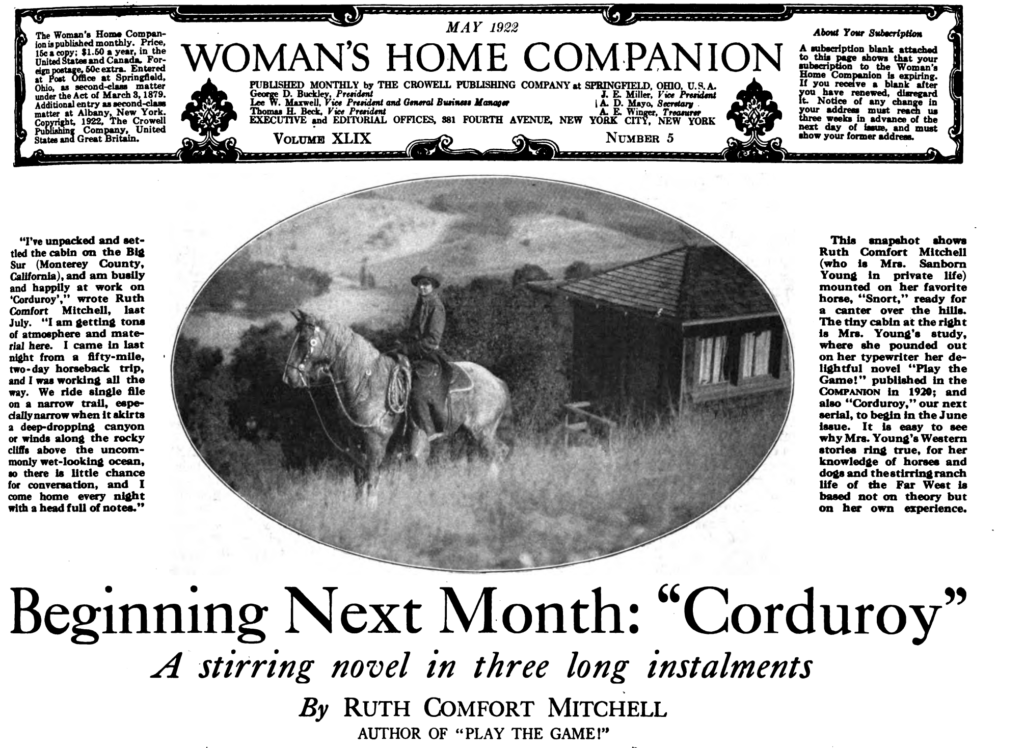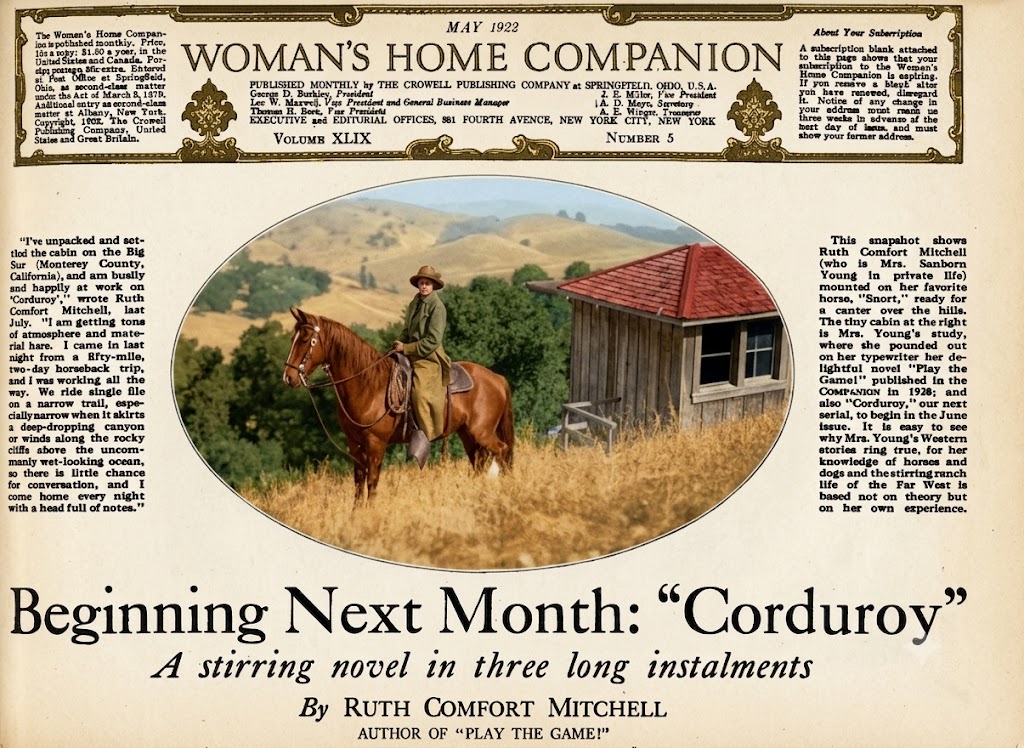
At Yung See San Fong, the Youngs’ Los Gatos home, stood a small cabin where Ruth Comfort Mitchell worked on her novels. It was a private space dedicated to hard work. No trace of the building survives, and exactly where on the property it stood, we do not know. This photograph, published in the May 1922 issue of Woman’s Home Companion, is the only photograph of the study that we have found.
If you saw the the magazine in 1922, the photo was unavoidable. It was on page 1, just above the table of contents.
The Magazine Behind the Photograph
The picture does not show the author seated formally at a desk or posing with one of her books. Instead, she is mounted on her favorite horse, Snort, beside the tiny cabin that served as her workshop. According to the magazine, Ruth wrote both Play the Game! and Corduroy there, pounding them out on her typewriter. It was a place where she could separate herself from the routines and conversations of the household and devote herself fully to writing.
To understand the impact, it helps to understand the magazine that published it. Woman’s Home Companion was no small journal. It had begun in Cleveland in 1874 as an eight-page paper called The Home, passed through several names and owners, and by 1922 had grown into one of the great mass-circulation women’s monthlies in America, published by the Crowell Publishing Company of Springfield, Ohio, with editorial offices in New York. It sold for fifteen cents a copy, a dollar fifty for the year, and it reached well over a million homes each month, on its way to more than two million by the middle of the 1920s.
When this issue reached subscribers in the spring of 1922, and was passed along from kitchen to parlor to porch, perhaps one in five or six adult American women saw the dashing Mrs. Young astride Snort. In a culture without TV or the internet, she was a national figure. In the local newspapers of the time, Ruth was constantly featured at all types of events and assemblies, giving a speech on various topics. There is no doubt why she was sought after so strongly, as she was the local celebrity.
Ruth would have been in sync with the Companion’s editor, Gertrude Battles Lane, who ran the Companion from 1912 until her death in 1941 and built its circulation nearly fivefold. The New York Times would call her the dean of American magazine editors. Her guiding principle was respect for the reader: “She is intelligent and clear-headed; I must tell her the truth.” Under Lane, the magazine was more than recipes and dress patterns. It had crusaded against child labor, with Theodore Roosevelt himself contributing an article in 1907, and after the Nineteenth Amendment passed in 1920 it ran the first major magazine campaign teaching women how to use their new vote. Every issue carried two serialized novels and a handful of short stories. Over its run the Companion published Jack London, Willa Cather, and Kathleen Norris, and would go on to print John Steinbeck and Shirley Jackson.
This is the company Ruth Comfort Mitchell was keeping in May of 1922. A full-page feature in the Companion, with a photograph and a personal letter, was national exposure on a scale few authors ever enjoyed. And a serial in its pages reached more American households in a single month than most novels reached in a lifetime of bookstore sales. The photograph was made because the magazine’s audience demanded it. Readers who were about to spend three issues with Corduroy wanted to know the woman behind it.
The photograph accompanied the announcement for Corduroy, which would begin appearing the following month. The editors wanted those million readers to understand that Ruth did not invent her Western settings from a comfortable distance. She rode through them, lived in them, and breathed their air. And here the story leaves Los Gatos for the wilder country down the coast.
The Ride Down the Coast
Ruth had written to the magazine the previous July, from a working expedition to Big Sur:
“I’ve unpacked and settled the cabin on the Big Sur, and am busily and happily at work on ‘Corduroy.’ I am getting tons of atmosphere and material here.”
Big Sur in 1921 was remote in a way that is hard to imagine now. Highway 1 through that country would not open until 1937, and travel within the region could mean long days in the saddle on narrow trails. Ruth had just returned from a fifty-mile horseback journey lasting two days. The trail sometimes skirted steep canyons and sometimes followed the rocky cliffs above the Pacific. Because the riders traveled single file, there was little opportunity for conversation.
“I was working all the way. I come home every night with a head full of notes.”
That sentence may tell us more about Ruth Comfort Mitchell as a writer than any posed studio portrait could. Her work began long before she sat down at the typewriter. She collected landscapes, sounds, personalities, dangers, and small details as she traveled. She composed in motion, then carried those observations back to the typewriter. Big Sur gave her both material and the solitude in which to begin shaping it. The study at Yung See San Fong offered a similar retreat at home. In both places, she stepped away from ordinary life so that she could think and work.
The photograph also reveals something about the position of a married woman writer in 1922. To her readers, she was Ruth Comfort Mitchell, the name printed prominently beneath her novels. The magazine nevertheless explained that she was “Mrs. Sanborn Young in private life.” Ruth had married Sanborn Young in 1914, but she continued publishing under the professional name she had already established.
Today, we associate Ruth and Sanborn with the main house at Yung See San Fong. This photograph expands that story. It shows that Ruth’s creative life depended upon both contact with the natural world and deliberate separation from everyday life. Even at home, she withdrew from the household to a building of her own.
She went into the world to fill her mind. Then she pulled away from the world to write.
She returned, as she put it, with “a head full of notes.”
Original Scan
The original picture has been enhanced by AI. Google has scanned the magazine in Black and White, and I wanted something that would envoke the original scene. However, for transparency, this is the original Google Scan. I consider this a good use of AI, as I believe it knits us together more with the past.