For thirty-four years a Republican couple in the hills above Los Gatos asked their visitors to sign a book. The names tell a stranger story than their politics would suggest.
In June 1922 a small party of riders from the Los Gatos Trail Club set out across the Santa Cruz Mountains toward Watsonville. Somewhere between the summit of Mount Umunhum and Loma Prieta the old trail gave out. For more than a mile, the San Francisco Call reported, they fought their way through “almost impenetrable brush.” The riders had come prepared, in chaps, high boots and leather suits. Their captain was a quiet man named Sanborn Young. Riding with him were his wife, the novelist Ruth Comfort Mitchell, a Miss Louise Spreckels and three other friends. They were carrying an invitation from the mayor of Los Gatos to the mayor of Watsonville to come and be the town’s guest at its summer pageant.
The mayor came. On June 23, Fred W. Atkinson, his wife, Anne, their daughter, Alice May, and two Watsonville friends named Elizabeth and Clement Pye climbed the hill to the Youngs’ house and signed the guest book. Each of them wrote the same joke: they had “received the ‘Message to Garcia’ brought by the brave horsemen from over the mountains.” That night Los Gatos staged the “Pageant of Fulfillment” in its terraced outdoor amphitheater, before a crowd the papers counted in the thousands. The pageant had been written by Wilbur Hall, and its committee was chaired by Grace Hyde Trine. Both of them had already signed the same guest book. The joke had a topical edge that summer. That same month Senator Samuel Shortridge was in the newspapers, trying to win a medal for Andrew Rowan, the Army officer who had carried the original message to the Cuban rebel general García in 1898.
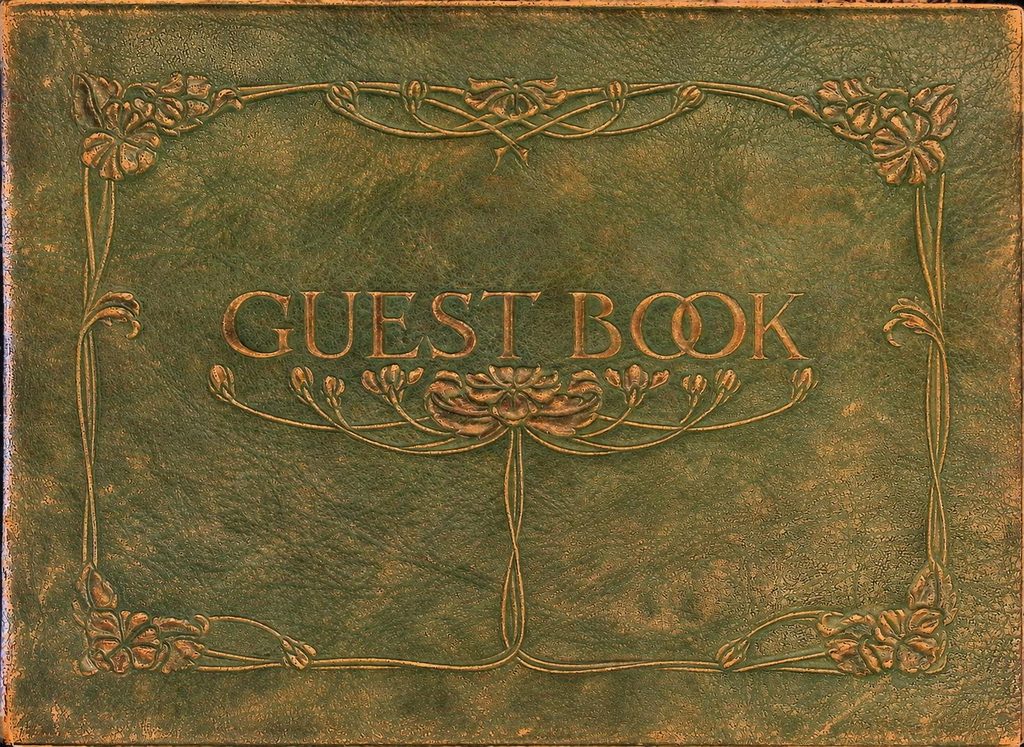
The book in which the Watsonville party wrote their names is a modest object. It is an oblong volume sold by the Dodge Publishing Company of New York, with Guest Book stamped on the cover and pages ruled into columns for name, address, date and remarks.
Between July 1919 and July 1953, about 190 people wrote in it. They did not write in order. They signed wherever they found room, so that an entry from 1950 can sit beside one from 1920. They wrote in English, French, Spanish, German and Chinese. They added verses and doggerel, drawings, pasted-in Easter cards and, on one page, two joke mug shots of a bespectacled man holding a placard that reads “FRESNO 1935.”
I recently scanned the book page by page, read every entry and set out to learn who these people were. The answer surprised me.
The house they came to still stands above Los Gatos, a Western house in its massing and plan with pagoda roofs and Chinese decoration laid over it. Its owners called it Yung See San Fong, which they translated as “Young’s Home in the Heart of the Hills.” The style came from the theater. In 1916 Ruth’s play The Sweetmeat Game, set in San Francisco’s Chinatown, opened at the Palace Theatre on Broadway. It then toured the Orpheum vaudeville circuit for two years. When the Youngs came home to build, they built Chinese. The house was finished in 1917.
Ruth Comfort Mitchell was born in San Francisco in 1882. She spent her childhood summers in Los Gatos, where her parents and grandparents kept summer homes, and she published her first poem in the Los Gatos Mail at fourteen. Wikipedia describes her as “born to wealth.” A Steinbeck scholar now at work on her biography disagrees: in her account the family was at best middle class. In that version, Ruth’s father, John S. Mitchell, had worked since the age of eleven and found real success only at fifty-five, as manager and then owner of the Hollenbeck Hotel in Los Angeles. He signed his daughter’s book three times. On the last occasion he signed simply as “Dad.”
Ruth wrote for a living all her life: sixteen novels, poems, short stories and one-act plays, several of them made into films. Politics took up nearly as much of her life. She campaigned for Herbert Hoover. She served for eight years as Republican National Committeewoman from California, and she was national and state president of Pro-America, an organization of Republican women founded in 1933. She belonged to the Los Gatos Christian Science church and to the Daughters of the American Revolution, whose Los Gatos chapter was organized in her house in November 1929.
In 1940 she published Of Human Kindness, a deliberate answer to her neighbor John Steinbeck’s The Grapes of Wrath. She considered his novel, Wikipedia says, to have “defamed her beloved state.”
Sanborn Young was born in 1873 and had sold a grain business when friends introduced him to Ruth in 1914. They married that October on the rim of the Grand Canyon and spent some time in New York, where he took up photography. The National Park Service calls him “a quiet, retiring man” who, it was said, won his seat in the State Senate because of his wife’s campaigning. He held it from 1925 to 1938.
His causes were wild animals and narcotics. His 1929 bill abolishing the sawtooth trap became law, and he chaired the Senate’s Narcotics Committee. Hoover sent him to Geneva in 1931 as a delegate to the international conference on limiting the manufacture of narcotic drugs. The Park Service credits him with drafting part of the resulting treaty, and says the work grew into “a close friendship between the Youngs and the Hoovers, who resided in nearby Palo Alto.”
By any measure of their day the Youngs were Republicans, and by the 1930s Republicans of a firmly conservative stamp. You would expect their guest book to read like a roster of the party faithful, and in places it does.
What you would not expect is everyone else.
The faithful are certainly there. On Sunday, September 16, 1934, Herbert Hoover signed the printed title page, a year and a half after leaving the White House. He was living then on the Stanford campus. Ruth’s father signed the same page, along with a handful of friends whose names have so far resisted identification: Homer and Maud Craig, Lutie and Bert C. Scott, Carl E. Johnson and an L. Harvey. Bert C. Scott may have been the Stanford-trained businessman who co-founded the Hall-Scott engine company of Berkeley, but that is only a guess.
Three governors of California signed. William D. Stephens came on June 18, 1920, and wished his hosts that “happiness and prosperity dwell with thee and thine.” His daughter, Barbara Stephens Zane, signed beneath him. Seven months earlier she had christened the new battleship USS California. Her own daughter, Marjorie, printed her name in capital letters and added, helpfully, “age 5 years.”
Friend Wm. Richardson signed as “Governor” on June 28, 1925, with his wife, Augusta, and two of their children. C. C. Young came in March 1930 with his wife, Lyla, and their daughters Barbara and Lucy.
Even this little gallery is less uniform than it looks. Stephens and Young were Progressives, heirs to Hiram Johnson’s reform movement; Wikipedia calls Young “one of the last governors from the Progressive movement.” Richardson, whose term “marked a sharp reversal” of those reforms, was the only true conservative of the three.
Lieutenant Governor H. L. Carnahan and his wife, Hattie, came on the Fourth of July, 1930, and called the visit “the glorious end of a trail that began the happy day we first knew you.” State Senator H. C. “Skipper” Nelson of Eureka, Governor Young’s Senate whip, came the summer before. He wrote that the Youngs were “such perfect hosts” and that he now partly understood “why they are of such value to the State and beloved by their friends.”
Then there were Sanborn’s allies in the war on drugs. Richmond P. Hobson, a Medal of Honor winner and former congressman known as “the Father of American Prohibition,” came in January 1927. He wished the Senator opportunities for public service “as majestic and vast as the outlook from your beautiful home.”
Harry J. Anslinger, the first U.S. Commissioner of Narcotics, came on August 21, 1932, with his wife, Martha. He held the job from 1930 until 1962. Beside the Anslingers’ names someone drew two small faces: a frown labeled “Before coming to Los Gatos” and a broad smile labeled “After.” A Harry D. Smith, “District Supervisor — Bur. of Narcotics,” signed the same day; he was probably the man 1920s newspapers called a federal narcotics chief on the Pacific Coast. So did Herbert C. Jones, a San Jose state senator and conservationist, who took the trouble to record that he had first proposed Sanborn Young as a delegate to Geneva, “which brought him in contact with Commissioner Anslinger.”
In March 1937 Dr. C. S. Mei of Shanghai, director of the Chapei Anti-Opium Hospital, wrote: “For the last two months, I have learned a lot of information about Narcotics. I hope in the near future to come again to talk with the senator about narcotics.” A 1938 U.S. Public Health Service report notes that Mei had given one treatment for opium addiction to more than 5,000 patients.
And on September 23, 1930, the Daughters of the American Revolution came in force. With the state regent, a Mrs. Frank Phelps Toms, came Elizabeth Gundrum of Sacramento and Irene Henry Payne, founding regent of the Los Gatos chapter that had been organized in this house ten months before.
That is the book you would expect. It is not the whole book.
On May 3, 1920, two Englishwomen signed with a flourish as the “High-binder Ladies.” The second of them, the novelist I. A. R. Wylie, styled herself “alias (in the underworld) Caliban.” She wrote that “San Fong under the stars, the prune orchards in September, Trick & Fynn, Reuben & Sanborn (these in order of merit) will always be the nicest things that ever happened.” The names appear to take in the household dogs as well as the hosts. She confessed that she had “meant to be really sprightly & witty this time but the poor soul sails to-morrow & has become a trifle maudlin instead.”
The first, Rachel Barrett, “the chief High-binder Lady,” invited the Youngs to visit them “at the Sign of the Hatchet in London town.”
A hatchet was an apt sign. Seven years earlier Barrett had been the editor of The Suffragette, the paper of the militant wing of the British votes-for-women movement. When the police raided its offices in April 1913 she was arrested and sentenced to nine months in Holloway prison. She went on hunger strike and was released under the so-called Cat and Mouse Act, which let the authorities free a starving prisoner and rearrest her once she had recovered. She was rearrested, starved again and was finally smuggled out of a safe house in disguise.
Wylie, already a popular novelist, had joined the movement and become Barrett’s companion. More than thirty of her stories and novels would eventually be filmed. The two had come to America in 1919, and the census of 1920 found them living together in Carmel.
They came back. On August 31, 1926, the High-binder Ladies signed again: “We came back, lovelier & more famous than ever. And San Fong & the dogs & Sanborn & Ruth — still in order of merit — are even nicer & dearer than we thought they were.”
On July 3, 1926, a guest wrote only “Another dumbbell! G. W.” The initials belonged to Gaylord Wilshire, the developer whose name is on one of the great boulevards of Los Angeles. He was also, in Wikipedia’s words, an “outspoken socialist.” He had been the first congressional candidate in the United States to run for a socialist party, and he was the author of a book called Socialism Inevitable. By the time he climbed the Youngs’ hill he was selling a “magnetic” health belt called the I-ON-A-CO. He died the following year. What he was doing at a Republican senator’s house the book does not say, but the joke suggests he knew.
Three years earlier, on April 15, 1923, Judge Ben B. Lindsey of the juvenile court in Denver had signed “in grateful appreciation for this little glimpse of Heaven.” Lindsey was then a leading figure of the Progressive movement, the man who had made the juvenile court a model for the country.
Four years after his visit he co-wrote The Companionate Marriage, which proposed that young couples be allowed to live together in a kind of trial marriage. Ministers denounced him as a prophet of free love, and Pope Pius XI condemned the idea. Lindsey was driven from the Denver bench after twenty-eight years and disbarred in Colorado in 1929. In 1930 he was arrested in a New York cathedral for heckling a bishop. The Youngs welcomed him before the storm. Whether they would have welcomed him after it, the book does not tell us.
Lindsey had once written a book on child labor, Children in Bondage, with the poet Edwin Markham and a journalist named George Creel. Creel turns up in the guest book too, twice: in August 1929 and again on August 21, 1932, the same day as Commissioner Anslinger.
Creel was a Democrat. He had run Woodrow Wilson’s Committee on Public Information, the propaganda office of the First World War. In 1934 he ran for governor of California and lost the Democratic primary to Upton Sinclair. His first visit was in the company of the novelists Charles and Kathleen Norris, and he signed himself as “completing the w.k. triangle.”
The Democrat most often in the house was probably a neighbor. James D. Phelan had been mayor of San Francisco and a United States senator, and his estate, Villa Montalvo, lay a few miles away in Saratoga. The Park Service lists him among the regular visitors. He signed on June 2, 1920, and remarked, “I feel quite at home.” With him that day was Marie Beale of San Rafael, the wife of the diplomat Truxtun Beale; she would later leave Decatur House, the family’s historic Washington mansion, to the National Trust. Phelan came again in July 1928 with Gertrude Atherton.
Phelan also carried a less comfortable distinction. In the Senate, Wikipedia notes, he was “a leader in the movement to restrict Japanese and Chinese immigration.” A year after he felt so much at home in this Chinese-style house, a Chinese delegation came to see it.
On June 25, 1921, the acting consul general of China at San Francisco, Hsiki Chow, signed the book in English and in Chinese. With him came the consul’s secretary, Suen Joon; Sir Hong Chin, secretary of the Chinese Six Companies, the community’s benevolent association; and an interpreter for the association who signed only in Chinese characters, as Chen Tong, noting that it was his first visit to their “honored home.”
Suen Joon wrote: “This is the first time I have seen a house in America which is what I called really Chinese. It is so Chinese, I just feel myself in China. Let America and China be long & good friends.” Sir Hong Chin added, “It is the most beautiful place I have ever been.”
He came back two years later with his wife and a friend, John Q. Lee of Grant Avenue. Someone in that party left four lines of Chinese verse in the margin, which might be rendered: “Setting foot in this place, / so happy I forget to go home; / a mountain dwelling, far from the ordinary, / makes me forget my cares.”
The date matters. The Chinese Exclusion Act, which barred nearly all Chinese immigration, had been law since 1882 and would remain so until 1943.
The house drew other foreign visitors. In November 1924 the Mexican consul general in San Francisco, L. Garza Leal, came with his wife, who thanked the Youngs in Spanish for their “cordial hospitality” and hoped “that happiness will always reign in your charming home.” Her husband added, in English, “Same here!” A visitor writing in German reworked a line of Eichendorff’s into “Whom God would show true favor, he sends to California (to Yung See San Fong).” Another, whose name reads like Elita Galdós Duque, wrote in Spanish that it was the most artistic and beautiful home she had ever had the privilege of seeing. A mother and son from Mount Vernon, Ohio, named Layfield, wrote that their “long cherished desire of seeing China and feeling its atmosphere” had at last been satisfied, in California.
Some time around April 1928 the journalist Bessie Beatty left what may be the best entry in the book. Beatty, born in Los Angeles, had gone to Russia in 1917, where she interviewed Leon Trotsky and the women of the Women’s Battalion. Her book about the revolution, The Red Heart of Russia, came out the next year. “I had been alive at a great moment,” she wrote of that time, “and knew it was great.” She later edited McCall’s and ended her career as a popular radio host in New York.
Her entry is a parable:
The weary pilgrim paused at a bend in the mountain road. ‘Is this heaven?’ he asked of the directing angel. ‘No’ said the angel. ‘Heaven is just the turn beyond. This is San Fong.’ ‘Are you sure?’ asked the Pilgrim. ‘This is just as I’ve always pictured it.’ ‘Sure’ replied the angel. ‘Well, I think I’ll just settle down here anyway.’ The directing angel gave a mirthful [?] sigh. ‘That’s what they all do now’ he said & walked slowly away.
The poets came, and not all of them were the respectable kind. On July 8, 1926, George Sterling and Edgar Lee Masters signed together. Sterling, the best-known poet in San Francisco and a leading figure of the bohemian colony at Carmel, wrote, “Nearer Heaven. There —”. Four months later he took his own life. Masters, whose Spoon River Anthology had stripped the varnish off small-town America a decade earlier, had once practiced law in partnership with Clarence Darrow.
The editor who had championed Masters had been there too. William Marion Reedy of St. Louis, whose weekly Reedy’s Mirror introduced Masters, Carl Sandburg and Sara Teasdale to its readers, was a liberal Democrat and a disciple of Henry George. In July 1920 he wrote in the date column, “Time is outdated in California,” and in the remarks column, “It is glorious to be alive and to be Young Mr. and Mrs.” He died suddenly in San Francisco on July 28, a few weeks later.
Witter Bynner gave his address simply as “China,” on a June 12 that must have fallen in 1920 or 1921, when he was going out to China or coming back. Bynner is remembered for the Spectra hoax, in which he and a friend invented an entire school of modernist poets and fooled the critics, and for the long companionship of his later life with Robert Hunt. He came with three people from Berkeley’s book world, all of whom wrote “Better late than never?” One of them was Bertha Clark Pope, who edited the letters of Ambrose Bierce and later, as Bertha Damon, wrote the best-selling Grandma Called It Carnal. Another was the young historian Oscar Lewis, who would write The Big Four.
In July 1928 Phelan and Gertrude Atherton brought a party that probably included the English playwright John van Druten, later the author of I Remember Mama and I Am a Camera. In the late 1930s he shared a ranch in the Coachella Valley with his companion, Carter Lodge.
Los Gatos had its own seekers. Ralph Waldo Trine, whose In Tune with the Infinite had sold in vast numbers, lived in town with his wife, Grace Hyde Trine. Both signed on April 17, 1921. Trine was a New Thought writer, influenced by George Herron’s Christian socialism, and an animal-welfare activist, a cause that sat well with Sanborn’s campaign against the sawtooth trap. He wrote out a credo: “To love the fields and the wild flowers, the stars, the far open sea, the soft warm earth, and to live much with them alone — but to love struggling and weary men and women, and every pulsing living creature better.”
In 1934 Cora L. Williams of Berkeley came. She had founded the A-Zed School and the Institute for Creative Development, which has been called “the first New Age institute.” Her entry announced that “the Youngs have discovered the fine art of living. So say we all of us.” One of her party, Alonzo L. Baker, probably the Seventh-day Adventist writer and editor of that name, made the point more plainly: “One feels at home immediately. That indicates true hospitality on the part of the Youngs.”
Several of the women writers who signed had campaigned for the vote. Stella Benson, an English feminist novelist who had worked for women’s suffrage, signed from a Berkeley address on “March 9th.” Her husband, James O’Gorman Anderson of the Chinese Maritime Customs, signed beneath her. They had married in 1921 and crossed America by Ford on their honeymoon, so the year was probably 1922. Anderson’s sons by a later marriage were the scholars Benedict and Perry Anderson.
Hildegarde Hawthorne, Nathaniel Hawthorne’s granddaughter, had marched in the great suffrage parade in New York in 1913. She came in November 1926 with her husband, the Cherokee novelist John Milton Oskison, a Stanford graduate and boyhood friend of Will Rogers. She wrote, “And Morning came and unveiled the loveliness of the Earth!” He replied beneath her, “It did, indeed! J.M.O.”
Gertrude Atherton, the dean of California novelists, appears twice. The first time is on April 1, 1920, and her name has been struck through, with “Margaret Burkhalter — April Fool” written beside it, evidently a friend’s prank. The second time, in 1928, she signed for herself. Her Black Oxen, the sensation of 1923, told of an aging woman restored to youth by gland treatment.
In April 1934 the English novelist Phyllis Bottome signed as Phyllis Forbes Dennis and copied out a verse of William Watson’s: “Strange the world about me lies, / Never yet familiar grown.” Bottome had studied under the psychologist Alfred Adler and was an active anti-fascist. Her novel The Mortal Storm became the 1940 film that was among the first to name Hitler and openly attack the Nazi regime.
Her husband, Ernan Forbes Dennis, who signed from “Casa Forbes, Lago d’Orta, Italy,” worked as a British passport control officer in Vienna, a post described as cover for the head of station of British intelligence. Between them the couple ran a school at Kitzbühel, where one of their pupils was a young Ian Fleming. “Heaven knows where I should be today without Ernan,” Fleming later wrote.
The novelist Kathleen Norris signed twice: in 1924 as “first wife of the above” and in 1929 as “still wife of the above.” The above was her husband, the novelist Charles G. Norris, who drew a small figure bent over an enormous book. Kathleen was a devout Catholic who wrote against birth control, and she also supported woman suffrage, Prohibition and pacifism. In 1930, the year after their second visit, Charles published Seed: A Novel of Birth Control. The guest book records no argument.
In 1929 the Norrises brought the poet and editor William Rose Benét, who would later win the Pulitzer Prize for poetry, and his daughters, Kathleen and Rosemary. Benét’s wife, Kathleen Norris’s sister, had died in 1919, and Norris had won guardianship of the children.
In January 1950 the pianist Hephzibah Menuhin, sister of the violinist Yehudi Menuhin, signed in green ink from “Pura Pura, Vic., Australia.” Pura Pura is the locality of Terrinallum, the property of her husband’s family. She had married Lindsay Nicholas in Los Gatos in 1938. She wrote, “To the Lady and the Lord of the Chinese manor!” Within a few years she had divorced, married the Austrian Quaker sociologist Richard Hauser and become a campaigner for human rights in London. We know that Ruth spoke warmly of Yehudi, and my guess is that he was here, but due to his mental state, the Young’s did not impose on him to sign the book.
There were writers of every other kind as well. Robert W. Service, “the Bard of the Yukon,” who had driven an ambulance for the American Red Cross in the First World War, came in April 1922 with his French wife, Germaine, and their daughter, Iris, then five. He offered a verse: “I wish that I might make a song / About this home — Yung See San Fong … / Alas! I’m but a happy guest / Who pass and envy those who rest.” Iris and her mother added, in a mixture of French and English, that they would never forget “une bonne journée passée à your home.” He was known by virtually every child through up to about the 70s, as many a school would ask their children to memorize his verse as a right of passage.
Frank H. Spearman, author of the Western Whispering Smith, signed in August 1920 “after a rare hour at San Fong.” He was a Catholic convert whose politics Wikipedia calls “proto-Libertarian.” Five years later the Chicago magazine editor Karl Edwin Harriman, who ran Red Book and Blue Book, wrote beneath him that he “rejoices in the opportunity to compensate with his loquacity for ‘Silent Smith’ above.”
The horror writer W. C. Morrow, whom Ambrose Bierce admired and who ran a school for writers, came in September 1920 with his wife, Lydia. He reminded Ruth of the advice he had sent her when her first work appeared in print: “Fight conceit as you would the plague.” John D. Barry, probably the San Francisco essayist and columnist, copied out a short poem titled “Judgment.” The poet Anna Blake Mezquida, who wrote the words of the theme song for the 1915 Panama-Pacific Exposition, quoted Calderón: “La vida es sueño,” “Life is a dream,” at Yung See San Fong. Barrett Willoughby, the best-selling novelist of Alaska, admitted that “your lovely California hill top has almost won me from my own Alaska seacoast.” The New York drama critic Clayton Hamilton came in November 1920 with his wife, Gladys.
At Easter 1923 two Berkeley poets who called themselves “the Gypsies,” Ruth Harwood and Lois Atkins, spent the holiday at the house and left behind verses and hand-painted cards.
Show people turn up throughout the book, which is less surprising when one remembers that Ruth’s own play had toured the vaudeville houses and several of her stories had been filmed. The earliest entries of all belong to the family of Richard Bennett, the stage star who in 1913 had starred in and co-produced Damaged Goods, Eugène Brieux’s notorious drama about venereal disease.
His wife, the actress Adrienne Morrison, wrote, “Sacred to the memory of a perfect July 1919.” Their daughter Joan Bennett, about nine years old and destined for Hollywood stardom, wrote, “Timid Agnes and the mouse.” The marriage ended in 1925. In October 1926 Bennett was back, signing himself “single” and writing, “Gee! I’m glad to see it again.” His companion that day was Hortense Alden, probably the Theatre Guild actress who later married the novelist James T. Farrell. We know her sister Constance was here, but she did not sign.
Margaret Anglin, celebrated for the Greek tragedies she staged at the Greek Theatre in Berkeley, signed in April 1920 with her husband, Howard Hull, who wrote, “The last shall be first.” With them was J. J. Gottlob, who ran San Francisco’s Columbia Theatre.
On a December 16, probably in 1926, members of George Arliss’s company touring Old English came up the hill. Among them were his stage manager, Maude T. Howell, later one of the few women to work as an assistant director in Hollywood, who called the place “Fresh as April — clean-run stock!”, and the actress Irby Marshal, mother of the film actor Alan Marshal.
The film star Conrad Nagel, one of the founders of the Academy of Motion Picture Arts and Sciences, came with his first wife, Ruth Helms, and declared them both “speechless on account of the glorious view.” With them was the Hollywood publicist Margaret Ettinger, a cousin of the gossip columnist Louella Parsons. Randolph Bartlett, probably the Photoplay editor of that name, wrote, “So near to heaven — and so like.”
The last entry in the book is dated July 25, 1953, and belongs to Rosalie Stewart, who had produced George Kelly’s Pulitzer Prize play Craig’s Wife on Broadway and later ran a talent agency in Los Angeles.
Then there is the matter of Scotty. Pasted into the book is a typed letter in verse on San Francisco Chronicle stationery, addressed to “Mrs. Honorable Senator Sanborn Young” and signed “Yir Frien’ Scotty.” Beside it, in his own hand, Scotty borrowed a line from Robert Burns: “I’m just a chiel amang ye takin’ notes, an’ ye hae gien me a fu’ stock o’ them.”
Scotty was Sam Mortland, feature editor of the Chronicle and the voice of its news digest on the radio station KPO, who wrote his verse in a Scots dialect and signed it that way. Before the Chronicle he had written a dialect column for the Fresno Morning Republican, and in 1918 Theodore Roosevelt had written him a letter about a book of it. For all the brogue, he was born in St. Louis.
Scotty brought radio people with him: H. J. Milholland, probably Howard I. Milholland, the former program director of NBC in San Francisco, and Eva Garcia, probably the pianist whom Milholland’s obituary would name as his widow. A Dorothy W. Mortland signed as “alias Mrs. Scotty.” The two mug shots labeled “FRESNO 1935” may be of Scotty himself.
The rest of the book belongs to friends and neighbors. Frank A. Miller, builder and master of the Mission Inn at Riverside, came in September 1923 with his wife, Marion, and wrote, “Yung See San Fong — a dream come true.” The San Francisco rare-book dealer John Howell came in 1935 with his family and wrote out the motto that was carved over his shop’s fireplace: “Where there is no vision, the people perish.” T. W. MacQuarrie, president of San Jose State College for twenty-five years, came in 1936 with his wife, Winifred. The three Misses Morrison, of an estate in San Jose called “Paradise,” spent what Angela Morrison called “an ambrosial afternoon mid a touch of the Orient.”
And Wilbur Hall, the pageant writer, who was probably also the man who later helped Luther Burbank write his autobiography, came in June 1920 and left the most graceful thank-you note in the book. Wilbur was a voice that propelled the nomination of Young as a state Senator, as an editorial in the San Jose Mercury News. He was extremely famous in the local area.
Why did so mixed a company climb this particular hill?
Ruth Comfort Mitchell was a working writer before she was a political wife, and that explains a good deal. Her world was the San Francisco and Berkeley literary scene, the Book Club of California crowd around Bertha Pope and Oscar Lewis, and the Carmel bohemians, and her plays and film sales tied her to the theater and to Hollywood. Writers visit writers, whatever their politics.
The house did its share. Again and again the guests write about the view, the Chinese style and the feeling of being “nearer heaven,” and almost never about their hosts’ opinions. The Chinese officials, the family from Ohio and the visitor who wrote in Spanish came, as much as anything, to see it. Los Gatos itself was something of a colony in those years. Phelan’s Villa Montalvo was a short drive away, the Trines lived in town, and Wilbur Hall’s pageants drew San Francisco society down the peninsula every summer. Many of the guests were neighbors first and anything else second.
The political lines of the 1920s also ran in different places. In 1920 many California Republicans were Progressives. The great moral causes of the day, Prohibition, woman suffrage, child welfare, cut across the parties. Hobson, Kathleen Norris and Anslinger were all for Prohibition. Barrett, Wylie, Hildegarde Hawthorne and Kathleen Norris were all for the vote. Lindsey and Creel had written a book together against child labor. A reformer of 1920 could be welcome at a Republican house in a way that would later become harder.
The book itself suggests that it did become harder. The most unconventional of the guests, the suffragettes, Wilshire, Lindsey, Sterling, Masters, Reedy, Bynner and the Bennetts, cluster in the years between 1919 and 1928. From about 1929 the pages fill with governors, senators, narcotics officials and the DAR, in the years when Sanborn went to Geneva and Ruth became a leader of Pro-America. There are exceptions, Bottome in 1934 and Menuhin in 1950 among them, but the drift is plain enough. The book seems to track a household whose politics hardened as the decades went on, while its doors stayed open longer than its politics might suggest.
Ruth died at home in February 1954, seven months after Rosalie Stewart signed the last page. Sanborn lived another ten years.
In June 1920 Wilbur Hall had written: “Something of what it has been to us to come & go through your house, Reuben and Boss, we write here in ink that fades — on pages that time will discolor. But we, happy ones, — we go forth with memories of your hospitality & of your graces for all time on our hearts!”
Some of the ink has faded, as he said it would. Nearly every name can still be read.
The other signers
Many of the people in the book have not yet been identified, and they are likely Los Gatos and Bay Area friends whose names have not surfaced in the records. Readers who recognize a family name are invited to get in touch.
On page 1 are Marguerite De Jean, Mrs. Eleanor C. Baker, James E. and Sidney M. Wales, Fisk M. and Agnes Ray (old directories put Fisk Ray near Cora Williams on Channing Way in Berkeley), a G. I. Gay, and, in 1945, Marvin E. Norton and Jessie Williamson. Page 2 has a couple who signed only as Frank and Lottie in 1929, and E. C. (“Bake”) and Pearl E. Baker in 1920; if the first initials are really C. C., he was State Senator C. C. Baker of Monterey.
Selma D. Gottlob and Margaret Burkhalter, the April Fool, are on page 6. Mrs. A. N. Young signed in 1920, Helen Young Hardy the same year, and Clarence and Georgie Olp Oliver of Kansas City and New York on page 12. Carol Prescott Taylor is on page 15.
The Arliss party on page 17, probably in 1926, included Mary T. Howell, probably Maude Howell’s mother; Josephine Botts Harrington, Jane Rollins Jacobus and Jacqueline Jacobus of Oakland; and Pauline B. Colmar of Los Gatos. N. P. Stedman, Alice Titus and Mollie Merrick signed with the Hamiltons in 1920. Myra Blake Schuler and Irving Schuler came with the MacQuarries in 1936, and Edith Barry and Alfred Allen signed beneath Reedy in 1920.
With John Howell in 1935 came Rebecca Ruskin Howell and William Robert Richardson Howell, and Henry B. and Bepina Averista Crall. With the Nagels came Stephen C. Maynard of San Jose. Elizabeth Whitely of Evanston signed in 1922, and Olive Delicia Leigh Hume and Huann Leigh Gross, “Hughie,” in 1930. Edith L. and Lee E. Harriman and a Helen Payne signed with Karl Harriman.
Lady Clare Mueller Weidner, a Los Angeles society woman, and Mary F. Woods came in 1923. Mary E. and Fred W. Scott of “Casa Loma” in Los Gatos signed on the same page as the Millers, and John Hamlin wrote there in 1947 that “always your home radiates a joyous welcome.” Charles W. Cox, Edith C. Eaton and Lillian Wilson signed beneath Richard Bennett in 1926. Harry S. Howland of the U.S. Army, Maude Call of Los Gatos and Marjory M. Fisher, possibly the San Francisco music critic, came with Phelan in 1928. Elizabeth Anne Jones, Helen L. Smith and Lucille R. Smith came with the narcotics party in 1932, and Mabel S. and Bryant B. Bailey with George Creel the same day.
A note on sources
The guest book was scanned in two passes, one for each side of the book, and put back in order by the penciled page numbers in its corners. Every quotation from it here comes from that transcription. Where the handwriting is uncertain, the uncertain reading is kept, and the alternatives are recorded in the working file.
Identifications marked “probably” rest on good but not conclusive evidence. No newspaper report of Herbert Hoover’s 1934 visit has been found. But his signature is clear, the two families were close, and the National Park Service names Hoover among the visitors, so the signature is treated here as his.
Biographical details come mainly from the Wikipedia articles linked in the text. Other sources:
- Steinbeck Now, Ruth Comfort Mitchell Responds to The Grapes of Wrath
- San Jose Postcard Club, Mitchell Biography
- San Francisco Call, June 24, 1922, on the pageant and the ride (California Digital Newspaper Collection; the site may show a browser check first)
- Press Democrat, September 22, 1934, on Sanborn Young’s Percherons
- Naval History and Heritage Command, USS California, on Barbara Stephens Zane
- Inside Facts, December 6, 1930, on the NBC San Francisco staff
- Sons of the American Revolution scrapbook, on Mrs. Frank Phelps Toms